.avif)
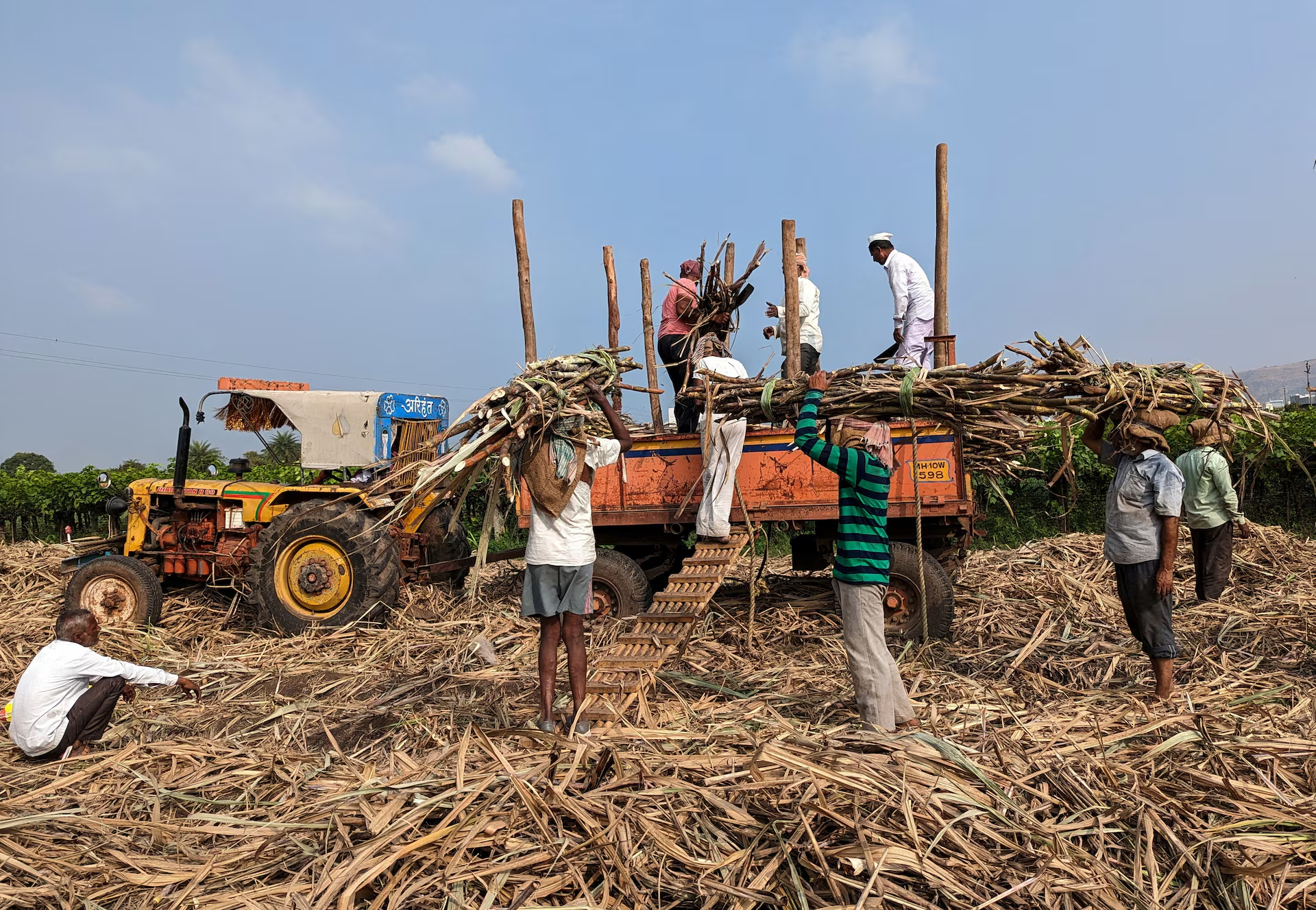
Sugar mills across India will pay an additional ₹10 per quintal for sugarcane starting October 2026, as the Cabinet approved a Fair and Remunerative Price (FRP) of ₹365 per quintal a modest 2.81% increase that masks the limited practical impact where most sugar is actually produced. The Cabinet Committee on Economic Affairs, chaired by Prime Minister Narendra Modi, approved the ₹365 per quintal FRP for the 2026-27 sugar season, but this federal floor price matters little in major producing states like Uttar Pradesh, where mills already pay State Advised Prices (SAP) well above the FRP. Uttar Pradesh mills currently pay ₹400 per quintal for early-maturing varieties and ₹390 for common varieties under the state's own pricing regime, rendering the federal increase largely symbolic. The real margin story lies in recovery premiums and operational efficiency, not in this headline rate.
The Fair and Remunerative Price (FRP) the minimum federal price that sugar mills must legally pay farmers for sugarcane operates as a safety net that rarely binds in practice. Set at a base sugar recovery of 10.25%, mills pay a premium of ₹3.56 per quintal for every 0.1% increase above that level, while no deductions apply for mills with recovery below 9.5%, guaranteeing farmers a minimum ₹338.3 per quintal. Consider a typical mid-sized mill processing 5,000 tonnes of cane daily: at baseline recovery, the FRP costs ₹1.825 crore per day in cane purchases. A mill achieving 11% recovery 0.75 percentage points above baseline pays an additional ₹26.7 per quintal, or roughly ₹13.35 lakh extra daily, but extracts 27.5 additional tonnes of sugar worth approximately ₹11.5 lakh at current wholesale rates. The arithmetic favors efficiency.
On the buy side: High-recovery mills in Karnataka and Maharashtra typically large integrated operations with modern crushing technology capture the premium structure while their per-tonne cane costs rise only marginally. These facilities, often achieving 11-12% recovery rates, benefit from sugar yields that more than offset the higher feedstock expense. The approved FRP is over 100.5% higher than the estimated production cost of ₹182 per quintal, providing substantial margin cushion for efficient operators. On the sell side: Low-efficiency mills, particularly older cooperative facilities in Uttar Pradesh and Bihar averaging 9-10% recovery, face margin compression as they cannot offset higher cane costs through operational improvements. For these mills, the ₹10 increase represents pure cost inflation with no corresponding revenue benefit.
State Advised Prices (SAPs) reveal the FRP's limited relevance in India's core sugar belt. Uttar Pradesh India's largest cane-producing state already mandates ₹400 per quintal for early varieties and ₹390 for common varieties, levels that dwarf the federal ₹365 rate. Haryana fixes its SAP at ₹400 per quintal while Punjab sets ₹401 per quintal, again exceeding the federal minimum. For large integrated traders (Cargill, Al Khaleej Sugar, EID Parry) managing pan-India procurement: the FRP increase has zero immediate impact where 70% of Indian sugar originates. These operators focus on SAP negotiations and mill-specific contracts in major producing states. For smaller regional cooperative mills and independent traders without direct state access: the FRP provides modest protection in secondary producing regions like Gujarat and Haryana, but practical procurement still occurs above federal rates due to competitive bidding.
Current M-grade sugar trades at ₹4,080-₹4,160 per quintal in Muzaffarnagar, reflecting recent sharp increases, while the cane to sugar arithmetic suggests mill margins remain comfortable despite rising feedstock costs. Watch the October 2026 crushing season startup for early signals on whether efficient mills capture the recovery premiums structure or if competitive SAP bidding in major states erodes the intended farmer benefit. The new FRP applies from October 1, 2026, for the 2026-27 season, with state governments likely announcing their own SAP rates in September. Monitor Uttar Pradesh's SAP decision if it exceeds ₹410 per quintal, the federal FRP becomes entirely academic.
.jpg)
'%3e%3cg id='Final-Copy-2_2_' transform='translate(1275.000000, 200.000000)'%3e%3cpath class='st0' d='M7.4,12.8h6.8l3.1-11.6H7.4C4.2,1.2,1.6,3.8,1.6,7S4.2,12.8,7.4,12.8z'/%3e%3c/g%3e%3c/g%3e%3c/g%3e%3cg id='final---dec.11-2020'%3e%3cg id='_x30_208-our-toggle' transform='translate(-1275.000000, -200.000000)'%3e%3cg id='Final-Copy-2' transform='translate(1275.000000, 200.000000)'%3e%3cpath class='st1' d='M22.6,0H7.4c-3.9,0-7,3.1-7,7s3.1,7,7,7h15.2c3.9,0,7-3.1,7-7S26.4,0,22.6,0z M1.6,7c0-3.2,2.6-5.8,5.8-5.8 h9.9l-3.1,11.6H7.4C4.2,12.8,1.6,10.2,1.6,7z'/%3e%3cpath id='x' class='st2' d='M24.6,4c0.2,0.2,0.2,0.6,0,0.8l0,0L22.5,7l2.2,2.2c0.2,0.2,0.2,0.6,0,0.8c-0.2,0.2-0.6,0.2-0.8,0 l0,0l-2.2-2.2L19.5,10c-0.2,0.2-0.6,0.2-0.8,0c-0.2-0.2-0.2-0.6,0-0.8l0,0L20.8,7l-2.2-2.2c-0.2-0.2-0.2-0.6,0-0.8 c0.2-0.2,0.6-0.2,0.8,0l0,0l2.2,2.2L23.8,4C24,3.8,24.4,3.8,24.6,4z'/%3e%3cpath id='y' class='st3' d='M12.7,4.1c0.2,0.2,0.3,0.6,0.1,0.8l0,0L8.6,9.8C8.5,9.9,8.4,10,8.3,10c-0.2,0.1-0.5,0.1-0.7-0.1l0,0 L5.4,7.7c-0.2-0.2-0.2-0.6,0-0.8c0.2-0.2,0.6-0.2,0.8,0l0,0L8,8.6l3.8-4.5C12,3.9,12.4,3.9,12.7,4.1z'/%3e%3c/g%3e%3c/g%3e%3c/g%3e%3c/g%3e%3c/svg%3e) Privacy Choices
Privacy Choices