.avif)
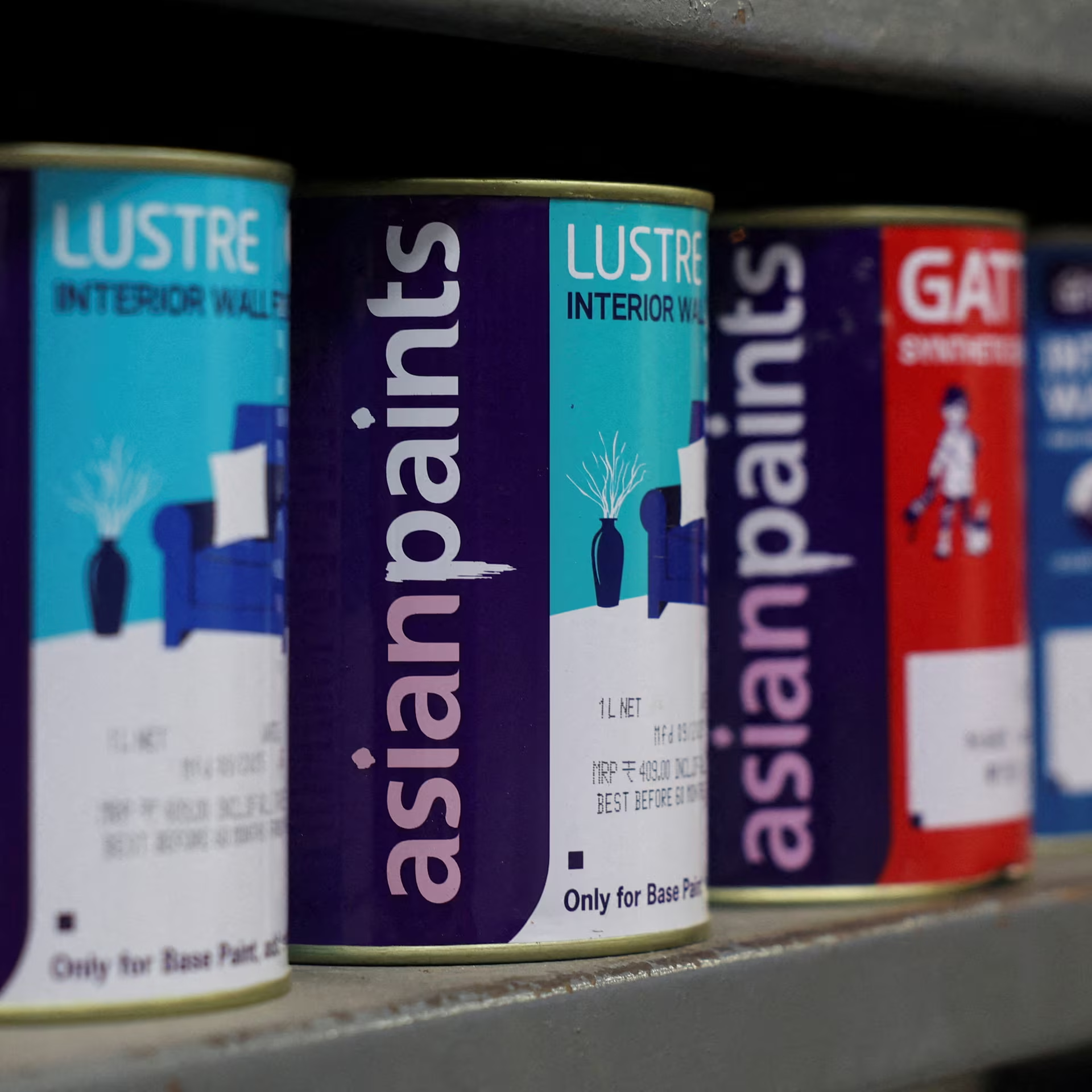
Indian decorative paint buyers from large infrastructure contractors to independent hardware dealers face input cost increases of 10–12% effective immediately, with Asian Paints' announcement on 13 July 2026 marking the sharpest single price move among major Indian manufacturers this year and setting a new pricing floor across the sector.
Asian Paints' 12% hike is the headline number, but the structural story is more layered than a simple crude-oil pass-through. The company's chairman R. Seshasayee has cited West Asia conflict disruptions as the primary driver, and the petrochemical linkage is real but it is not the whole picture. Decorative paints are not made from crude oil directly. The bill of materials for a standard exterior emulsion paint rests on three core chemical feedstocks: titanium dioxide (TiO2) the white pigment that gives opacity and coverage, sourced largely from Chinese producers; acrylic emulsions the binder that holds pigment to surfaces, derived from propylene and vinyl acetate monomer (VAM) via petrochemical crackers; and phthalic anhydride a solvent and resin intermediate produced from ortho-xylene, itself a naphtha derivative. Each has a different supply origin, a different pricing dynamic, and a different exposure to West Asia instability. Treating the 12% hike as a uniform crude-linked adjustment obscures those distinctions and obscures where the real margin opportunity lies.
The West Asia disruption matters most through the naphtha and propylene channels. Naphtha a light petroleum fraction used as the primary feedstock for petrochemical crackers is disproportionately sourced from Middle East refineries for Indian buyers. According to reports, ongoing conflict has tightened available cargoes from the Gulf, pushing spot naphtha prices approximately 8–11% above their January 2026 baseline on the India west coast delivery basis. Propylene, derived from naphtha cracking, feeds directly into acrylic emulsion production. A 10% rise in propylene availability cost translates to roughly a 4–6% increase in acrylic emulsion input costs since propylene typically represents 40–55% of acrylic emulsion production cost. Phthalic anhydride, tracking ortho-xylene from the same cracker complex, has moved similarly. The petrochemical exposure is genuine. But it does not explain the full 12%.
Here is where the margin anatomy becomes important. Consider a mid-sized Indian decorative paint batch: a 10,000 litre production run of premium exterior emulsion, typical for a Tier-2 regional manufacturer. Assume a standard formulation: TiO2 at 20% of material cost, acrylic emulsion at 35%, phthalic anhydride and other solvents at 15%, packaging and additives at 10%, and manufacturing overhead at the remaining 20%. If propylene linked feedstocks (acrylic emulsion, phthalic anhydride) are up 8% on average, and packaging materials up 3%, the blended input cost increase is approximately 4.5–5.5% against the full cost base. A 12% price hike on finished goods, against a 5% underlying cost increase, implies 6–7 percentage points of gross margin recovery embedded in the announced pricing not a neutral pass-through. Asian Paints and JSW Dulux (which announced a 10% hike earlier this year) appear to be using a legitimate inflationary moment to repair margins compressed over the prior 18 months. Berger Paints India at 1–2% and Kansai Nerolac at 2–3% are either less margin pressured, more volume sensitive, or signalling competitive intent to hold share at Asian Paints' expense.
The TiO2 counter-narrative deserves explicit attention. Titanium dioxide from Chinese producers who control roughly 55–60% of global output is currently in a state of structural oversupply. Chinese TiO2 export prices have fallen approximately 12–15% over the past 12 months as domestic capacity additions outpaced demand. For Indian paint manufacturers with the purchasing infrastructure to import and qualify Chinese TiO2, this is a meaningful deflationary offset one that partially cancels the petrochemical inflation being cited. A large integrated manufacturer like Asian Paints, procuring TiO2 at scale through established import channels, is already capturing this arbitrage. The net effect: Chinese TiO2 softness potentially offsets 2–3 percentage points of the crude-linked cost increase. The 12% hike, viewed in this light, is not purely defensive.
On the buy side, Indian paint distributors and painting contractors are the immediate pressure point. These operators sit between manufacturer price lists and end-consumer budgets absorbing whatever gap the market will not pass through. In price sensitive urban housing and infrastructure segments, contractors typically operate on 8–12% gross margin over material cost. A 12% manufacturer hike that translates to only 8–9% consumer price acceptance compresses distributor and contractor margins by 3–5 percentage points in some cases eliminating working profit on standard jobs. For a mid-sized painting contractor running ₹50 lakh (approximately $60,000) of annual material spend, a 4% margin compression represents ₹2 lakh ($2,400) of lost income on existing contracts not recoverable unless jobs are repriced. On the sell side, Asian Paints and JSW Dulux gain the most from this pricing environment: their scale gives them the purchasing power to benefit from Chinese TiO2 arbitrage while passing full petrochemical inflation and then some downstream.
For large integrated paint manufacturers Asian Paints, JSW Dulux, and equivalents with formal procurement desks and derivatives access the immediate instrument is spot to term procurement switching on propylene and VAM (vinyl acetate monomer the other key acrylic emulsion feedstock). Locking 60–70% of Q3 and Q4 propylene requirements at current spot levels before any West Asia resolution creates a correction captures the current margin window. Simultaneously, diversifying naphtha sourcing toward US Gulf Coast and Southeast Asian cargoes (Malaysia, South Korea) reduces geopolitical concentration risk. US Gulf naphtha to India's west coast ports (Mundra, Hazira) adds approximately 12–15 days of transit versus 4–6 days from the Gulf a cost of roughly $8–10/MT in additional freight but provides supply continuity if Hormuz access becomes constrained.
For smaller regional paint manufacturers a Tier-2 decorative paint producer in Gujarat or Maharashtra with annual revenues under ₹200 crore ($24 million), buying feedstocks on the spot market without forward contracts the practical response is bilateral. Fix acrylic emulsion supply agreements with domestic producers (Celanese India, Dow India) for a minimum 90 day term at current prices. This forecloses upside on any correction but eliminates exposure to a further 10–15% propylene spike if the West Asia situation deteriorates, as management at Asian Paints has explicitly warned it might. Separately, qualify at least one Chinese TiO2 supplier for incoming cargoes: Lomon Billions or Tronox's Chinese output are available through established trading intermediaries at meaningful discounts to European or domestic Indian TiO2. The qualification process takes 4–6 weeks but the feedstock saving 12–15% on a 20% cost-base component is worth the overhead.
The single most time-bound signal for observers is the ICIS propylene contract price assessment for Asia (CFR Northeast Asia basis), published monthly, with the next publication due by end of July 2026. If propylene contracts settle above $900/MT the level at which acrylic emulsion manufacturers have historically passed through full cost increases with no absorption expect a second wave of paint price increases across the sector in Q4 2026, with even Berger Paints and Kansai Nerolac forced to close the gap with Asian Paints' pricing. If propylene settles below $820/MT, indicating that Gulf supply disruption is easing, the current hike structure becomes partially opportunistic and volume pressure from distributors switching to lower-priced rivals will test Asian Paints' ability to hold its new price floor. Watch also the China TiO2 export price index (tracked by Chemanalyst and TZMI) over the same 30 day window: continued weakness below $2,200/MT on rutile grade material signals that feedstock relief is already available to any manufacturer willing to source it, and that the 12% hike embeds more margin recovery than cost recovery.
.jpg)




'%3e%3cg id='Final-Copy-2_2_' transform='translate(1275.000000, 200.000000)'%3e%3cpath class='st0' d='M7.4,12.8h6.8l3.1-11.6H7.4C4.2,1.2,1.6,3.8,1.6,7S4.2,12.8,7.4,12.8z'/%3e%3c/g%3e%3c/g%3e%3c/g%3e%3cg id='final---dec.11-2020'%3e%3cg id='_x30_208-our-toggle' transform='translate(-1275.000000, -200.000000)'%3e%3cg id='Final-Copy-2' transform='translate(1275.000000, 200.000000)'%3e%3cpath class='st1' d='M22.6,0H7.4c-3.9,0-7,3.1-7,7s3.1,7,7,7h15.2c3.9,0,7-3.1,7-7S26.4,0,22.6,0z M1.6,7c0-3.2,2.6-5.8,5.8-5.8 h9.9l-3.1,11.6H7.4C4.2,12.8,1.6,10.2,1.6,7z'/%3e%3cpath id='x' class='st2' d='M24.6,4c0.2,0.2,0.2,0.6,0,0.8l0,0L22.5,7l2.2,2.2c0.2,0.2,0.2,0.6,0,0.8c-0.2,0.2-0.6,0.2-0.8,0 l0,0l-2.2-2.2L19.5,10c-0.2,0.2-0.6,0.2-0.8,0c-0.2-0.2-0.2-0.6,0-0.8l0,0L20.8,7l-2.2-2.2c-0.2-0.2-0.2-0.6,0-0.8 c0.2-0.2,0.6-0.2,0.8,0l0,0l2.2,2.2L23.8,4C24,3.8,24.4,3.8,24.6,4z'/%3e%3cpath id='y' class='st3' d='M12.7,4.1c0.2,0.2,0.3,0.6,0.1,0.8l0,0L8.6,9.8C8.5,9.9,8.4,10,8.3,10c-0.2,0.1-0.5,0.1-0.7-0.1l0,0 L5.4,7.7c-0.2-0.2-0.2-0.6,0-0.8c0.2-0.2,0.6-0.2,0.8,0l0,0L8,8.6l3.8-4.5C12,3.9,12.4,3.9,12.7,4.1z'/%3e%3c/g%3e%3c/g%3e%3c/g%3e%3c/g%3e%3c/svg%3e) Privacy Choices
Privacy Choices