.avif)
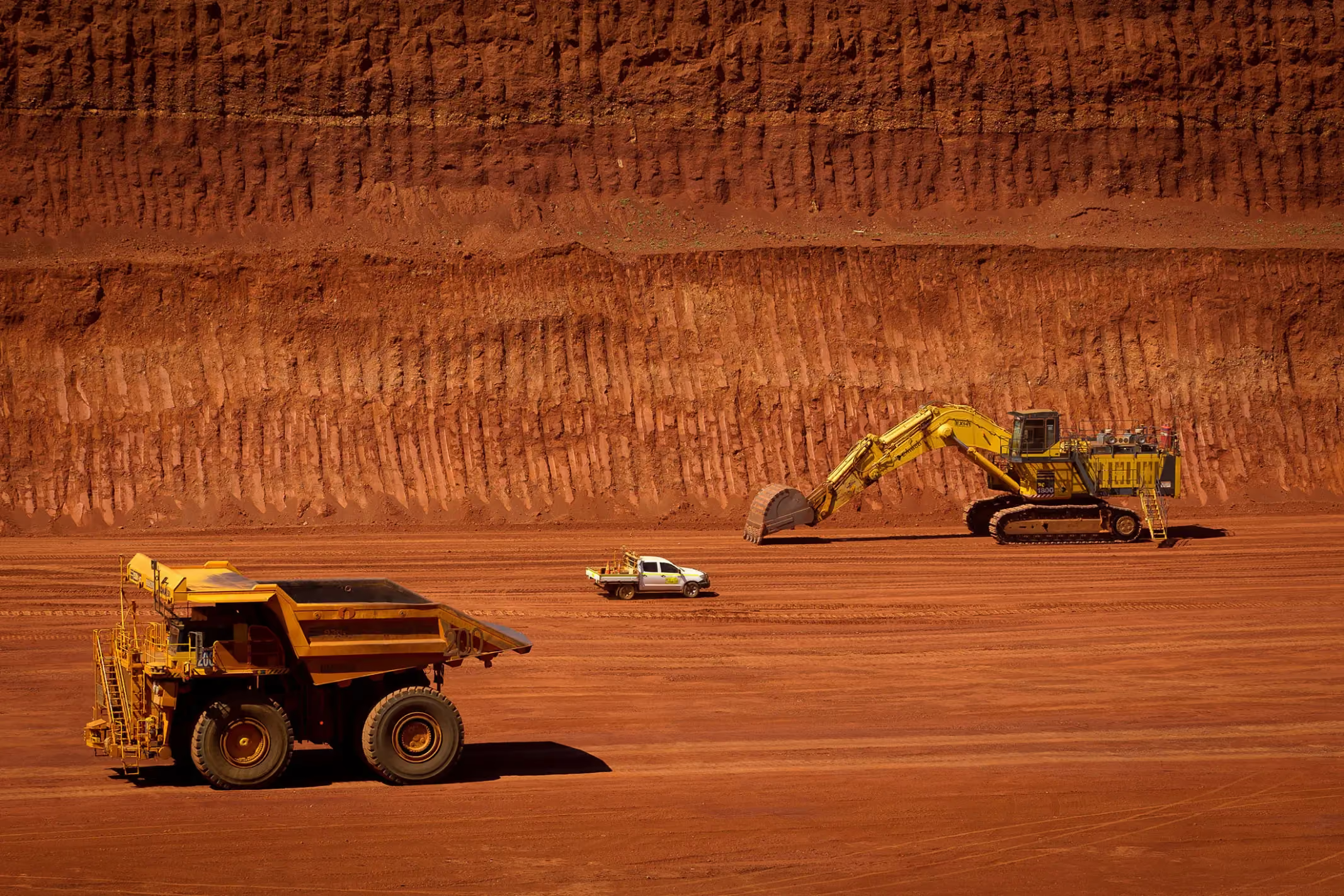
Iron ore miners shipping to China face an immediate margin compression of $15–25/MT depending on grade and origin, effective from the week of 17 June 2026, as benchmark 62% Fe prices breach the psychologically and commercially critical $100/MT threshold for the first time since March.
The benchmark in question is the 62% Fe CFR China price the standard reference for iron ore with 62% iron content, delivered cost and freight to Chinese ports. This is the number against which most supply contracts and spot cargoes are priced globally. Its breach of $100/MT is not a technical signal alone: it is a real delivered-cost reality that forces every producer and trader to recompute whether their particular mine, grade, and route still generates positive contribution margin the revenue per tonne remaining after direct production and shipping costs are met. For Australian 62% producers operating in the Pilbara at cash costs typically ranging from $18–35/MT FOB (free on board, meaning the price at the loading port before freight), the margin cushion has narrowed dramatically. Add Capesize freight the cost of shipping on a vessel designed for 150,000–180,000 tonne iron ore cargoes of approximately $8–10/MT on the Australia-China lane, and delivered costs for higher-cost Australian operations can exceed $45–50/MT, leaving notional margins under $55/MT at best, and far less for marginal producers.
The supply chain context matters here. Iron ore extracted in Australia's Pilbara region or Brazil's Carajás basin travels an average of 5,500 to 19,000 kilometres respectively before reaching Chinese blast furnaces the industrial installations that smelt iron ore into pig iron, which is then converted to crude steel. Capesize vessels load at dedicated iron ore terminals Port Hedland in Australia, Ponta da Madeira in Brazil and transit 15 to 25 days to arrive at Chinese discharge ports including Qingdao, Rizhao, and Caofeidian. At those ports, inventories are currently reported at record-high levels. High portside inventory means mills can defer restocking, which eliminates the urgency premium that typically supports spot prices. Chinese crude steel production in May fell 2.7% year on year to 84.35 million tonnes, and iron ore imports dropped nearly 6% month on month both figures that confirm mills are operating in deliberate destocking mode rather than building supply ahead of demand.
The grade premium story partially offsets the benchmark collapse, but only for a specific subset of sellers. Brazilian 65% Fe ore higher iron content, lower impurities, delivering greater efficiency per tonne charged into a blast furnace was assessed at approximately $117/MT CFR China as of mid-June. The premium over the 62% Australian benchmark has widened marginally to 8.7%, or roughly $10.2/MT in absolute terms. For Vale, the Brazilian miner and dominant 65% Fe supplier, this widening provides relative insulation. A mill running blast furnace maintenance from June 13 to 19, according to SteelOrbis data, cutting approximately 1.11 million tonnes of pig iron output has incentive to use its remaining operating capacity efficiently, which favours premium grades. The premium, in effect, buys margin resilience when the benchmark falls faster than the grade differential can compress.
Consider a concrete worked example. A mid-sized Australian iron ore producer ships a 170,000 tonne Capesize cargo of 62% Fe from Port Hedland. At $105/MT FOB three months ago, with freight at $9/MT, the cargo delivered at $114/MT CFR China. Against a then prevailing spot price of $110/MT, the delivered margin was thin but operational. Today, the same cargo loads at approximately $91/MT FOB (backing out freight from a sub $100 delivered price), with Capesize freight having softened to roughly $7.50/MT on the Australia-China route a fall linked in part to lower crude oil prices and expectations, according to reports, that the Strait of Hormuz may reopen, which would further reduce shipping market tightness. The cargo arrives at $98.50/MT CFR. For a producer with a mine cash cost of $30/MT and sustaining capital of $8/MT, the contribution margin is $60.50/MT still positive in aggregate, but 28% lower than three months ago. For a higher cost operation at $45/MT all-in, that same cargo is now deeply marginal. Volume becomes the only lever, and volume cannot solve a price problem.
On the sell side, the structural constraint that amplifies this pain is Chinese blast furnace overcapacity. Chinese steelmaking capacity remains largely intact and politically protected capacity closure programmes face significant resistance from regional governments protecting employment bases. This means inventory drawdowns through production cuts are slow and incomplete. Even with 1.11 million tonnes of pig iron output temporarily removed by June maintenance, the underlying Chinese import run-rate is still tracking toward a multi-billion tonne annual pace. Port inventories will not normalise until either a credible, large-scale capacity closure programme is announced none is currently on the near-term horizon or Guinea's Simandou mine, currently ramping up, pauses its production increase. Simandou is a 65% Fe-grade Guinean project being developed by Rio Tinto and Chinalco, capable of adding 60–120 million tonnes of annual capacity at full production. Its ramp-up adds a bearish supply signal to an already oversupplied seaborne market and structurally challenges Australian volume dominance over the medium term.
On the buy side, Chinese steel mills are the central actors. For large integrated mills Baowu, HBIS the sub-$100 benchmark is operationally welcome: their raw material input cost falls, improving finished steel margins at a time when construction demand, suppressed by the ongoing Chinese property sector contraction, is compressing steel product prices simultaneously. The tension is that falling iron ore prices reflect demand weakness, not supply windfalls, so the net benefit to mills is limited. For smaller regional mills operating older blast furnaces with lower efficiency, the grade premium calculus becomes acute: they cannot extract the same yield from 65% ore as large modern furnaces, so they are priced toward 62% material and directly exposed to the benchmark decline without the offsetting efficiency gain.
For large integrated miners BHP, Rio Tinto, CMOC with fully hedged freight positions through Forward Freight Agreements (FFAs, derivative contracts that lock in future shipping costs and revenue) and options on iron ore swap curves, the near-term exposure is manageable. They hold diversified grade portfolios, long life low-cost assets, and can blend cargoes to optimise delivered chemistry. For a smaller independent iron ore miner or a regional trader intermediating cargoes, no such instruments are typically accessible. The practical response is bilateral: negotiating floor-price mechanisms into term supply agreements, reducing spot exposure by extending contract tenors where buyers are willing, and critically reviewing whether marginal high-cost production should be curtailed rather than sold into a falling market. Shipping smaller parcel sizes via Panamax vessels approximately 75,000 tonne capacity, more flexible on routing rather than committing to full Capesize cargoes can also reduce per-voyage risk exposure when freight savings are partially offset by smaller lot premiums.
Observers tracking this position should monitor two specific, time-bound signals. First: the Dalian Commodity Exchange September 2026 iron ore futures contract (DCE i2509) if it fails to hold $95/MT by end of June, the market is pricing in a second leg lower and miners should treat that as a trigger for formal production rate reviews. Second: weekly iron ore port inventory data published every Friday by Mysteel, the Shanghai based steel industry data service if portside stocks exceed 155 million tonnes (the current estimate is near 150 million), that level historically signals a three to six week further price suppression cycle. If, conversely, blast furnace restart rates accelerate above 85% utilisation following the June maintenance window, a short covering bounce toward $105/MT is plausible but should not be mistaken for a structural reversal. The fundamental equation high inventory, protected overcapacity, rising Simandou supply does not change on a six week horizon.





'%3e%3cg id='Final-Copy-2_2_' transform='translate(1275.000000, 200.000000)'%3e%3cpath class='st0' d='M7.4,12.8h6.8l3.1-11.6H7.4C4.2,1.2,1.6,3.8,1.6,7S4.2,12.8,7.4,12.8z'/%3e%3c/g%3e%3c/g%3e%3c/g%3e%3cg id='final---dec.11-2020'%3e%3cg id='_x30_208-our-toggle' transform='translate(-1275.000000, -200.000000)'%3e%3cg id='Final-Copy-2' transform='translate(1275.000000, 200.000000)'%3e%3cpath class='st1' d='M22.6,0H7.4c-3.9,0-7,3.1-7,7s3.1,7,7,7h15.2c3.9,0,7-3.1,7-7S26.4,0,22.6,0z M1.6,7c0-3.2,2.6-5.8,5.8-5.8 h9.9l-3.1,11.6H7.4C4.2,12.8,1.6,10.2,1.6,7z'/%3e%3cpath id='x' class='st2' d='M24.6,4c0.2,0.2,0.2,0.6,0,0.8l0,0L22.5,7l2.2,2.2c0.2,0.2,0.2,0.6,0,0.8c-0.2,0.2-0.6,0.2-0.8,0 l0,0l-2.2-2.2L19.5,10c-0.2,0.2-0.6,0.2-0.8,0c-0.2-0.2-0.2-0.6,0-0.8l0,0L20.8,7l-2.2-2.2c-0.2-0.2-0.2-0.6,0-0.8 c0.2-0.2,0.6-0.2,0.8,0l0,0l2.2,2.2L23.8,4C24,3.8,24.4,3.8,24.6,4z'/%3e%3cpath id='y' class='st3' d='M12.7,4.1c0.2,0.2,0.3,0.6,0.1,0.8l0,0L8.6,9.8C8.5,9.9,8.4,10,8.3,10c-0.2,0.1-0.5,0.1-0.7-0.1l0,0 L5.4,7.7c-0.2-0.2-0.2-0.6,0-0.8c0.2-0.2,0.6-0.2,0.8,0l0,0L8,8.6l3.8-4.5C12,3.9,12.4,3.9,12.7,4.1z'/%3e%3c/g%3e%3c/g%3e%3c/g%3e%3c/g%3e%3c/svg%3e) Privacy Choices
Privacy Choices