.avif)
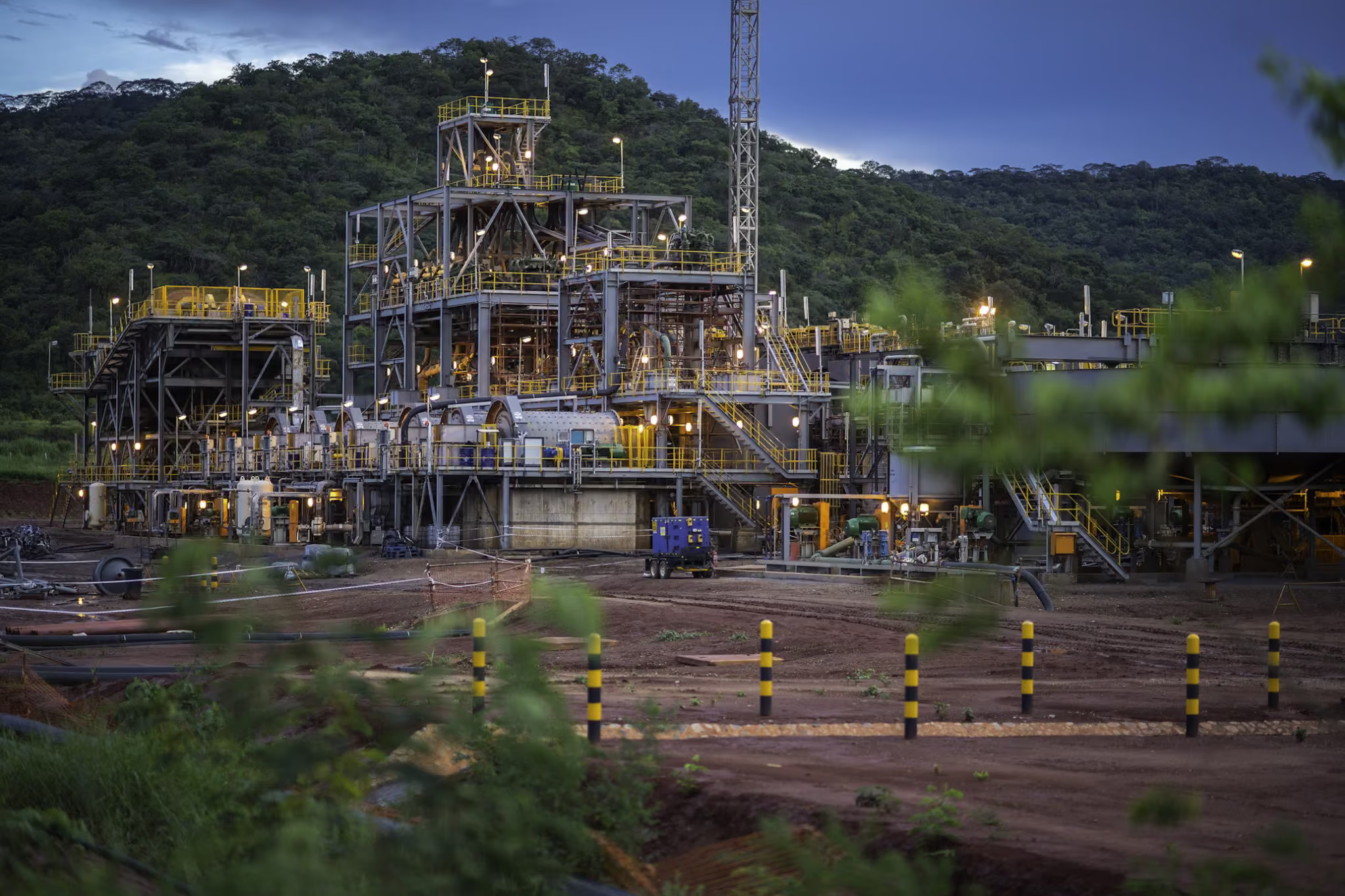
Foreign graphite miners with active or planned projects in Mozambique face an immediate structural repricing of project economics: a new mining law signed by President Daniel Chapo in June 2026 mandates a free 15% equity stake for the state in all mining ventures and restricts raw mineral exports without ministerial approval tied to commitments on local processing. For any project already in development, this is not a future risk it is a present-tense dilution of equity value with no compensation mechanism.
The law's most direct impact falls on graphite, a mineral that has moved from industrial obscurity to strategic criticality in less than a decade. Natural graphite is the principal material in the anode the negative electrode of lithium-ion batteries, which power electric vehicles and grid-scale energy storage. Mozambique hosts one of the world's most significant graphite deposits: Syrah Resources' Balama mine in Cabo Delgado province, which is the largest natural graphite operation on earth by production capacity. Balama's output flake graphite concentrated on-site then shipped via the port of Nacala flows primarily to anode material processors in China, Japan, and South Korea. That supply chain, from pit face to battery cell, is what the new law now intersects.
The margin anatomy is straightforward, and the numbers are not small. A greenfield graphite project in Mozambique with a capital expenditure of $500 million a reasonable benchmark for a mid to large scale operation immediately transfers approximately $75 million of equity value to the state at zero cost to the government. This is not a future royalty on revenue; it is an upfront dilution of the project's ownership structure from day one. For institutional mining investors targeting a 15–20% internal rate of return the IRR, meaning the annualised return that makes a risky, long-horizon investment worthwhile that $75 million loss before a tonne of graphite is shipped materially compresses the return profile below the threshold at which frontier investment is commercially rational. An IRR that clears 18% on a fully-owned project may fall to 13–14% once the free-carry stake is factored in. That 4–5 percentage point gap is not recoverable through operational efficiency.
The export restriction adds a second, structurally different form of risk. Under the new law, companies wishing to export raw or semi-processed graphite concentrate must obtain ministerial approval linked to a plan for domestic processing meaning the conversion of concentrate into the spherical purified graphite used in battery anodes. The Chamber of Mines, through vice president Geert Kolk, has acknowledged that encouraging domestic value addition is a legitimate policy objective. The problem is physical and infrastructural: graphite purification is an energy-intensive, chemically continuous process that requires uninterrupted high-voltage power. Mozambique's electricity grid, outside greater Maputo, is chronically inadequate. Processing facilities cannot operate on intermittent supply. The law has created a legal obligation that the host country's infrastructure cannot currently fulfil, meaning ministerial approvals will function either as a bureaucratic bottleneck or as de facto waivers granted case by case neither of which provides the regulatory certainty that long-horizon mining investment requires.
On the buy side, Asian anode processors and battery manufacturers that source Mozambican graphite are already running contingency qualification processes. Procurement teams at major South Korean and Japanese battery materials companies evaluate origin diversification across a 12–18 month qualification cycle the time required to test, approve, and contract an alternative supply source. Tanzania's Mahenge graphite deposit, Canadian projects in Quebec, and Australian producers in Western Australia are the most immediately competitive alternatives on specification and geography. If Balama's export flows face approval delays or processing obligations that cannot be operationally met, buyers will accelerate those qualification timelines. The supply disruption risk is not acute today, but it is being priced into forward sourcing strategy right now.
On the sell side, the picture bifurcates sharply by operator scale. For a large, vertically integrated mining company a Syrah Resources, a Rio Tinto, a company with legal teams, government relations capacity, and access to project finance from multilateral development banks the law is a negotiation challenge, not an existential one. These operators can model the equity dilution, engage in bilateral investment treaty analysis, and absorb the regulatory complexity over time. For a smaller exploration-stage company with a prospecting licence in Mozambique and a project still in pre-feasibility the stage at which the technical and economic case for a mine is first fully modelled the calculus is different. At that scale, the $75 million equity transfer on a $500 million project is the difference between a bankable financing structure and one that institutional lenders will not support. Smaller operators cannot hedge policy risk through diversification; they carry it entirely.
The law also arrives at a moment of wider competitive pressure among African mineral jurisdictions. The Ghana Chamber of Mines raised comparable concerns after Accra introduced a revised gold royalty regime and removed development incentives, creating what investors described as a pattern of unpredictable fiscal change. Tanzania, Zambia, and the Democratic Republic of Congo are each watching how capital responds to Mozambique's legislation: each has strategic mineral assets graphite in Tanzania, copper in Zambia, cobalt in the DRC and the ability to market against a Mozambican policy environment that foreign investors now perceive as having increased political and fiscal risk. Resource nationalism the trend of mineral producing states asserting greater ownership and revenue share over their natural endowments is not unique to Mozambique, but the specific combination of free-carry equity, export restrictions, and inadequate infrastructure gives the Mozambican version a particular set of implementation risks that its competitors will use as a direct marketing argument to attract redirected capital.
One implementation question remains materially unresolved and needs to be watched with care. It is not yet clear, according to industry representatives, whether the mandatory 15% free-carry stake applies only to new mining ventures or also to existing operations, including Balama. If confirmed to apply retrospectively, the economic and legal implications for current licence holders would be substantially more severe than a forward looking rule: existing project financing structures, royalty agreements, and shareholder arrangements would all require renegotiation. Gemfields' Montepuez ruby operation and the legacy coal assets previously held by Rio Tinto and Vale in Tete province would similarly be affected. The retrospective scope question is not a technical detail it is the variable that determines whether this law reprices the Mozambican mining sector at the margin or restructures it entirely.
For observers tracking this developing regulatory situation, the most precise leading indicator is not a commodity price it is project pipeline activity. Watch the Mozambican Minerals Registry and announcements from the Ministry of Mineral Resources and Energy over the next 60 days for any guidance on retrospective application. Monitor whether Syrah Resources or any other licence holder files a request under a bilateral investment treaty a BIT, a formal legal agreement between two governments protecting investors from each other's regulatory changes which would signal that the free-carry question has moved from industry lobbying to formal legal dispute. A BIT filing would be the clearest possible signal that the regulatory environment has shifted from difficult to adversarial, and it would accelerate capital reallocation to competing jurisdictions within months, not years.





'%3e%3cg id='Final-Copy-2_2_' transform='translate(1275.000000, 200.000000)'%3e%3cpath class='st0' d='M7.4,12.8h6.8l3.1-11.6H7.4C4.2,1.2,1.6,3.8,1.6,7S4.2,12.8,7.4,12.8z'/%3e%3c/g%3e%3c/g%3e%3c/g%3e%3cg id='final---dec.11-2020'%3e%3cg id='_x30_208-our-toggle' transform='translate(-1275.000000, -200.000000)'%3e%3cg id='Final-Copy-2' transform='translate(1275.000000, 200.000000)'%3e%3cpath class='st1' d='M22.6,0H7.4c-3.9,0-7,3.1-7,7s3.1,7,7,7h15.2c3.9,0,7-3.1,7-7S26.4,0,22.6,0z M1.6,7c0-3.2,2.6-5.8,5.8-5.8 h9.9l-3.1,11.6H7.4C4.2,12.8,1.6,10.2,1.6,7z'/%3e%3cpath id='x' class='st2' d='M24.6,4c0.2,0.2,0.2,0.6,0,0.8l0,0L22.5,7l2.2,2.2c0.2,0.2,0.2,0.6,0,0.8c-0.2,0.2-0.6,0.2-0.8,0 l0,0l-2.2-2.2L19.5,10c-0.2,0.2-0.6,0.2-0.8,0c-0.2-0.2-0.2-0.6,0-0.8l0,0L20.8,7l-2.2-2.2c-0.2-0.2-0.2-0.6,0-0.8 c0.2-0.2,0.6-0.2,0.8,0l0,0l2.2,2.2L23.8,4C24,3.8,24.4,3.8,24.6,4z'/%3e%3cpath id='y' class='st3' d='M12.7,4.1c0.2,0.2,0.3,0.6,0.1,0.8l0,0L8.6,9.8C8.5,9.9,8.4,10,8.3,10c-0.2,0.1-0.5,0.1-0.7-0.1l0,0 L5.4,7.7c-0.2-0.2-0.2-0.6,0-0.8c0.2-0.2,0.6-0.2,0.8,0l0,0L8,8.6l3.8-4.5C12,3.9,12.4,3.9,12.7,4.1z'/%3e%3c/g%3e%3c/g%3e%3c/g%3e%3c/g%3e%3c/svg%3e) Privacy Choices
Privacy Choices