.avif)
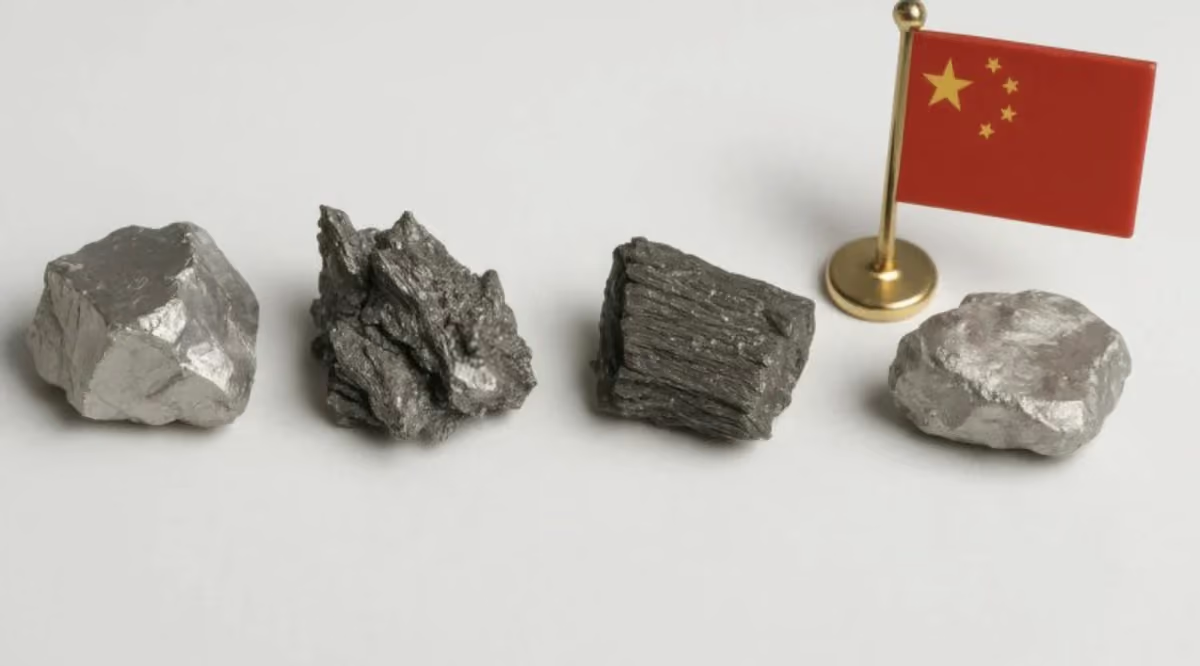
US defence mineral procurement has structurally shifted away from Chinese origin processed materials for five specific mineral streams rare earths, graphite, lithium, boron, and antimony beginning with construction contracts expected in 2027 and initial production from 2028, directly affecting the margin position of every critical mineral miner, processor, and import trader with exposure to US defence supply chains today.
The mechanism is the Enhanced Use Leasing (EUL) programme a federal authority that allows the US Army to lease underutilised land on military installations to private firms in exchange for cash or in-kind base improvements. Under EUL agreements signed in June 2026, REalloys, Titan Mining, EnergyX, and Ioneer (a Sydney based lithium boron developer, the only non-US partner in the group) will build commercial processing facilities at designated Army depots: rare earths at Tooele Army Depot in Utah; purified graphite at Pine Bluff Arsenal in Arkansas or Anniston Army Depot in Alabama (Titan Mining's site selection between the two remains conditional, chosen following a December 2025 request for information); lithium and boron processing at facilities assigned to EnergyX and Ioneer respectively. The commercial logic for the private companies is straightforward: EUL removes the typical greenfield cost of site acquisition, environmental permitting for the processing footprint, and utility hookups costs that, on a comparable industrial site, can reach tens of millions of dollars before a single tonne of product moves.
The programme's most immediate and commercially measurable component is already operating. The Army runs a modular antimony trisulfide refinery antimony trisulfide (Sb₂S₃) is a compound used primarily in defence primers, the small explosive charge that initiates artillery shell propellant capable of producing 7–10 metric tonnes per year. To put that number in context: global antimony production runs at roughly 80,000–100,000 tonnes per year, and US defence consumption of defence-grade antimony compounds is estimated in the hundreds of tonnes annually. The Army's 7–10 MT/year domestic capacity covers a fraction of its own requirement. Perpetua Resources' Idaho antimony gold project is the intended upstream feedstock supplier, but that project remains in permitting and financing stages. For a mid-sized antimony import trader currently supplying defence-grade Sb₂S₃ sourced from Chinese processors at, say, $8,000–10,000/MT, the Army's domestic refinery represents a precedent and a signal, not yet a volume threat but the precedent is the point.
On the buy side, US defence procurement offices and their tier-one contractor supply chains think prime contractors sourcing purified graphite for ammunition primers or rare earth compounds for guidance systems gain a domestically processed, on-base alternative that bypasses the export control risk embedded in Chinese origin materials. The commercial value is less about unit cost reduction (on-base processing at small scale will not be cheaper than Chinese imports in the near term) and more about supply assurance: a disruption in Chinese graphite exports, which occurred in practice with Beijing's October 2023 graphite export licensing controls, can now be partially mitigated without a spot-market scramble. On the sell side, the four partner companies gain a subsidised land and infrastructure arrangement whose value is not publicly disclosed but is materially significant eliminating greenfield site permitting and acquisition costs is roughly equivalent to a project level subsidy. The structural risk, however, sits upstream: Ioneer's Rhyolite Ridge lithium-boron project in Nevada, the intended feedstock source for its on-base processing plant, remains in permitting and financing stages as of mid-2026. Building a processing facility on a military base does not resolve the mining permit, the environmental review, or the capital stack needed to extract the ore. The infrastructure ceiling is not at the base gate it is in the mine permit office.
For large integrated critical mineral traders and processors a Trafigura Metals or a mid-sized rare earth toll processor the actionable move is to monitor Perpetua Resources' permitting timeline and Ioneer's Rhyolite Ridge financing milestones as the two nearest upstream triggers that would convert on-base processing from policy announcement into physical volume. Neither has confirmed domestic feedstock today. For smaller regional operators a regional graphite distributor or an independent antimony trader the near-term margin position is unchanged, but the medium-term signal is clear: defence grade product specifications will increasingly require documented domestic processing, and price premiums for domestically processed material will widen as the EUL facilities approach commissioning. For observers tracking the pace of this shift, the specific signal to watch is the US Army Corps of Engineers' issuance of construction permits for the Tooele and Pine Bluff/Anniston facilities expected to appear in federal procurement databases by Q2 2027. Absence of those permits by that date would indicate the programme has stalled at the infrastructure stage, which would be a material signal for traders currently discounting Chinese origin supply to retain their defence adjacent margins.





'%3e%3cg id='Final-Copy-2_2_' transform='translate(1275.000000, 200.000000)'%3e%3cpath class='st0' d='M7.4,12.8h6.8l3.1-11.6H7.4C4.2,1.2,1.6,3.8,1.6,7S4.2,12.8,7.4,12.8z'/%3e%3c/g%3e%3c/g%3e%3c/g%3e%3cg id='final---dec.11-2020'%3e%3cg id='_x30_208-our-toggle' transform='translate(-1275.000000, -200.000000)'%3e%3cg id='Final-Copy-2' transform='translate(1275.000000, 200.000000)'%3e%3cpath class='st1' d='M22.6,0H7.4c-3.9,0-7,3.1-7,7s3.1,7,7,7h15.2c3.9,0,7-3.1,7-7S26.4,0,22.6,0z M1.6,7c0-3.2,2.6-5.8,5.8-5.8 h9.9l-3.1,11.6H7.4C4.2,12.8,1.6,10.2,1.6,7z'/%3e%3cpath id='x' class='st2' d='M24.6,4c0.2,0.2,0.2,0.6,0,0.8l0,0L22.5,7l2.2,2.2c0.2,0.2,0.2,0.6,0,0.8c-0.2,0.2-0.6,0.2-0.8,0 l0,0l-2.2-2.2L19.5,10c-0.2,0.2-0.6,0.2-0.8,0c-0.2-0.2-0.2-0.6,0-0.8l0,0L20.8,7l-2.2-2.2c-0.2-0.2-0.2-0.6,0-0.8 c0.2-0.2,0.6-0.2,0.8,0l0,0l2.2,2.2L23.8,4C24,3.8,24.4,3.8,24.6,4z'/%3e%3cpath id='y' class='st3' d='M12.7,4.1c0.2,0.2,0.3,0.6,0.1,0.8l0,0L8.6,9.8C8.5,9.9,8.4,10,8.3,10c-0.2,0.1-0.5,0.1-0.7-0.1l0,0 L5.4,7.7c-0.2-0.2-0.2-0.6,0-0.8c0.2-0.2,0.6-0.2,0.8,0l0,0L8,8.6l3.8-4.5C12,3.9,12.4,3.9,12.7,4.1z'/%3e%3c/g%3e%3c/g%3e%3c/g%3e%3c/g%3e%3c/svg%3e) Privacy Choices
Privacy Choices