.avif)
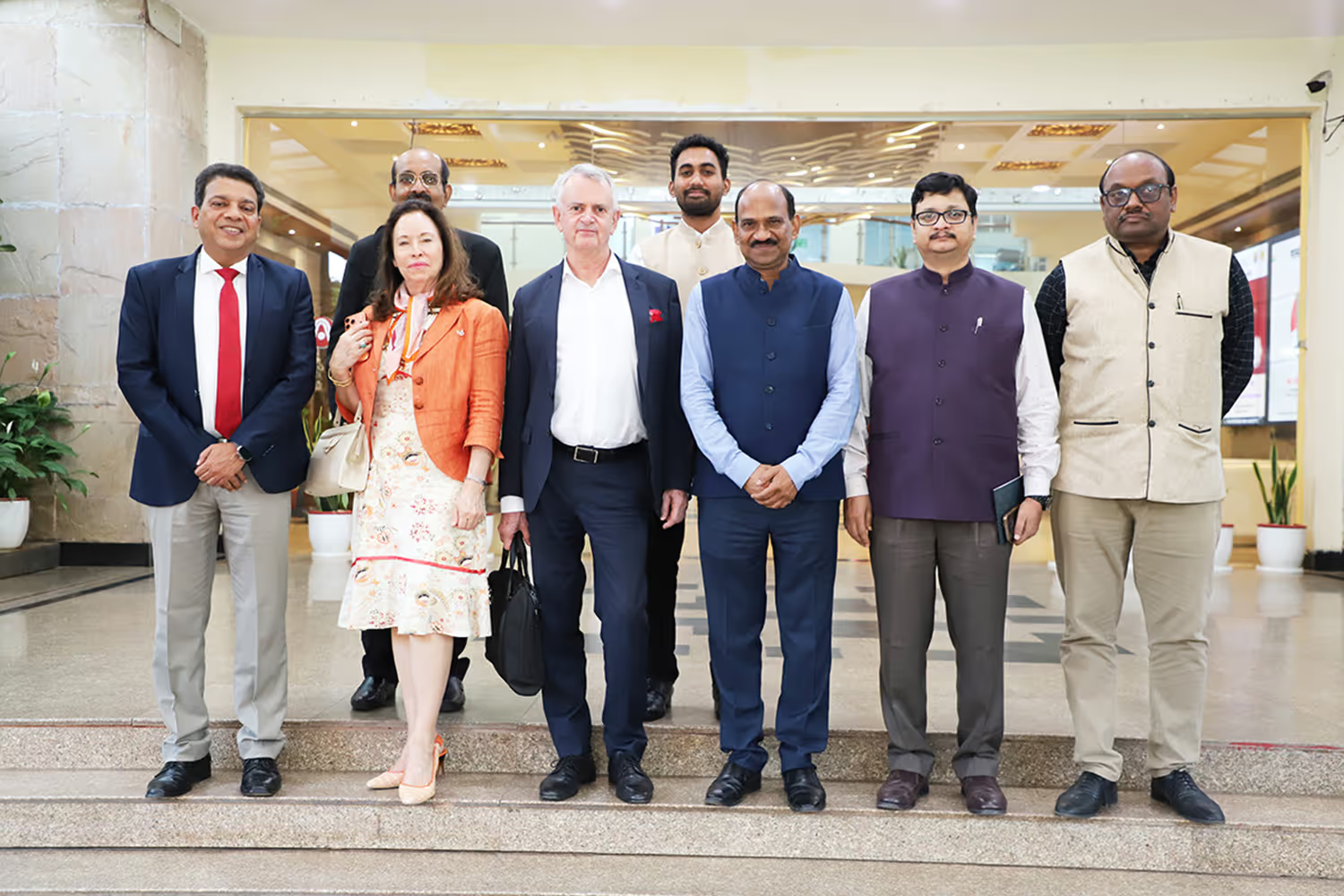
Canadian High Commissioner Christopher Cooter's discussions with NALCO focused on critical minerals collaboration and sustainable resource development, exploring potential avenues for long-term engagement aimed at reinforcing Canada-India economic ties. The visit exposes the central challenge constraining global critical minerals buildout: investment decisions today face significant market and economic uncertainties, particularly for midstream processors who must commit 5-8 years and $500 million or more to develop refining capacity while commodity prices swing by orders of magnitude. Lithium carbonate prices collapsed from $80,000/tonne in late 2022 to under $12,000/tonne in late 2024, before partially recovering to $18,000-22,000/tonne in early 2026, with at least 15 lithium developments globally placed on care and maintenance during the price trough.
Critical minerals naturally occurring elements including lithium, cobalt, nickel, copper, and rare earth elements that are essential for electric vehicles, renewable energy systems, and defence applications face supply chain vulnerabilities due to extreme geographic concentration. China supplies 91% of refined rare earths and 92% of magnets, while the Democratic Republic of Congo supplies approximately 73% of mined cobalt, China controls roughly 60% of global rare earth mining and over 85% of rare earth processing, three countries account for over 90% of lithium production, and Indonesia dominates nickel smelting with a 50%+ global share. NALCO is a key partner in Khanij Bidesh India Limited (KABIL), a joint venture engaged in the identification, acquisition, exploration, and development of critical mineral assets globally.
Global demand for key energy minerals continued to grow strongly in 2024, with lithium demand rising by nearly 30% and demand for nickel, cobalt, graphite and rare earths increasing by 6-8%. Consider a mid-scale lithium processing facility targeting 20,000 tonnes annual lithium carbonate equivalent production. The facility requires approximately $600-800 million in capital expenditure, with construction timelines extending 6-8 years from feasibility study to first production. At current lithium carbonate prices of $20,000/tonne, the delivered processing margin approximates $8,000-12,000/tonne viable but dependent on price stability. However, the 75% price volatility witnessed over 24 months makes project financing nearly impossible without government risk-sharing mechanisms that neither Canada nor India has fully developed for midstream processors.
On the buy side: Large integrated battery manufacturers (Tesla, CATL, BYD) with long-term supply contracts can absorb midstream processing premiums of 15-25% over Chinese alternatives to secure non-China supply chains, particularly for North American and European battery factories requiring "friend-shored" materials. Mid-sized regional battery assemblers and automotive OEMs without derivatives access face binary supply security versus cost trade-offs, often defaulting to Chinese supply chains for spot purchases. On the sell side: Established midstream processors in China maintain 60-70% margins through vertical integration and government financing support. New non-China processors require 20-30% higher processing fees to compensate for financing costs and operational learning curves, creating a margin structure that concentrates profits in diversified supply chains rather than traditional spot trading.
For large integrated mining companies (Rio Tinto, BHP, Vale) with existing critical minerals exposure: bilateral government partnerships provide regulatory certainty and potential offtake guarantees that justify midstream capex commitments, particularly when coupled with strategic customer pre-financing arrangements. For smaller regional mining operators and exploration companies: government partnerships offer access to development finance institutions and export credit agencies that can bridge the financing gap between resource development and cash-flow generation timelines. For observers: monitor Canada's March 2026 announcement of $12.1 billion in critical minerals projects with 12 allied partners and EXIM's $14.8 billion in Letters of Interest for critical minerals projects bilateral partnership announcements without accompanying project finance commitments within 12-18 months signal policy coordination without commercial substance.




'%3e%3cg id='Final-Copy-2_2_' transform='translate(1275.000000, 200.000000)'%3e%3cpath class='st0' d='M7.4,12.8h6.8l3.1-11.6H7.4C4.2,1.2,1.6,3.8,1.6,7S4.2,12.8,7.4,12.8z'/%3e%3c/g%3e%3c/g%3e%3c/g%3e%3cg id='final---dec.11-2020'%3e%3cg id='_x30_208-our-toggle' transform='translate(-1275.000000, -200.000000)'%3e%3cg id='Final-Copy-2' transform='translate(1275.000000, 200.000000)'%3e%3cpath class='st1' d='M22.6,0H7.4c-3.9,0-7,3.1-7,7s3.1,7,7,7h15.2c3.9,0,7-3.1,7-7S26.4,0,22.6,0z M1.6,7c0-3.2,2.6-5.8,5.8-5.8 h9.9l-3.1,11.6H7.4C4.2,12.8,1.6,10.2,1.6,7z'/%3e%3cpath id='x' class='st2' d='M24.6,4c0.2,0.2,0.2,0.6,0,0.8l0,0L22.5,7l2.2,2.2c0.2,0.2,0.2,0.6,0,0.8c-0.2,0.2-0.6,0.2-0.8,0 l0,0l-2.2-2.2L19.5,10c-0.2,0.2-0.6,0.2-0.8,0c-0.2-0.2-0.2-0.6,0-0.8l0,0L20.8,7l-2.2-2.2c-0.2-0.2-0.2-0.6,0-0.8 c0.2-0.2,0.6-0.2,0.8,0l0,0l2.2,2.2L23.8,4C24,3.8,24.4,3.8,24.6,4z'/%3e%3cpath id='y' class='st3' d='M12.7,4.1c0.2,0.2,0.3,0.6,0.1,0.8l0,0L8.6,9.8C8.5,9.9,8.4,10,8.3,10c-0.2,0.1-0.5,0.1-0.7-0.1l0,0 L5.4,7.7c-0.2-0.2-0.2-0.6,0-0.8c0.2-0.2,0.6-0.2,0.8,0l0,0L8,8.6l3.8-4.5C12,3.9,12.4,3.9,12.7,4.1z'/%3e%3c/g%3e%3c/g%3e%3c/g%3e%3c/g%3e%3c/svg%3e) Privacy Choices
Privacy Choices