.avif)
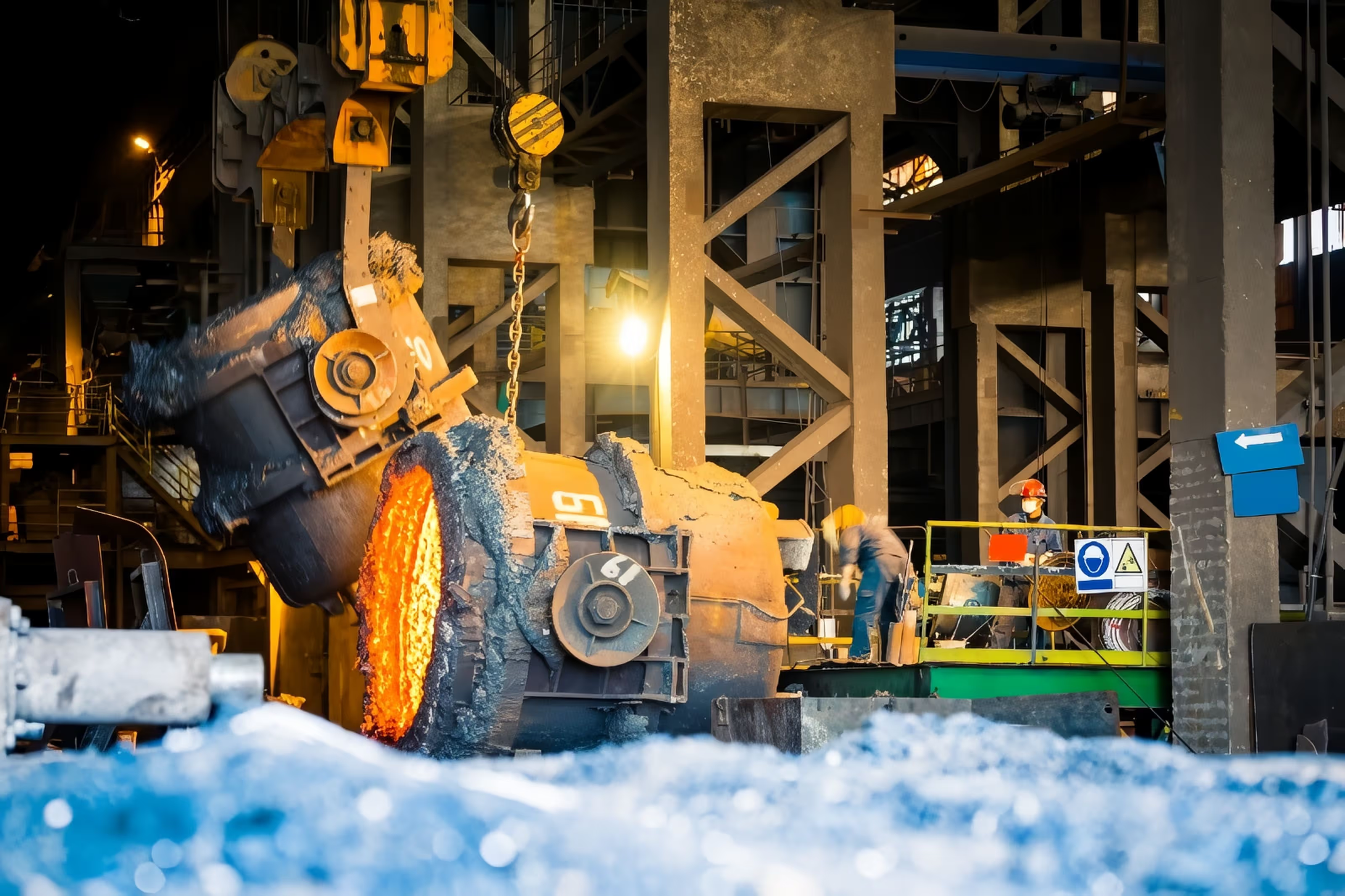
Defense contractors and qualified metal suppliers face a capacity crunch starting Q2 2025 as the proposed $1.5 trillion defense budget locks approximately 400,000 tonnes of steel and specialty alloy capacity at margins that compress civilian supply chains. The request combines a $1.15 trillion base budget with $350 billion in reconciliation funding, concentrating on weapons modernization including 34 new naval vessels requiring 180,000 tonnes of defense grade steel alone. For defense certified suppliers holding DFARS (Defense Federal Acquisition Regulation Supplement) compliance security clearances and mill certifications taking 18-24 months to obtain this represents guaranteed cost plus contracts with 15-25% premiums over civilian grades. For civilian fabricators, material access disappears as defense priorities redirect qualified capacity. The arbitrage is structural, not cyclical.
The margin anatomy reveals a three tier squeeze mechanism across the metals supply chain. Defense grade steel carries a $75-125/tonne premium over commercial hot rolled coil, driven by traceability requirements, restricted sourcing (no Chinese content), and specialized testing protocols. A typical destroyer class vessel consumes 6,000-8,000 tonnes of high-tensile steel at these premium rates. On the buy side, prime defense contractors like General Dynamics lock multi-year supply agreements at cost plus fixed fee terms, insulating them from spot volatility while guaranteeing supplier margins. On the sell side, the dozen US mills holding defense certifications led by Nucor's specialized facilities and Steel Dynamics' military-grade lines can redirect 25-30% of capacity to defense contracts without capital investment. Civilian buyers face the residual supply at rising spot prices.
Grade specifications create winner take all dynamics that commercial steel analysis misses entirely. The Golden Dome missile defense initiative alone requires 15,000 tonnes annually of specialized radar absorbent alloys and high-strength low-alloy (HSLA) steel grades that only four US facilities can produce to MIL-DTL specifications. Standard construction steel even high-grade structural cannot substitute. Shipbuilding programs demand HY-80 and HY-100 steel (high-yield strength at 80,000 and 100,000 PSI respectively) for submarine hulls, available from exactly two qualified US sources. The F-35 program expansion adds demand for titanium alloys and aluminum-lithium composites with aerospace certifications. Grade premiums stack, defense qualification adds $75/tonne, restricted sourcing adds $45/tonne, and specialized testing adds $35/tonne over base metal prices.
Create execution gaps that favor prepared operators over reactive buyers. The budget request triggers immediate forward-buying by defense primes, but actual contract awards lag 6-9 months behind appropriation. Large integrated suppliers like Nucor can hedge this gap through futures contracts and maintain strategic inventory. Mid-tier fabricators without derivatives access face impossible choices, buy expensive spot material now or risk unavailability later. The qualification ceiling compounds timing pressure new suppliers cannot enter defense markets quickly enough to relieve capacity constraints. A commercial fabricator seeking defense certification faces 18-24 months of compliance work, security clearances, and mill audits. Meanwhile, existing qualified capacity gets absorbed by multi-year defense contracts.
Cap the volume that can realistically shift to defense production, creating unavoidable bottlenecks regardless of price signals. US defense certified steel capacity totals approximately 2.8 million tonnes annually across qualified facilities insufficient for the proposed buildup without civilian displacement. Specialty alloy production faces tighter constraints, titanium sponge capacity of 45,000 tonnes annually, with aerospace-grade finishing limited to six facilities. Naval steel production requires specific mill configurations for plate thickness and width Nucor's Hertford facility and Steel Dynamics' Fort Wayne plant represent 60% of qualified capacity. Port infrastructure adds constraints: only three US ports (Newport News, Bath, Groton) possess both heavy lift capability and security clearances for defense shipment. Storage capacity for defense grade materials requires bonded, climate controlled facilities with restricted access.
Buyer and seller positioning reveals asymmetric margin capture across operator scales. On the buy side: Tier 1 defense contractors (Boeing, Lockheed Martin, General Dynamics) benefit from cost plus contract structures that pass material inflation directly to the Pentagon while maintaining fixed profit margins. Their supply managers can offer take or pay contracts to qualified mills, guaranteeing volume in exchange for priority allocation. Smaller defense subcontractors face fixed price contracts with primes, absorbing material cost volatility without pricing power. On the sell side, defense certified mills gain pricing leverage impossible in civilian markets Nucor's specialized facilities can command $200-300/tonne premiums during peak demand periods. Commodity traders without defense market access lose arbitrage opportunities as qualified supply becomes illiquid and price discovery shifts to bilateral negotiations.
The forward signal points toward structural supply chain separation rather than temporary price elevation, creating permanent market bifurcation. Defense budget appropriation in Q2 2025 triggers immediate contract competitions, with material deliveries extending through 2028-2030. Qualified suppliers will sign multi year agreements removing capacity from civilian markets indefinitely. New defense certifications require 24 month lead times minimum, preventing supply response before 2027. For procurement managers, defense grade material costs increase 20-35% above civilian benchmarks and remain elevated through the decade. The alternative civilian-grade substitution requires specification changes, testing, and approval cycles consuming 12-18 months. Commercial fabricators should secure alternative supply sources now or exit markets requiring premium grades. The capacity is spoken for.






'%3e%3cg id='Final-Copy-2_2_' transform='translate(1275.000000, 200.000000)'%3e%3cpath class='st0' d='M7.4,12.8h6.8l3.1-11.6H7.4C4.2,1.2,1.6,3.8,1.6,7S4.2,12.8,7.4,12.8z'/%3e%3c/g%3e%3c/g%3e%3c/g%3e%3cg id='final---dec.11-2020'%3e%3cg id='_x30_208-our-toggle' transform='translate(-1275.000000, -200.000000)'%3e%3cg id='Final-Copy-2' transform='translate(1275.000000, 200.000000)'%3e%3cpath class='st1' d='M22.6,0H7.4c-3.9,0-7,3.1-7,7s3.1,7,7,7h15.2c3.9,0,7-3.1,7-7S26.4,0,22.6,0z M1.6,7c0-3.2,2.6-5.8,5.8-5.8 h9.9l-3.1,11.6H7.4C4.2,12.8,1.6,10.2,1.6,7z'/%3e%3cpath id='x' class='st2' d='M24.6,4c0.2,0.2,0.2,0.6,0,0.8l0,0L22.5,7l2.2,2.2c0.2,0.2,0.2,0.6,0,0.8c-0.2,0.2-0.6,0.2-0.8,0 l0,0l-2.2-2.2L19.5,10c-0.2,0.2-0.6,0.2-0.8,0c-0.2-0.2-0.2-0.6,0-0.8l0,0L20.8,7l-2.2-2.2c-0.2-0.2-0.2-0.6,0-0.8 c0.2-0.2,0.6-0.2,0.8,0l0,0l2.2,2.2L23.8,4C24,3.8,24.4,3.8,24.6,4z'/%3e%3cpath id='y' class='st3' d='M12.7,4.1c0.2,0.2,0.3,0.6,0.1,0.8l0,0L8.6,9.8C8.5,9.9,8.4,10,8.3,10c-0.2,0.1-0.5,0.1-0.7-0.1l0,0 L5.4,7.7c-0.2-0.2-0.2-0.6,0-0.8c0.2-0.2,0.6-0.2,0.8,0l0,0L8,8.6l3.8-4.5C12,3.9,12.4,3.9,12.7,4.1z'/%3e%3c/g%3e%3c/g%3e%3c/g%3e%3c/g%3e%3c/svg%3e) Privacy Choices
Privacy Choices