.avif)
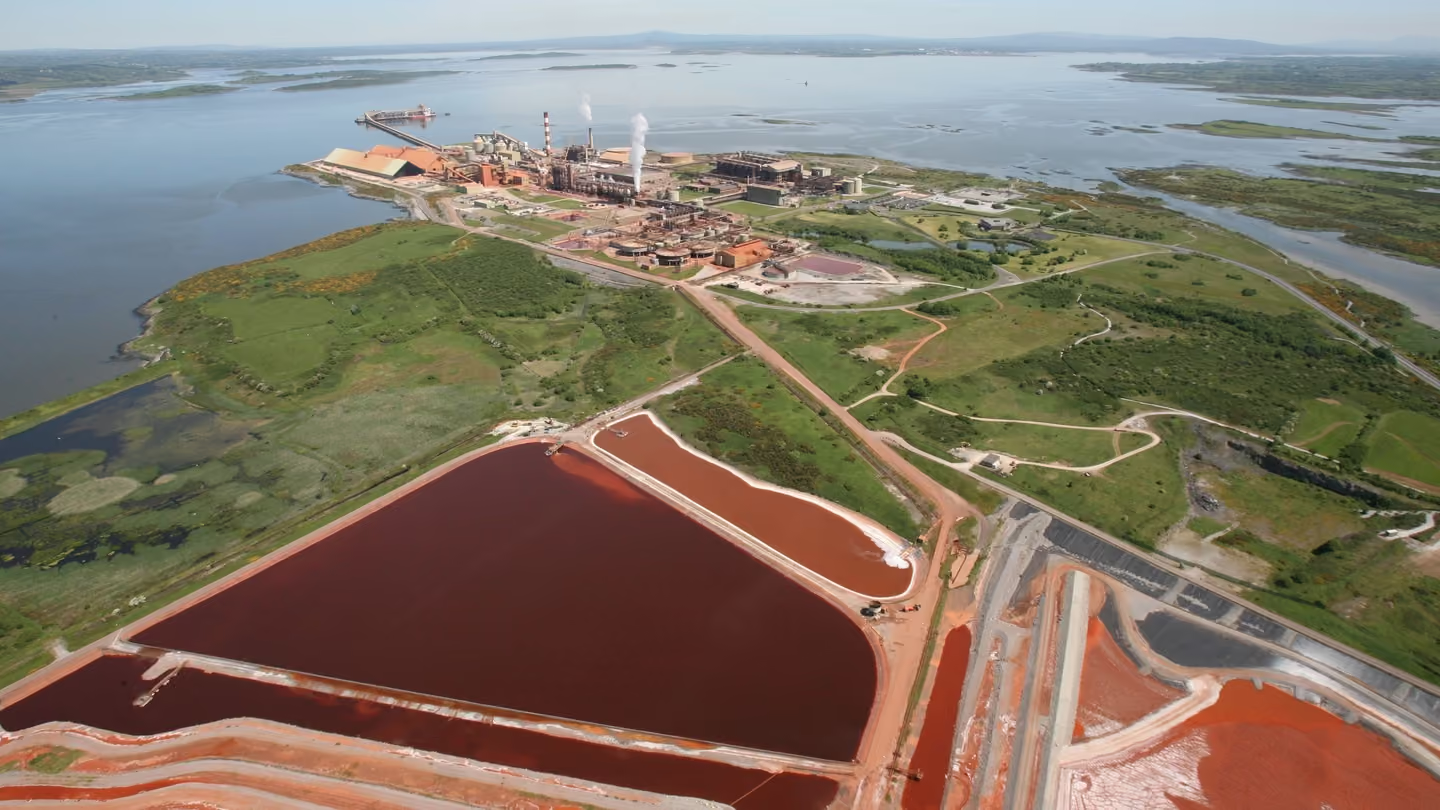
European aluminum smelters face a potential supply crisis worth approximately $570 million annually as the EU Commission abandons plans to sanction Aughinish Alumina, the Russian-owned Irish refinery that supplies 37% of Europe's smelter-grade alumina. With LME aluminum already trading at $3,668 per tonne a four-year high driven by Middle East supply disruptions any additional alumina constraint could push European production costs beyond viability for energy intensive smelters. Aughinish warned it would lose 45% of its customer base under sanctions, forcing closure of the 1.9 million tonne plant and eliminating what amounts to roughly 850,000 tonnes of annual European alumina supply. For context, alumina a white crystalline compound refined from bauxite ore is the primary feedstock for aluminum smelting, typically requiring 2 tonnes of alumina to produce 1 tonne of aluminum metal.
Current alumina pricing at $307.67 per tonne appears benign, but European buyers understand the substitution reality: alternative suppliers in Guinea, Australia, or Brazil cannot readily replace 1.9 million tonnes of refined capacity. While global alumina markets face oversupply pressure with prices potentially falling 10-15% in 2026, European premiums remain elevated due to energy costs and the EU's Carbon Border Adjustment Mechanism. Consider a mid-sized European aluminum smelter consuming 400,000 tonnes of alumina annually. At current pricing, their feedstock costs approximately $123 million per year. Losing access to Aughinish alumina would force sourcing from alternative suppliers at premiums of $50-100 per tonne, adding $20-40 million to annual operating costs often the margin between profitability and closure.
The sanctions debate stems from investigative reports showing that alumina from Aughinish's Shannon Estuary facility reaches Russian Rusal smelters, where it becomes aluminum sold to ASK, a Moscow trading company that supplies "dozens of Russian arms manufacturers". Aughinish acknowledges that approximately 45% of its 2025 exports roughly 855,000 tonnes went to Russian smelters, while 55% served European and international customers.
The indirect supply chain pathway runs:
Irish bauxite processing
Russian aluminum smelting
Moscow aluminum trading
defense manufacturing.
Yet sanctions law struggles with this multi-step connection where the sanctioned activity occurs two commercial steps removed from the EU facility.
Industry sources confirm that Aughinish remains "one of Europe's largest alumina suppliers," serving multiple smelters across the bloc already "grappling with elevated energy costs, oversupply pressures and geopolitical uncertainty". European smelting capacity already operates under structural pressure from elevated energy costs, meaning any feedstock disruption carries amplified consequences across automotive, aerospace, packaging, and construction sectors. European aluminum physical premiums have already doubled since the Middle East conflict began, with Rotterdam extrusion billet premiums reaching $1,100 per tonne compared to $530 pre-war, while general European aluminum premiums surged 63% to $585 per tonne. Additional alumina supply constraints would compound these pressures exponentially.
On the buy side: European smelters, particularly those serving automotive and aerospace sectors, face immediate margin compression as alternative alumina sourcing adds $50-100 per tonne to input costs while aluminum selling prices remain tied to LME benchmarks. Major smelters like Norsk Hydro's European operations or smaller regional players already contend with "green" aluminum supply deficits as Iceland's Nordural Grundartangi reduces output by two-thirds due to electrical failures. For buyers, Aughinish's continued operation represents the difference between manageable input costs and potential production curtailments. European primary aluminum capacity of 1.2 million tonnes annually depends on consistent alumina flows, with any supply disruption forcing either higher-cost sourcing or production cuts.
On the sell side: Aughinish itself faces potential closure under sanctions, with fixed costs of €25 million annually for Irish gas grid maintenance becoming "socialized" if the refinery cannot operate, while the facility warns of losing 1,000 jobs and material cost base deterioration. The company exports electricity equivalent to powering 200,000 Irish households, creating additional infrastructure dependencies. Rusal's broader network benefits from maintaining this European foothold, as any "closure of the Limerick plant" would eliminate a strategic processing location outside Russia's direct control. Alternative alumina suppliers in Australia, Guinea, and Brazil could capture premium pricing if European buyers lose access to Aughinish capacity, but logistical bottlenecks limit immediate substitution.
For large integrated producers with derivatives access: Companies like Norsk Hydro, Alcoa's European operations, or Constellium can hedge aluminum price exposure through LME futures while locking alumina costs through bilateral contracts with multiple suppliers including Aughinish. The hedging instrument is the LME/alumina spread trade shorting LME aluminum futures while fixing alumina costs through physical contracts. Current backwardation of approximately $60 between cash and three-month aluminum contracts provides some margin buffer, but this evaporates quickly if alumina premiums spike. With the global aluminum market in a slight deficit of 140,000 tonnes in 2026, integrated producers must secure feedstock access rather than rely on spot markets.
For smaller regional operators without derivatives access: Mid-sized European smelters operating at thin margins cannot easily absorb $50-100 per tonne alumina premium increases without derivatives protection. Their practical equivalent involves diversifying alumina suppliers geographically, maintaining 90 day inventory buffers, and negotiating escalation clauses in aluminum selling contracts that pass through feedstock cost increases to customers. Regional operators must accept that European alumina prices will remain above global averages due to carbon border adjustments and energy costs, with floor support at $230-250 per tonne production costs. The strategy is operational efficiency and customer contract protection rather than financial hedging.
Brussels' decision reflects the structural reality that sanctioning Aughinish would harm European industry more than Russian capabilities, as Irish Taoiseach Micheál Martin noted: sanctions would be "worse on the European Union" with impacts on Swedish and French smelters leading to "very strong inflationary outcome". The European Commission's restraint represents structural constraints governing sanctions policy when member state industrial interests and geopolitical objectives conflict directly, requiring either new legal frameworks for addressing indirect supply chain harm or member state consensus that has not yet materialized. This standoff illustrates how commodity level sanctions collide with industrial self-preservation when substitution capacity requires 5-7 years and $2-3 billion investment to develop.
For observers monitoring this situation: Watch the LME aluminum cash to three month spread daily. Current backwardation of $60 premium for immediate delivery signals physical tightness, but this could expand to $150-200 if Aughinish supply becomes genuinely threatened. The EU's 21st sanctions package is expected June 15th, though Aughinish appears excluded from current drafts. Any renewed political pressure following further weapons supply chain revelations could restart the sanctions debate by Q4 2026. Monitor aluminum physical premiums in Rotterdam and Antwerp sustained increases above $650 per tonne signal European supply stress that makes Aughinish sanctions economically prohibitive regardless of geopolitical pressure.





'%3e%3cg id='Final-Copy-2_2_' transform='translate(1275.000000, 200.000000)'%3e%3cpath class='st0' d='M7.4,12.8h6.8l3.1-11.6H7.4C4.2,1.2,1.6,3.8,1.6,7S4.2,12.8,7.4,12.8z'/%3e%3c/g%3e%3c/g%3e%3c/g%3e%3cg id='final---dec.11-2020'%3e%3cg id='_x30_208-our-toggle' transform='translate(-1275.000000, -200.000000)'%3e%3cg id='Final-Copy-2' transform='translate(1275.000000, 200.000000)'%3e%3cpath class='st1' d='M22.6,0H7.4c-3.9,0-7,3.1-7,7s3.1,7,7,7h15.2c3.9,0,7-3.1,7-7S26.4,0,22.6,0z M1.6,7c0-3.2,2.6-5.8,5.8-5.8 h9.9l-3.1,11.6H7.4C4.2,12.8,1.6,10.2,1.6,7z'/%3e%3cpath id='x' class='st2' d='M24.6,4c0.2,0.2,0.2,0.6,0,0.8l0,0L22.5,7l2.2,2.2c0.2,0.2,0.2,0.6,0,0.8c-0.2,0.2-0.6,0.2-0.8,0 l0,0l-2.2-2.2L19.5,10c-0.2,0.2-0.6,0.2-0.8,0c-0.2-0.2-0.2-0.6,0-0.8l0,0L20.8,7l-2.2-2.2c-0.2-0.2-0.2-0.6,0-0.8 c0.2-0.2,0.6-0.2,0.8,0l0,0l2.2,2.2L23.8,4C24,3.8,24.4,3.8,24.6,4z'/%3e%3cpath id='y' class='st3' d='M12.7,4.1c0.2,0.2,0.3,0.6,0.1,0.8l0,0L8.6,9.8C8.5,9.9,8.4,10,8.3,10c-0.2,0.1-0.5,0.1-0.7-0.1l0,0 L5.4,7.7c-0.2-0.2-0.2-0.6,0-0.8c0.2-0.2,0.6-0.2,0.8,0l0,0L8,8.6l3.8-4.5C12,3.9,12.4,3.9,12.7,4.1z'/%3e%3c/g%3e%3c/g%3e%3c/g%3e%3c/g%3e%3c/svg%3e) Privacy Choices
Privacy Choices