.avif)
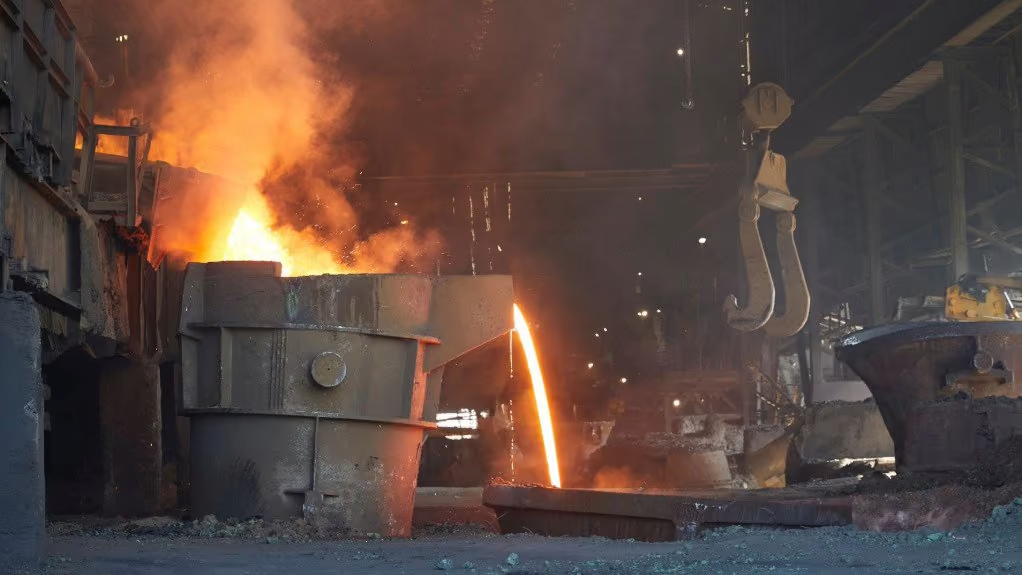
South African ferroalloy buyers sourcing manganese alloys for steel production face a structural supply disruption beginning immediately, with Transalloys the country's last operating manganese smelter having halted furnace operations as of early July 2026 and facing permanent closure by July 31 unless electricity tariff relief is granted.
Transalloys produces ferromanganese an alloy of iron and manganese used to deoxidise and strengthen steel at its Witbank facility in Mpumalanga, drawing power from Eskom, South Africa's national utility. The core problem is arithmetic, not negotiation. NERSA the National Energy Regulator of South Africa, the body that sets electricity tariffs approved a reduced rate of 62 cents per kilowatt-hour (kWh) for ferrochrome producers including Samancor and Glencore Merafe, a relief of approximately 54% against standard industrial rates. Transalloys, despite operating the same class of submerged arc furnace an energy intensive electric smelting vessel that continuously draws several hundred megawatts to maintain a molten ore bath was denied equivalent treatment. Its effective tariff remains approximately R1.35/kWh. At current rand dollar exchange rates of roughly R18.5/$, that differential is not marginal: Transalloys is paying more than double the regulated rate granted to its ferrochrome peers, on an energy cost that typically represents 35–45% of total ferromanganese production cost.
Work through the numbers on a representative monthly production run. A functional submerged arc furnace producing ferromanganese at Transalloys draws roughly 150–180 megawatt hours of electricity per tonne of alloy output. At R1.35/kWh, that is R202–243 per tonne in energy costs alone, or approximately $11–13/MT at current exchange rates. At the ferrochrome equivalent rate of 62 cents/kWh, the same energy envelope costs R93–112/MT, or roughly $5–6/MT. The differential $5 to $7 per tonne sounds contained, but ferromanganese margins in spot markets are currently thin. European CIF (cost, insurance, and freight delivered price to buyer's port) prices for standard grade ferromanganese sit around $900–950/MT. Chinese export offers have compressed global pricing. South African production, after freight to Rotterdam or Antwerp via the Cape route approximately 25–30 days, adding $35–50/MT in shipping costs on a handysize or supramax bulk carrier leaves very little room before the energy cost asymmetry alone tips the operation into loss. Transalloys' CEO Konstantin Sadovnik has stated publicly that the plant is loss-making at current tariff levels. The numbers confirm why.
The supply chain consequence of permanent closure is not theoretical. South Africa is the world's largest manganese ore producer holding roughly 80% of known economic reserves but Transalloys is now its only operating converter of that ore into smelted alloy. Ferromanganese moves from the Witbank smelter by rail to Richards Bay or Durban, loaded onto bulk carriers, and delivered CIF to European steel mills in Germany, the Netherlands, and Belgium, or to East Asian buyers in South Korea and Japan. If Transalloys closes permanently, those volumes estimated at several hundred thousand tonnes annually reroute. The primary beneficiaries are Chinese ferromanganese producers, who already dominate global supply, Australian output from the Groote Eylandt mine operated by South32, and Gabonese production through COMILOG Compagnie Minière de l'Ogooué, the majority state-owned operation that is the world's largest single manganese mine. None of these alternatives can absorb South African volume instantly, and none offer equivalent freight economics to European buyers. A supply gap, even a temporary one, shifts negotiating leverage materially.
On the buy side, European steel mill procurement teams sourcing ferromanganese on spot or quarterly term contracts face immediate decisions. The question is not whether to find alternative supply they must but at what premium. A German flat steel producer running a basic oxygen furnace that consumes ferromanganese as a deoxidiser typically holds two to three months of stock. A three-month forward cover at current prices looks conservative but rational. The risk is that if Transalloys closes permanently and the market reprices, locking supply now, even at a small spot premium, is cheaper than chasing the curve later. Australian and Gabonese material commands a quality and provenance premium over Chinese alloy among European buyers operating under increasingly stringent supply chain due diligence frameworks. That premium is currently modest; it will not remain so if South African supply exits the market structurally.
On the sell side, the immediate pressure falls on Transalloys and its workforce 600 direct employees, an estimated 7,000 downstream livelihoods including logistics, maintenance contractors, and local service businesses. The Ferro Alloy Producers Association (FAPA), which represents the broader South African smelting sector, has argued that ferrochrome accounts for roughly 70% of national smelting capacity and that the remaining 30% of which Transalloys is the manganese component is now operating under acute hardship without equivalent policy protection. For FAPA members still running operations, the competitive distortion is direct: producing ferrochrome under a 62 cent tariff while a peer facility producing a chemically distinct but industrially equivalent alloy pays R1.35/kWh is not a market outcome. It is a regulatory asymmetry with identifiable commercial victims. Chinese ferromanganese producers insulated from these dynamics by domestic energy subsidies and integrated ore supply gain margin through reduced global competition the moment Transalloys idles permanently.
The freight dimension compounds the margin story in ways that matter specifically for intermediary traders. For a large integrated ferroalloy trader a Trafigura, Traxys, or a steel company's captive trading arm with derivatives access and established freight contracts on the Richards Bay–Rotterdam route, the Transalloys shutdown opens an arbitrage: sourcing spot tonnages from Gabon or Australia and delivering CIF Europe at a time when competing South African supply is absent. The Cape route freight for a 25,000 tonne supramax cargo from Libreville, Gabon to Rotterdam runs approximately $40–55/MT under current bulk freight rates; from Port Hedland, Australia it is somewhat higher at $55–65/MT. Neither is cheap, but the spread between Chinese domestic pricing and European CIF offers historically $40–80/MT under normal supply conditions can widen sharply when South African volume disappears. The trader who moves first to fix Australian or Gabonese supply on forward terms controls where the margin concentrates. For a smaller regional distributor without derivatives access, the practical equivalent is extending bilateral supply agreements with existing Australian or European stockholding counterparties before the market prices in the South African shortfall a conversation that should be happening now, not in September.
The structural constraint the July 31 deadline framing obscures is this: even if NERSA grants Transalloys tariff relief by the deadline, relief alone does not return ferromanganese to the market quickly. Submerged arc furnaces cannot be restarted instantaneously after a cold shutdown the refractory lining, the molten bath chemistry, and the electrode systems all require controlled recommissioning. Industry practice suggests a restart after a prolonged cold halt requires three to six months and meaningful capital expenditure, likely in the range of $5–15 million depending on the duration of the shutdown and the state of the equipment. Years of operating losses have likely depleted Transalloys' working capital. Who provides the financing bridge between a tariff grant and first saleable output is the genuine commercial unknown, and no public statement from NERSA, Eskom, or the government has addressed it. A tariff concession without a financing mechanism is a necessary but insufficient condition for survival.
For observers tracking this market, the July 31 deadline is the first gate, not the final one. Watch the Platts ferromanganese CIF Rotterdam weekly assessment published by S&P Global Commodity Insights for any movement above $960/MT, which would signal the market has begun pricing in South African supply loss. Monitor NERSA's official gazette for any emergency tariff instrument applicable to manganese smelters before July 31; absence of a gazette notice by July 25 makes closure the base case. Track Richards Bay bulk export volumes in South African port authority data a drop in manganese alloy shipments in August–September 2026 would confirm the physical supply gap has opened. If that gap materialises, the arbitrage window for Gabonese and Australian origin material into Europe is likely to be the defining ferroalloy trade of the second half of 2026.





'%3e%3cg id='Final-Copy-2_2_' transform='translate(1275.000000, 200.000000)'%3e%3cpath class='st0' d='M7.4,12.8h6.8l3.1-11.6H7.4C4.2,1.2,1.6,3.8,1.6,7S4.2,12.8,7.4,12.8z'/%3e%3c/g%3e%3c/g%3e%3c/g%3e%3cg id='final---dec.11-2020'%3e%3cg id='_x30_208-our-toggle' transform='translate(-1275.000000, -200.000000)'%3e%3cg id='Final-Copy-2' transform='translate(1275.000000, 200.000000)'%3e%3cpath class='st1' d='M22.6,0H7.4c-3.9,0-7,3.1-7,7s3.1,7,7,7h15.2c3.9,0,7-3.1,7-7S26.4,0,22.6,0z M1.6,7c0-3.2,2.6-5.8,5.8-5.8 h9.9l-3.1,11.6H7.4C4.2,12.8,1.6,10.2,1.6,7z'/%3e%3cpath id='x' class='st2' d='M24.6,4c0.2,0.2,0.2,0.6,0,0.8l0,0L22.5,7l2.2,2.2c0.2,0.2,0.2,0.6,0,0.8c-0.2,0.2-0.6,0.2-0.8,0 l0,0l-2.2-2.2L19.5,10c-0.2,0.2-0.6,0.2-0.8,0c-0.2-0.2-0.2-0.6,0-0.8l0,0L20.8,7l-2.2-2.2c-0.2-0.2-0.2-0.6,0-0.8 c0.2-0.2,0.6-0.2,0.8,0l0,0l2.2,2.2L23.8,4C24,3.8,24.4,3.8,24.6,4z'/%3e%3cpath id='y' class='st3' d='M12.7,4.1c0.2,0.2,0.3,0.6,0.1,0.8l0,0L8.6,9.8C8.5,9.9,8.4,10,8.3,10c-0.2,0.1-0.5,0.1-0.7-0.1l0,0 L5.4,7.7c-0.2-0.2-0.2-0.6,0-0.8c0.2-0.2,0.6-0.2,0.8,0l0,0L8,8.6l3.8-4.5C12,3.9,12.4,3.9,12.7,4.1z'/%3e%3c/g%3e%3c/g%3e%3c/g%3e%3c/g%3e%3c/svg%3e) Privacy Choices
Privacy Choices