.avif)
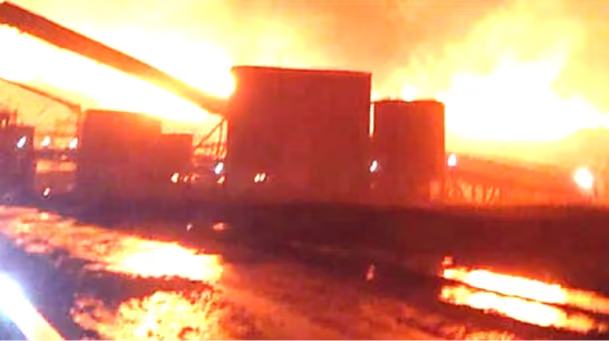
DTEK's suspended Dnipropetrovsk coal mine is costing the company thousands of tonnes of daily output starting 5 July 2026, with emergency repair timelines uncertain and European import alternatives carrying a material price premium that Ukrainian utility buyers cannot easily absorb ahead of winter.
The mine in question belongs to DTEK Energy Ukraine's largest private energy group, operating multiple coal and power assets across the country. A coking coal mine one that produces coal used to make steel, as distinct from thermal coal burned in power stations in the Dnipropetrovsk region was struck by Russian forces on 5 July, according to company reporting. One security service employee was killed; five workers were injured. At the time of the strike, 86 miners were working underground. All were brought safely to the surface as power to the facility failed. Operations are now suspended while DTEK assesses structural and equipment damage under active conflict conditions. Critically, this is not the first strike on this facility: a previous attack on 7 June damaged life-support systems the ventilation, gas monitoring, and emergency communication infrastructure that keeps underground workers safe and injured another employee. A mine struck twice in four weeks is not a mine facing temporary disruption. It is a mine operating under recurrent, targeted attack.
The commercial arithmetic is straightforward, even if the exact output figure for this specific facility is not public. Ukrainian coking coal mines in the Dnipropetrovsk region typically produce in the range of 1,000 to 3,000 tonnes per day of raw coal output. At a conservative 2,000 tonnes per day and a domestic coking coal price of approximately $130–150 per tonne below the seaborne benchmark because of transport constraints and captive market dynamics each suspended day costs DTEK somewhere between $260,000 and $300,000 in foregone revenue. Across a two to four week repair window assuming no further strikes that is $3.5 million to $8.5 million in lost production. The deeper problem is that insurance for operational interruption caused by active military strikes is effectively unavailable at any commercial premium in frontline regions. Emergency repair investment carries no guarantee of return if the facility is struck a third time before restoration is complete.
On the buy side, Ukrainian steel producers and utilities that depend on domestic coking coal face a narrowing margin position. Seaborne coking coal imported via the Danube river corridor, since active conflict severely restricts Black Sea routing for commercial vessels trades at a significant premium to domestic supply. Australian premium hard coking coal (PHCC), the global benchmark assessed by Platts and Argus, was trading around $215–220 per tonne CFR (cost and freight, meaning the seller pays shipping to the destination port) for Asian delivery in mid-2026. Ukrainian buyers accessing seaborne coal via the Danube and then overland rail would pay a further $20–35 per tonne in logistics costs, pushing delivered cost well above $240 per tonne a gap of $90–110 per tonne versus domestic supply. For a steel mill consuming 500,000 tonnes of coking coal annually, a partial shift to seaborne supply adds $45–55 million per year in input costs. On the sell side, DTEK faces both production revenue loss and the reputational and contractual pressure of failing to supply long-term domestic counterparties pressure it cannot resolve through operational decisions alone.
For a large integrated European coal trader a Glencore, a Trafigura, or a major commodity house with seaborne coking coal positions the immediate question is whether Ukrainian import demand increases enough to move marginal volumes from Atlantic Basin or Australian suppliers. The near-term volume uplift is modest: analysts estimate Ukrainian coking coal import displacement at under 0.5 million tonnes in the near term, insufficient to materially shift benchmark pricing but enough to tighten specific grades in the Danube logistics corridor. For a smaller regional operator a Central European steel mill or an independent coal distributor supplying Ukrainian industrial buyers the practical move is to secure fixed-price supply agreements now, before winter procurement cycles begin in earnest in August and September. Spot exposure through Q3 and Q4 carries compounding risk if additional DTEK facilities are struck. For all observers, the signal to watch is the Argus CIS coking coal export price assessment, published weekly if that index diverges upward from the global PHCC benchmark by more than $15 per tonne over the next 30 days, it will confirm that regional supply displacement is pricing through. Separately, any DTEK operational update indicating a third strike on Dnipropetrovsk assets before repairs are complete should be treated as a structural supply reduction, not a temporary interruption and procurement decisions should adjust accordingly.







'%3e%3cg id='Final-Copy-2_2_' transform='translate(1275.000000, 200.000000)'%3e%3cpath class='st0' d='M7.4,12.8h6.8l3.1-11.6H7.4C4.2,1.2,1.6,3.8,1.6,7S4.2,12.8,7.4,12.8z'/%3e%3c/g%3e%3c/g%3e%3c/g%3e%3cg id='final---dec.11-2020'%3e%3cg id='_x30_208-our-toggle' transform='translate(-1275.000000, -200.000000)'%3e%3cg id='Final-Copy-2' transform='translate(1275.000000, 200.000000)'%3e%3cpath class='st1' d='M22.6,0H7.4c-3.9,0-7,3.1-7,7s3.1,7,7,7h15.2c3.9,0,7-3.1,7-7S26.4,0,22.6,0z M1.6,7c0-3.2,2.6-5.8,5.8-5.8 h9.9l-3.1,11.6H7.4C4.2,12.8,1.6,10.2,1.6,7z'/%3e%3cpath id='x' class='st2' d='M24.6,4c0.2,0.2,0.2,0.6,0,0.8l0,0L22.5,7l2.2,2.2c0.2,0.2,0.2,0.6,0,0.8c-0.2,0.2-0.6,0.2-0.8,0 l0,0l-2.2-2.2L19.5,10c-0.2,0.2-0.6,0.2-0.8,0c-0.2-0.2-0.2-0.6,0-0.8l0,0L20.8,7l-2.2-2.2c-0.2-0.2-0.2-0.6,0-0.8 c0.2-0.2,0.6-0.2,0.8,0l0,0l2.2,2.2L23.8,4C24,3.8,24.4,3.8,24.6,4z'/%3e%3cpath id='y' class='st3' d='M12.7,4.1c0.2,0.2,0.3,0.6,0.1,0.8l0,0L8.6,9.8C8.5,9.9,8.4,10,8.3,10c-0.2,0.1-0.5,0.1-0.7-0.1l0,0 L5.4,7.7c-0.2-0.2-0.2-0.6,0-0.8c0.2-0.2,0.6-0.2,0.8,0l0,0L8,8.6l3.8-4.5C12,3.9,12.4,3.9,12.7,4.1z'/%3e%3c/g%3e%3c/g%3e%3c/g%3e%3c/g%3e%3c/svg%3e) Privacy Choices
Privacy Choices