.avif)
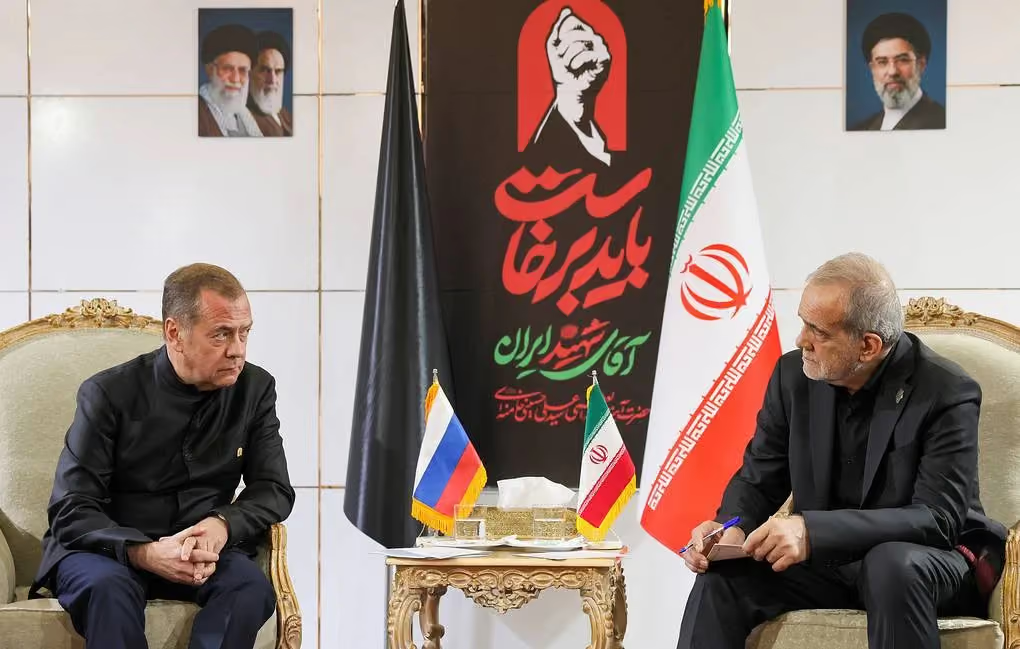
Asian state refiners and independent buyers of Persian Gulf crude face an estimated $2–6 per barrel compression in refinery intake margins starting now as Dmitry Medvedev's public framing of the Strait of Hormuz as a strategic deterrent equivalent to a nuclear weapon forces commodity markets to reprice the probability of sustained, multi-choke point disruption across the world's two most critical energy shipping corridors.
Medvedev, Russia's Security Council Deputy Chairman, made the remarks after attending the funeral of Iran's Supreme Leader Ali Khamenei in Tehran, according to reports. His language was precise and deliberate: Hormuz, he argued, is 'no less powerful' than a nuclear weapon, and the Bab el-Mandeb Strait the 29 kilometre wide passage between Yemen and Djibouti through which roughly 10% of global trade transits could function as a 'thermonuclear weapon' in a wider conflict, halting all oil shipments and maritime traffic simultaneously. Whether or not this reflects coordinated Iranian-Russian strategy, the statement functions commercially as a risk signal: it elevates the perceived probability that both chokepoints could be activated together. That scenario simultaneous credible closure of Hormuz and Bab el-Mandeb is the one that no current war-risk insurance pricing or tanker freight forward curve has fully absorbed.
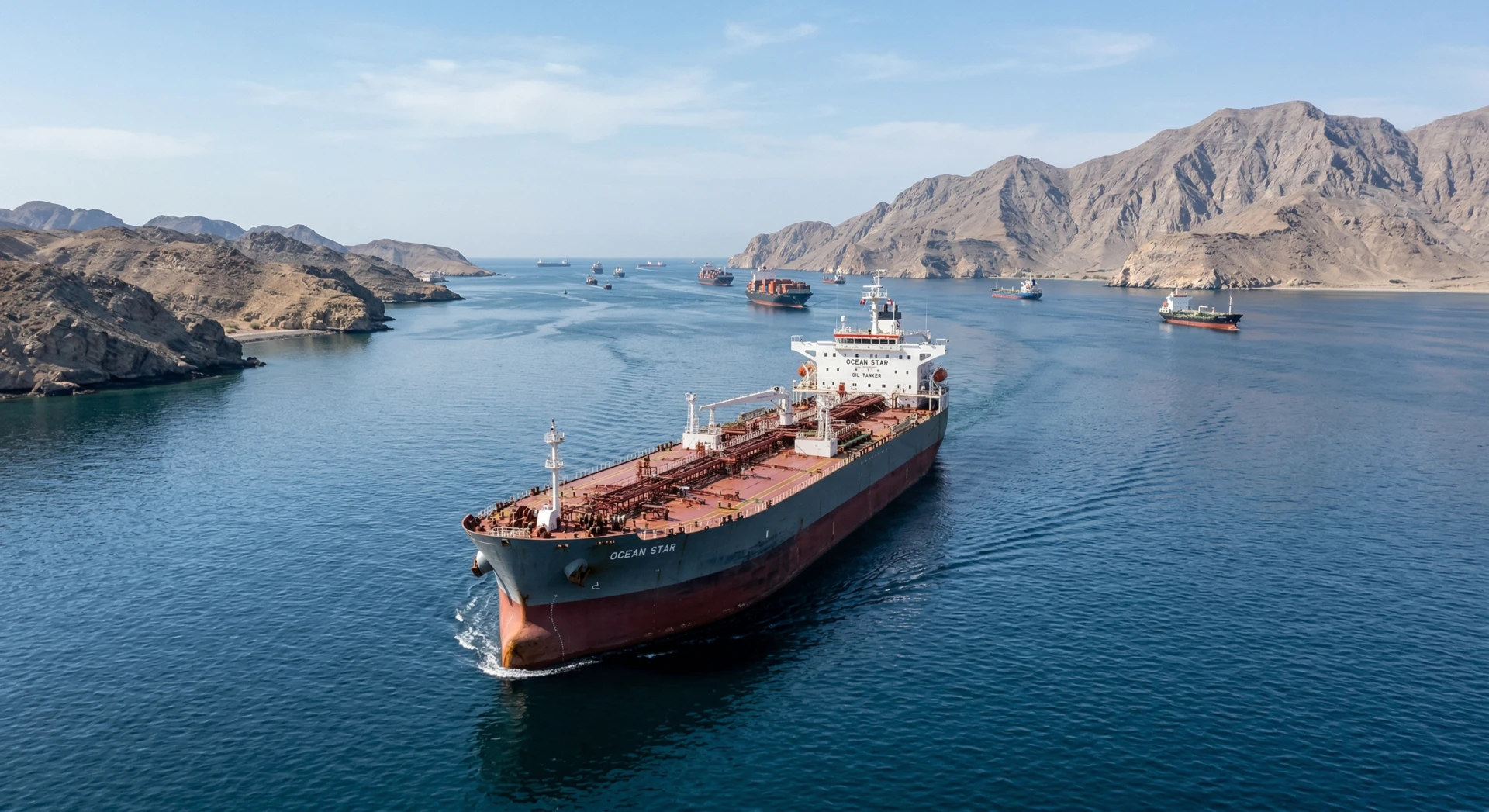
To understand why dual closure is categorically different from the partial Hormuz disruption already experienced, consider the physical geography. The Strait of Hormuz is the exit valve for Persian Gulf production. If closed or degraded, cargo reroutes via the Cape of Good Hope, the southern tip of Africa, adding 12 to 20 voyage days to sailings bound for Asia. That rerouting is viable, if costly. Bab el-Mandeb is the entry point to the Red Sea and, from there, the Suez Canal gateway to European markets. If both passages are simultaneously threatened, there is no practical rerouting for Gulf crude and LNG heading to either Asia or Europe that does not add weeks and tens of millions of dollars per voyage. The market has partially priced one closure. It has not priced two.
The freight arithmetic is where this story becomes concrete. A VLCC a Very Large Crude Carrier, the supertanker class capable of carrying approximately 2 million barrels of crude rerouted around the Cape of Good Hope from the Middle East Gulf to a Japanese refinery adds roughly 18 voyage days to a standard 20–25 day Hormuz transit passage. At current spot TCE rates TCE, or Time Charter Equivalent, being the daily earnings a vessel operator receives net of voyage costs of $40,000 to $60,000 per day, those 18 additional days generate $720,000 to $1.08 million in additional freight cost per voyage. That freight increment does not accrue to the cargo owner. It accrues entirely to the vessel operator. For a mid-sized independent refiner in South Korea or Japan buying a single VLCC cargo of 2 million barrels, the Cape rerouting adds approximately $0.36 to $0.54 per barrel in freight alone before war-risk insurance surcharges of 0.5% to 2% of hull and cargo value are applied. Add those surcharges, and the delivered cost per barrel rises by $1.50 to $3.00 on top of the freight increment. Refinery intake margins already thin in a high crude price environment compress accordingly.
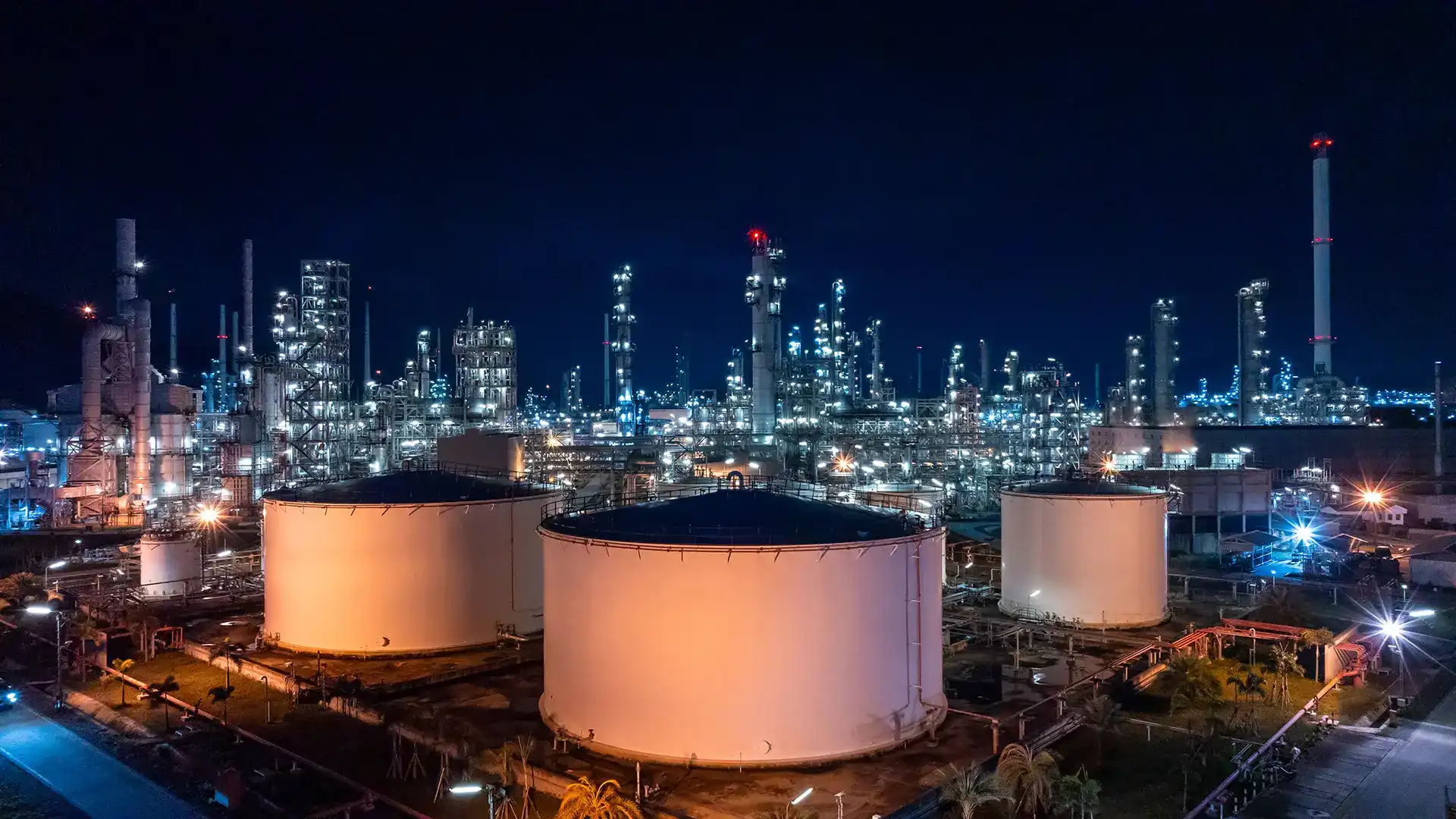
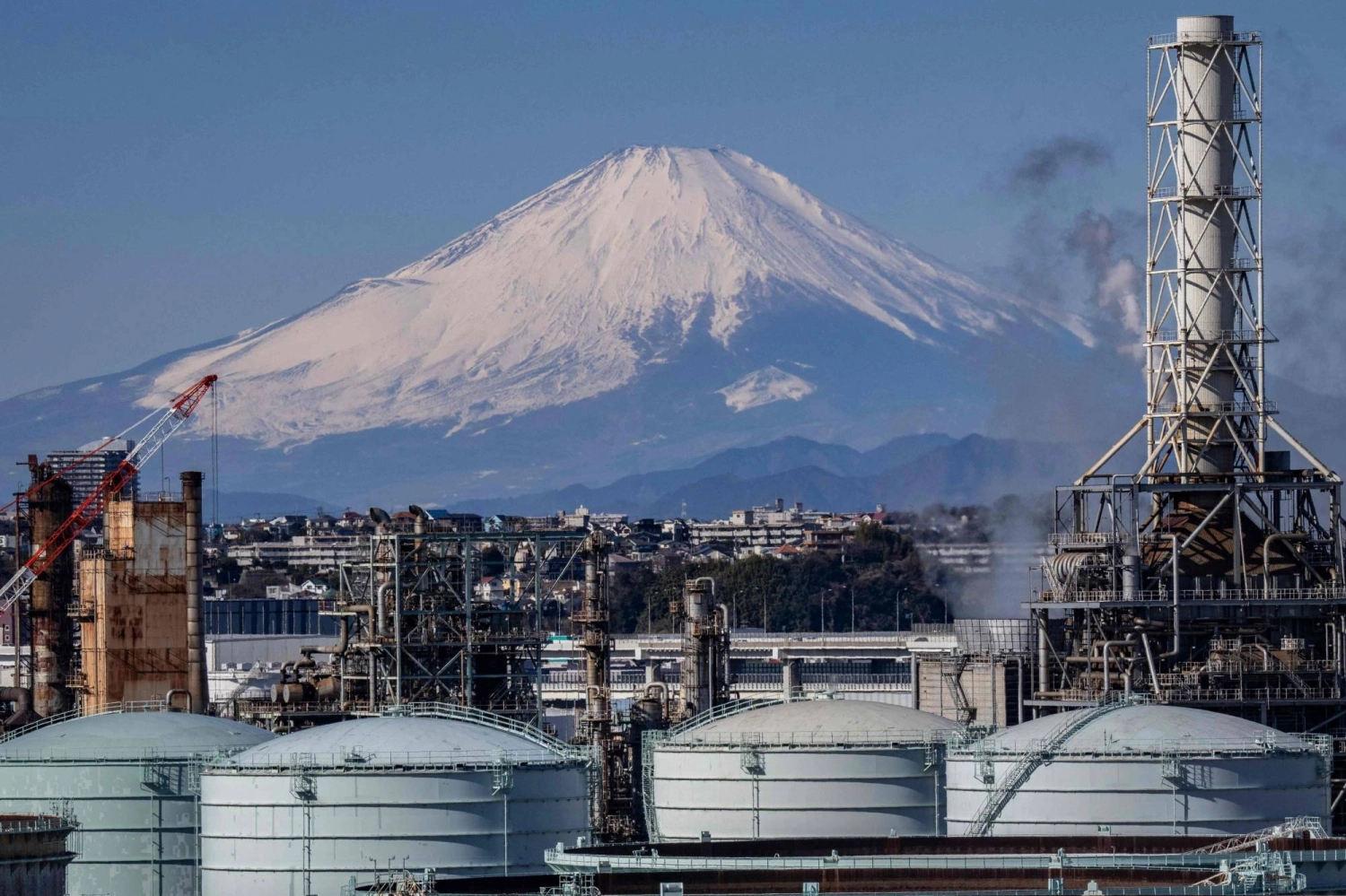
On the buy side, Asian state refiners including entities such as Japan's ENEOS, South Korea's SK Innovation, and India's Indian Oil Corporation face a compounding problem. They are structurally dependent on Persian Gulf crude, which constitutes 60–70% of Asia's import slate, because Middle East barrels are priced on a Dubai/Oman benchmark that typically trades at a discount to the North Sea Brent benchmark used for Atlantic Basin crude. That discount the Brent-Dubai spread is the commercial reason Asian refiners prefer Gulf barrels. As Hormuz risk premiums widen, Dubai/Oman barrels paradoxically move to a deeper discount relative to Brent, not because they are cheaper to deliver, but because their risk-adjusted delivered cost has risen. The spread widens, but it signals distress, not opportunity, for buyers already locked into Gulf supply agreements. Smaller and independent Asian refiners, without the hedging infrastructure of national oil companies, face the full pass-through of freight and insurance escalation with no derivative instrument to offset it.
On the sell side, Gulf national oil companies Saudi Aramco, ADNOC, Kuwait Petroleum face a structural tension. Their crude is in demand precisely because it is cheap on a benchmark basis, but a sustained Hormuz disruption or risk premium degrades the competitive position of their barrels relative to Atlantic Basin alternatives, specifically West African crude priced on Brent, US WTI Midland exported from Corpus Christi, or North Sea cargoes. If the Brent-Dubai spread widens beyond approximately $4 to $5 per barrel compared to its historical average of $1 to $3 Atlantic barrels become price competitive at Asian ports even after the longer voyage freight cost. This is the arbitrage that begins to flow when Gulf risk premiums spike: Atlantic LNG and crude gain pricing competitiveness for Asian buyers, redirecting cargo flows and reducing Gulf seller netbacks the price the seller receives after all delivery costs are subtracted.
For large integrated traders Trafigura, Vitol, or a national oil company's trading arm with full derivatives access the current environment offers both hedging instruments and positioning opportunities. ICE Brent futures and Dubai swap contracts allow these operators to lock in the Brent-Dubai spread at current elevated levels. War-risk insurance can be priced into forward freight agreements (FFAs) contracts that fix freight costs for a future voyage securing a known delivered cost before physical contracts are executed. The more sophisticated play is positioning long on VLCC freight derivatives via the Baltic Exchange Dirty Tanker Route TD3C, which tracks VLCC rates from the Middle East Gulf to China. This route is the most direct indicator of Hormuz freight stress. For smaller regional operators an independent fuel importer in Southeast Asia or a regional cooperative without derivatives desks the practical equivalent is fixing bilateral supply terms with Atlantic Basin suppliers now, before risk premiums are fully reflected in spot quotes, and extending physical inventory buffers beyond standard 30 day cycles to absorb potential supply timing disruptions.
The historical anchor is instructive. The last comparable Hormuz disruption was the Iran-Iraq tanker war of the 1980s, when Iranian and Iraqi forces attacked commercial vessels transiting the Gulf between 1984 and 1988. Freight rates tripled within weeks of each major attack. War-risk insurance premiums then structured as Lloyd's of London syndicate add-ons rose to 0.5% of hull value per single voyage, from near zero in peacetime. The critical difference today is scale: in the 1980s, approximately 7 million barrels per day transited Hormuz. Today that figure is closer to 20 million barrels per day, and the corridor carries LNG volumes liquefied natural gas, chilled to -162°C for transport that did not exist as a significant trade flow in the 1980s. Qatar alone ships approximately 77 million tonnes of LNG annually, the majority of which transits Hormuz. A sustained disruption today would affect a market three times larger and far less substitutable.
The specific signal to watch is the Baltic Exchange Dirty Tanker Route TD3C the benchmark freight rate for a VLCC voyage from Ras Tanura in Saudi Arabia to Ningbo, China published daily by the Baltic Exchange. If TD3C moves above $7.00 per tonne within the next 14 days, it indicates that the market is beginning to price sustained Cape rerouting as the operational baseline rather than a contingency. A secondary signal is the Brent-Dubai EFS (Exchange of Futures for Swaps) the traded spread between ICE Brent futures and Dubai swaps available on ICE. If this spread widens beyond $5 per barrel and holds for more than three consecutive trading days, it signals that Atlantic Basin crude is beginning to displace Gulf barrels in Asian tender procurement. Both signals are observable in real time. Both will move before diplomatic headlines resolve anything.

.jpg)
.jpg)

'%3e%3cg id='Final-Copy-2_2_' transform='translate(1275.000000, 200.000000)'%3e%3cpath class='st0' d='M7.4,12.8h6.8l3.1-11.6H7.4C4.2,1.2,1.6,3.8,1.6,7S4.2,12.8,7.4,12.8z'/%3e%3c/g%3e%3c/g%3e%3c/g%3e%3cg id='final---dec.11-2020'%3e%3cg id='_x30_208-our-toggle' transform='translate(-1275.000000, -200.000000)'%3e%3cg id='Final-Copy-2' transform='translate(1275.000000, 200.000000)'%3e%3cpath class='st1' d='M22.6,0H7.4c-3.9,0-7,3.1-7,7s3.1,7,7,7h15.2c3.9,0,7-3.1,7-7S26.4,0,22.6,0z M1.6,7c0-3.2,2.6-5.8,5.8-5.8 h9.9l-3.1,11.6H7.4C4.2,12.8,1.6,10.2,1.6,7z'/%3e%3cpath id='x' class='st2' d='M24.6,4c0.2,0.2,0.2,0.6,0,0.8l0,0L22.5,7l2.2,2.2c0.2,0.2,0.2,0.6,0,0.8c-0.2,0.2-0.6,0.2-0.8,0 l0,0l-2.2-2.2L19.5,10c-0.2,0.2-0.6,0.2-0.8,0c-0.2-0.2-0.2-0.6,0-0.8l0,0L20.8,7l-2.2-2.2c-0.2-0.2-0.2-0.6,0-0.8 c0.2-0.2,0.6-0.2,0.8,0l0,0l2.2,2.2L23.8,4C24,3.8,24.4,3.8,24.6,4z'/%3e%3cpath id='y' class='st3' d='M12.7,4.1c0.2,0.2,0.3,0.6,0.1,0.8l0,0L8.6,9.8C8.5,9.9,8.4,10,8.3,10c-0.2,0.1-0.5,0.1-0.7-0.1l0,0 L5.4,7.7c-0.2-0.2-0.2-0.6,0-0.8c0.2-0.2,0.6-0.2,0.8,0l0,0L8,8.6l3.8-4.5C12,3.9,12.4,3.9,12.7,4.1z'/%3e%3c/g%3e%3c/g%3e%3c/g%3e%3c/g%3e%3c/svg%3e) Privacy Choices
Privacy Choices