.avif)
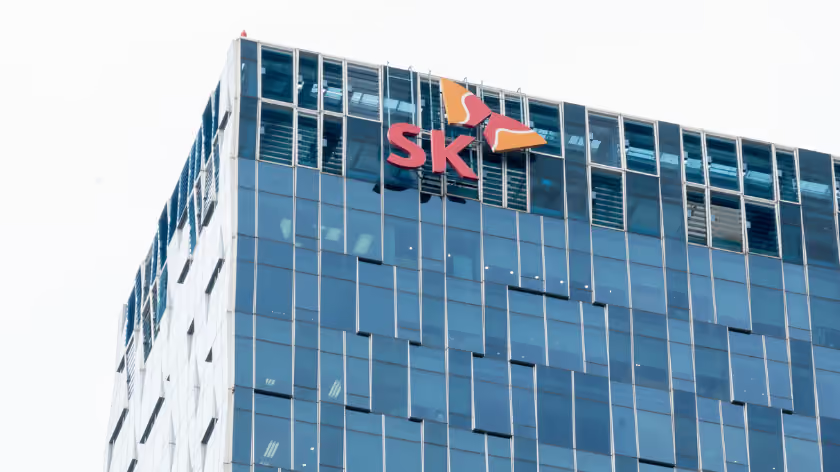
Korean LNG importers face a structural demand uplift of 5–8 million tonnes per year by the mid-2030s if SK Telecom's 15GW AI data center buildout reaches even half its stated ambition a volume shift worth $2–4 billion annually at current JKM prices that will begin registering in term contract negotiations as early as 2027.
SK Telecom announced on 5 July 2026 a phased plan to develop up to 15GW of AI data center capacity across Korea by 2035, starting with a 1GW facility already underway in Ulsan and scaling to a 5GW domestic cluster by 2029. The total investment is estimated at approximately 1,000 trillion won roughly $730 billion USD making it, if executed, the largest infrastructure project in Korean history. JKM (Japan Korea Marker the benchmark spot price for LNG delivered to Northeast Asia, published daily by S&P Global Platts) is the pricing reference that will absorb any demand signal from this buildout. Korea's power grid is anchored in nuclear baseload and gas-fired peaking capacity, and data centers of this scale run continuously at near-100% utilization they are, in power terms, always on industrial load. At a 40% gas-fired power share assumption consistent with Korea's current generation mix 15GW of new data center load implies roughly 5–8 MT/year of incremental LNG demand at full buildout, on top of Korea's existing ~45 MT/year import base. That is not a rounding error. It is a material new demand vector for every LNG seller with Korean offtake exposure.
The physical supply chain consequence runs through three import terminals: Incheon, Pyeongtaek, and Tongyeong Korea Gas Corporation (KOGAS) regasification facilities that receive LNG from Qatar, Australia, the United States, and Malaysia, converting it from cryogenic liquid back to pipeline gas for power generators. Current terminal send-out capacity is not the binding constraint in the near term; grid interconnection and Korea Electric Power Corporation (KEPCO) transmission infrastructure are. KEPCO the state utility responsible for transmitting power from generators to end users is already financially stressed, carrying accumulated losses from regulated tariff suppression. Funding the grid upgrades required to deliver 1GW/year of new data center load from 2026 to 2029 implies sustained KEPCO capex that is not visible in its current balance sheet or approved plans. The 2029 5GW milestone is therefore the first credibility test: Korean interconnection queues and KEPCO's published capex cycle will either confirm or refute whether this project is progressing at the pace SK Telecom has announced.
Consider what the demand signal means at operator scale. A large integrated LNG trader Vitol, TotalEnergies' LNG desk, or a national oil company trading arm with Korean term contracts can begin positioning today. If Korean power sector LNG demand grows by even 3 MT/year by 2029 (a conservative partial buildout scenario), that represents approximately $1.2 billion per year in incremental cargo value at a JKM price of $13/MMBtu (million British thermal units the standard LNG energy measure). A trader holding spare long-term supply from a US Gulf Coast LNG project, where FOB (free on board seller delivers cargo to the vessel, buyer pays freight) prices are currently $3–4/MMBtu below JKM on a delivered basis, holds a structural arbitrage option worth $9/MMBtu on marginal Korean-bound volumes. For a smaller regional LNG importer a Korean city gas distributor or an independent power producer without derivatives access the practical move is to lock bilateral term contract extensions with existing suppliers before the demand signal becomes consensus and JKM spot premiums widen. The window for below-consensus term pricing is approximately 12–18 months, before hyperscaler offtake contracts (long-term supply agreements from Microsoft, Google, or Amazon the anchor tenants whose commitments make project financing bankable) are confirmed and the demand uplift is priced in.
On the buy side, Korean power generators and KOGAS face rising average procurement costs if spot LNG demand increases faster than long-term contract coverage. A utility that is 70% covered on long-term supply but must source 30% on spot will feel JKM upside acutely every $1/MMBtu move on 3 MT of spot volume costs approximately $160 million per year. On the sell side, Australian LNG exporters (Woodside, Santos) and Qatari sellers with Korean term exposure gain: higher baseload demand structurally supports renewal prices on contracts maturing between 2028 and 2032, and reduces the probability that Korean buyers renegotiate volumes downward. The central risk to this entire thesis is the one the enrichment flags clearly: hyperscaler offtake contracts are not confirmed. Without a signed capacity agreement from a major cloud provider, no project lender funds at this scale, and without project finance, the 5GW by 2029 milestone does not close. LNG importers should treat the demand uplift as directionally real but volume uncertain, and watch KEPCO's FY2026 capex guidance due in the September 2026 earnings release as the first hard signal of whether grid infrastructure is moving at the pace the project requires.
'%3e%3cg id='Final-Copy-2_2_' transform='translate(1275.000000, 200.000000)'%3e%3cpath class='st0' d='M7.4,12.8h6.8l3.1-11.6H7.4C4.2,1.2,1.6,3.8,1.6,7S4.2,12.8,7.4,12.8z'/%3e%3c/g%3e%3c/g%3e%3c/g%3e%3cg id='final---dec.11-2020'%3e%3cg id='_x30_208-our-toggle' transform='translate(-1275.000000, -200.000000)'%3e%3cg id='Final-Copy-2' transform='translate(1275.000000, 200.000000)'%3e%3cpath class='st1' d='M22.6,0H7.4c-3.9,0-7,3.1-7,7s3.1,7,7,7h15.2c3.9,0,7-3.1,7-7S26.4,0,22.6,0z M1.6,7c0-3.2,2.6-5.8,5.8-5.8 h9.9l-3.1,11.6H7.4C4.2,12.8,1.6,10.2,1.6,7z'/%3e%3cpath id='x' class='st2' d='M24.6,4c0.2,0.2,0.2,0.6,0,0.8l0,0L22.5,7l2.2,2.2c0.2,0.2,0.2,0.6,0,0.8c-0.2,0.2-0.6,0.2-0.8,0 l0,0l-2.2-2.2L19.5,10c-0.2,0.2-0.6,0.2-0.8,0c-0.2-0.2-0.2-0.6,0-0.8l0,0L20.8,7l-2.2-2.2c-0.2-0.2-0.2-0.6,0-0.8 c0.2-0.2,0.6-0.2,0.8,0l0,0l2.2,2.2L23.8,4C24,3.8,24.4,3.8,24.6,4z'/%3e%3cpath id='y' class='st3' d='M12.7,4.1c0.2,0.2,0.3,0.6,0.1,0.8l0,0L8.6,9.8C8.5,9.9,8.4,10,8.3,10c-0.2,0.1-0.5,0.1-0.7-0.1l0,0 L5.4,7.7c-0.2-0.2-0.2-0.6,0-0.8c0.2-0.2,0.6-0.2,0.8,0l0,0L8,8.6l3.8-4.5C12,3.9,12.4,3.9,12.7,4.1z'/%3e%3c/g%3e%3c/g%3e%3c/g%3e%3c/g%3e%3c/svg%3e) Privacy Choices
Privacy Choices