.avif)
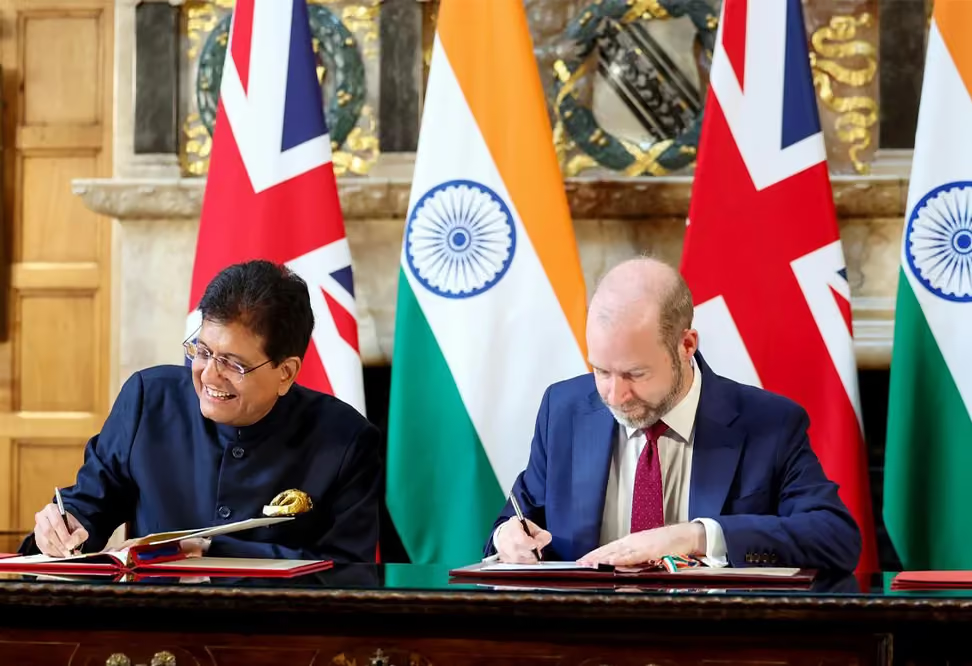
Indian commodity exporters particularly garment and textile manufacturers can begin capturing a landed-cost advantage worth 9–12 percentage points on UK-bound shipments from 15 July 2026, provided their goods satisfy the Rules of Origin now notified by India's finance ministry under the India-UK Comprehensive Economic and Trade Agreement (CETA a bilateral trade deal granting preferential tariff access between two signatory economies). The operational catch is immediate and material: exporters whose supply chains route through third countries such as the UAE, Singapore, or Bangladesh for processing, transit, or re-invoicing may find that their goods do not qualify as originating under the new framework, forfeiting those savings entirely and reverting to standard MFN (Most Favoured Nation the default, non-preferential tariff rate applied to all trading partners without a special deal) rates. The rules are not aspirational they are enforceable from day one, with customs verification and duty-recovery provisions built in.
The origin framework operates on three qualifying pathways. First, goods wholly obtained in India meaning born, grown, or extracted there with no foreign input. Second, goods produced entirely from materials that themselves already qualify as originating. Third, goods that undergo sufficient transformation to meet the agreement's product specific criteria, typically defined by a change in tariff classification (HS code the internationally standardised Harmonised System code that classifies every traded good) or a value-addition threshold. Cumulation the provision allowing inputs from one CETA partner to count as originating when used in production by the other is explicitly permitted, creating a structural optimisation opportunity for integrated manufacturers with genuine operations in both countries. Proof of origin takes the form of a certificate issued by an authorised agency or an origin declaration by the exporter; both carry a 12 month validity. The anti-circumvention rules are pointed: goods transiting non-signatory countries must remain under customs supervision throughout, and any operation performed solely to circumvent origin requirements relabelling, minor sorting, dilution is explicitly excluded from conferring origin status.
Consider a mid-sized Indian garment exporter shipping 10,000 units of woven cotton shirts to a UK retailer. At current UK MFN tariffs of approximately 12% on HS 6205, a consignment invoiced at £150,000 carries a duty liability of £18,000 per shipment. Under CETA preferential treatment, that liability falls to zero a direct saving of £18,000 per consignment, or roughly $23,000 at current exchange rates. Annualised across four to six shipments, that is $90,000–$140,000 in recovered margin for a single mid-sized exporter without changing a single price or finding a new customer. The condition is that the fabric and cut-and-sew operations must originate in India. If the fabric was woven in China and only stitched in India, the product-specific rule for Chapter 62 apparel typically requiring a yarn forward or at minimum fabric forward transformation may not be satisfied, and the entire saving evaporates. The exporter's compliance team, not its sales team, is where the margin is won or lost.
On the buy side, UK importers of Indian textiles, pharma active pharmaceutical ingredients (APIs the chemically active components in medicines), and processed foods gain a direct landed-cost reduction that strengthens India as a sourcing origin relative to competitors still facing MFN rates. A UK pharmaceutical importer currently paying 4–6% on Indian API imports under MFN could redirect that saving to buffer stock or contract security. On the sell side, Indian exporters face a bifurcation: those with vertically integrated, India sourced supply chains will compete on a structurally improved cost basis; those relying on Dubai or Singapore as re-invoicing or light processing hubs face an immediate decision restructure the supply chain to qualify, absorb MFN rates and lose competitiveness, or exit the UK market segment. For large integrated trading groups with legal and compliance infrastructure a Reliance Industries trading arm, an Aditya Birla textiles division the investment in origin mapping and pre-qualification audits is marginal relative to the tariff gain. For a smaller regional cooperative or independent exporter without dedicated trade compliance staff, the documentation burden is real: assembling supplier declarations, HS code classifications, and value-addition calculations for the first time is a minimum two to three month operational task before a single qualifying shipment can move.
The forward signal to watch is UK HMRC's (His Majesty's Revenue and Customs the UK's tax and customs authority) publication of the authorised certifying body list and the first set of origin verification request notices, both of which should emerge within 60–90 days of the 15 July commencement date. If HMRC begins issuing verification requests on early shipments a standard post-entry audit tool it will signal that the anti-circumvention provisions are being actively enforced rather than passively notified. Exporters whose origin claims do not survive scrutiny face retrospective duty recovery, which in a 12% tariff environment on textiles can represent the entire operating margin on a consignment. The India-UK two-way trade total of $25.12 billion in 2025–26, with India holding a $1.76 billion surplus, gives Indian exporters a strong baseline but that surplus was built under MFN conditions. The CETA either widens it for compliant exporters or narrows it for those who assumed the headline tariff reduction would apply automatically without supply chain due diligence.


.jpg)



'%3e%3cg id='Final-Copy-2_2_' transform='translate(1275.000000, 200.000000)'%3e%3cpath class='st0' d='M7.4,12.8h6.8l3.1-11.6H7.4C4.2,1.2,1.6,3.8,1.6,7S4.2,12.8,7.4,12.8z'/%3e%3c/g%3e%3c/g%3e%3c/g%3e%3cg id='final---dec.11-2020'%3e%3cg id='_x30_208-our-toggle' transform='translate(-1275.000000, -200.000000)'%3e%3cg id='Final-Copy-2' transform='translate(1275.000000, 200.000000)'%3e%3cpath class='st1' d='M22.6,0H7.4c-3.9,0-7,3.1-7,7s3.1,7,7,7h15.2c3.9,0,7-3.1,7-7S26.4,0,22.6,0z M1.6,7c0-3.2,2.6-5.8,5.8-5.8 h9.9l-3.1,11.6H7.4C4.2,12.8,1.6,10.2,1.6,7z'/%3e%3cpath id='x' class='st2' d='M24.6,4c0.2,0.2,0.2,0.6,0,0.8l0,0L22.5,7l2.2,2.2c0.2,0.2,0.2,0.6,0,0.8c-0.2,0.2-0.6,0.2-0.8,0 l0,0l-2.2-2.2L19.5,10c-0.2,0.2-0.6,0.2-0.8,0c-0.2-0.2-0.2-0.6,0-0.8l0,0L20.8,7l-2.2-2.2c-0.2-0.2-0.2-0.6,0-0.8 c0.2-0.2,0.6-0.2,0.8,0l0,0l2.2,2.2L23.8,4C24,3.8,24.4,3.8,24.6,4z'/%3e%3cpath id='y' class='st3' d='M12.7,4.1c0.2,0.2,0.3,0.6,0.1,0.8l0,0L8.6,9.8C8.5,9.9,8.4,10,8.3,10c-0.2,0.1-0.5,0.1-0.7-0.1l0,0 L5.4,7.7c-0.2-0.2-0.2-0.6,0-0.8c0.2-0.2,0.6-0.2,0.8,0l0,0L8,8.6l3.8-4.5C12,3.9,12.4,3.9,12.7,4.1z'/%3e%3c/g%3e%3c/g%3e%3c/g%3e%3c/g%3e%3c/svg%3e) Privacy Choices
Privacy Choices