.avif)
U.S. obligated petroleum refiners companies legally required to blend renewable fuels or purchase compliance credits are facing a materially higher cost burden starting now, as the domestic RIN bank (the running inventory of Renewable Identification Numbers, the tradeable credits generated each time a gallon of qualifying biofuel is blended in the United States) tightens ahead of schedule. Through the first four months of 2026, the market accumulated a deficit of approximately 1.41 billion RINs against the levels required under the Renewable Fuel Standard (RFS) the EPA's statutory programme mandating that a set volume of renewable fuel be blended into the U.S. transportation fuel supply each year. Closing that gap would require monthly domestic production to exceed the industry's highest ever single month output by more than 20% for every remaining month of 2026. That is not a stretch target it is, under current operating conditions, close to arithmetically impossible.
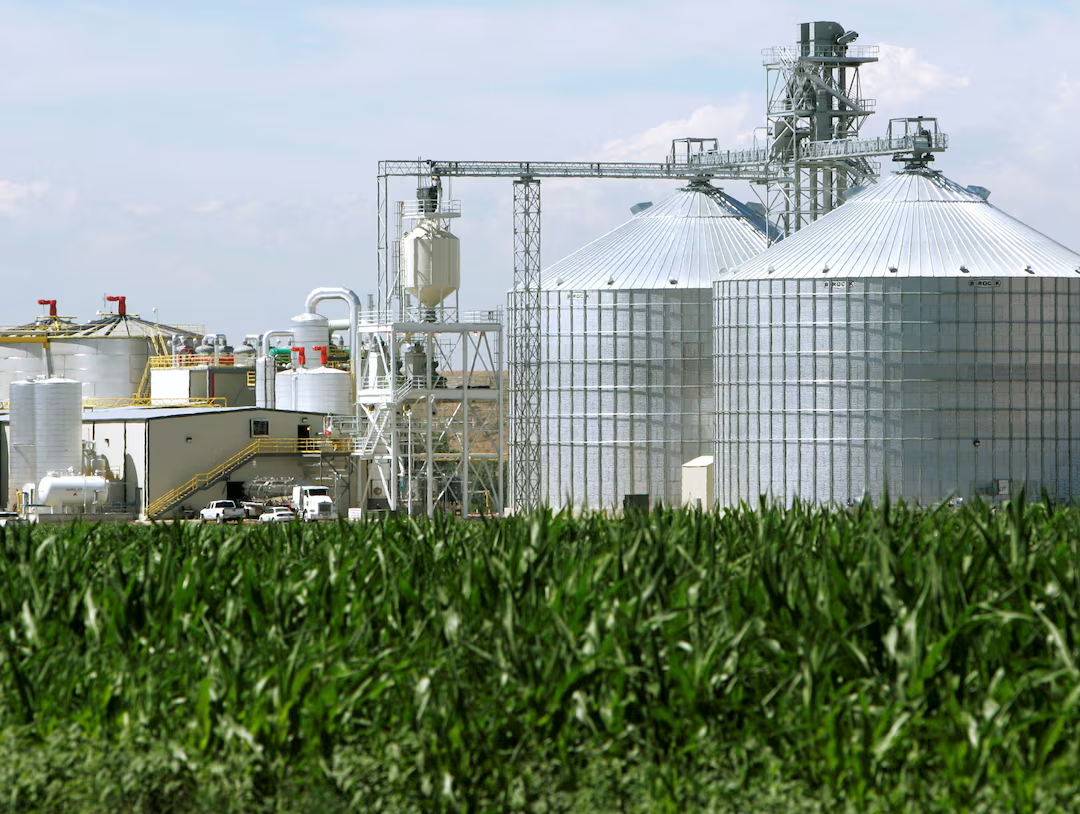
The supply-side problem is structural, not incidental. U.S. biodiesel and renewable diesel plants facilities that chemically process vegetable oils, animal fats, and other biological feedstocks into diesel equivalent fuels operated at approximately 77–78% of installed capacity in May 2026. The EPA's 2026 RFS mandate was constructed on a 90% capacity utilisation assumption. That 12–13 percentage point gap is the foundational error. The mandate for biomass-based diesel alone targets 7.12 billion D4 RINs D4 being the RIN credit category specific to biomass-based diesel, distinct from broader cellulosic or ethanol categories. Against an 8.86 billion total RIN obligation across all categories, the shortfall is not a marginal miss; it is a systematic undershoot baked in from the first week of the compliance year.
Three separate forces are suppressing output below even the reduced 77–78% utilisation rate the sector is achieving. First, regulatory uncertainty around the 45Z clean fuel production tax credit a federal incentive that pays producers per unit of fuel based on its carbon intensity score has delayed investment decisions at multiple plants. Operators cannot confidently underwrite capacity expansion when the rules governing their primary subsidy were unresolved for the first half of the year. Second, Iran-related crude oil price disruptions have altered the feedstock economics that govern when soy oil, tallow, or used cooking oil is more profitably converted to renewable diesel versus sold into the food or industrial oleochemical market. When crude rises, renewable diesel competes better on price but feedstock costs also rise, compressing the processing margin, called the "crush spread," between raw feedstock and finished fuel. Third and this is the structural leak the headline figures obscure a meaningful share of U.S. renewable diesel output is being shipped to export markets under pre-committed contracts, primarily to European buyers purchasing hydrotreated vegetable oil (HVO) for their own blending mandates. Exported renewable diesel generates zero D4 RINs toward U.S. obligations.
The export diversion is not irrational behaviour it is rational margin optimisation. Consider a mid-sized U.S. renewable diesel producer operating a 100 million gallon per year facility. Domestically, the blending economics might yield a net margin of roughly $0.30–$0.45 per gallon, inclusive of the D4 RIN value (currently trading in a range that implies approximately $0.25–$0.40 per gallon equivalent when converted from RIN price to per-gallon terms). An export cargo to a Rotterdam terminal, however, may offer a netback the delivered price minus freight and terminal costs, back calculated to the plant gate of $0.50–$0.60 per gallon, with no RIN obligation attached to the buyer. The spread is live and determinative. At a 10 million gallon export parcel, the difference between domestic blending and export is approximately $1–3 million per cargo. Producers with the logistics capability to serve both markets will allocate to the higher-return destination. The D4 RIN bank tightens accordingly, independent of what the plant's utilisation rate looks like on paper.
On the buy side, obligated petroleum refiners companies that refine crude oil into conventional fuels and are legally required to demonstrate annual RFS compliance bear the direct cost. Each RIN deficit must be covered either by blending renewable fuel or purchasing credits on the open market. A refiner running a 100,000 barrel per day operation faces a meaningful exposure: a sustained rise in D4 RIN prices by $0.10 per gallon equivalent translates to roughly $0.10–0.15 per barrel of total compliance cost increase across the blending pool, depending on obligation intensity. Aggregated across a year's throughput, that is tens of millions of dollars in additional compliance expenditure a number that moves earnings per share at independent refiners. Small and regional refiners without their own renewable fuel production assets have no natural hedge; they are pure buyers in a tightening credit market.
On the sell side, domestic producers of biodiesel and renewable diesel hold two simultaneous levers: the ability to capture rising D4 RIN prices on domestically blended volumes, and the ability to arbitrage the export premium on uncommitted capacity. For large integrated renewable fuel producers companies operating multi-site refinery scale HVO facilities this bifurcation creates genuine optionality. A sophisticated operator with derivatives access can sell D4 RIN forwards (locking in current elevated prices on expected future domestic production) while simultaneously running export spot tenders on uncommitted barrels. For a smaller, single-facility biodiesel cooperative or regional independent without derivatives infrastructure, the practical equivalent is negotiating longer-dated domestic offtake contracts with fixed RIN pass-through clauses, insulating them from both RIN price volatility and the logistics cost of establishing export channels they cannot efficiently service.
The revised 45Z guidance released in mid-2026 which removed certain land-use restriction requirements and expanded the incentive for soy based renewable diesel does provide a structural improvement in the investment case for new capacity. Analysts broadly characterise the change as increasing certainty for project finance on soy feedstock facilities. But new capacity takes 18–36 months to commission; it is irrelevant to the 2026 compliance calendar. The political dimension, however, is immediate. The American Fuel & Petrochemical Manufacturers (AFPM) has filed legal challenges urging mandate reconsideration. Farmers and rural-state legislators are watching RFS politics closely ahead of the 2026 midterm cycle, because RFS mandates directly support soybean and corn demand. The Trump administration is caught between its stated support for rural producers who benefit from biofuel demand and pressure from refiners facing higher compliance costs. The administration's practical response options include invoking small refinery exemptions (waivers that reduce individual obligations) or formally adjusting the mandate volume downward.
For traders and intermediaries positioned in the RIN credit market, the tightening bank is the commercial event. RIN brokers and credit aggregators firms that accumulate RINs from small blenders and resell them to obligated parties gain directly as D4 prices rise. The margin in credit intermediation concentrates when prices move; a spread of even $0.01–0.02 per RIN across a portfolio of several hundred million RINs is material revenue. The watch signal for whether export volumes redirect back to the domestic market is European HVO import demand from the U.S. specifically Rotterdam spot premiums for U.S.-origin renewable diesel. If the Atlantic HVO arbitrage closes meaning European prices soften relative to U.S. domestic netbacks plus the RIN value producers will pivot back to domestic blending without any policy intervention required. That rebalancing mechanism exists; it has simply not yet been triggered.
The time-bound signal for all operators and observers is the EPA's monthly production data release, published with approximately a six-week lag. The August 2026 release covering June production will be the first month fully reflecting post-45Z guidance certainty and any production response to elevated D4 RIN prices. If June utilisation has not moved above 80%, the 20% above peak monthly output requirement for the remainder of 2026 becomes mathematically unachievable, and market pricing will need to reflect either a formal mandate revision or a sustained D4 RIN price high enough to pull export volumes back onshore. Watch the OPIS D4 RIN daily assessment and compare it against the Rotterdam HVO CIF (cost, insurance, and freight the delivered price inclusive of shipping) spread. When the domestic RIN-inclusive margin exceeds the European export netback by more than $0.05 per gallon on a sustained basis, the export diversion structural leak will begin to self-correct.



.jpg)
.jpg)


'%3e%3cg id='Final-Copy-2_2_' transform='translate(1275.000000, 200.000000)'%3e%3cpath class='st0' d='M7.4,12.8h6.8l3.1-11.6H7.4C4.2,1.2,1.6,3.8,1.6,7S4.2,12.8,7.4,12.8z'/%3e%3c/g%3e%3c/g%3e%3c/g%3e%3cg id='final---dec.11-2020'%3e%3cg id='_x30_208-our-toggle' transform='translate(-1275.000000, -200.000000)'%3e%3cg id='Final-Copy-2' transform='translate(1275.000000, 200.000000)'%3e%3cpath class='st1' d='M22.6,0H7.4c-3.9,0-7,3.1-7,7s3.1,7,7,7h15.2c3.9,0,7-3.1,7-7S26.4,0,22.6,0z M1.6,7c0-3.2,2.6-5.8,5.8-5.8 h9.9l-3.1,11.6H7.4C4.2,12.8,1.6,10.2,1.6,7z'/%3e%3cpath id='x' class='st2' d='M24.6,4c0.2,0.2,0.2,0.6,0,0.8l0,0L22.5,7l2.2,2.2c0.2,0.2,0.2,0.6,0,0.8c-0.2,0.2-0.6,0.2-0.8,0 l0,0l-2.2-2.2L19.5,10c-0.2,0.2-0.6,0.2-0.8,0c-0.2-0.2-0.2-0.6,0-0.8l0,0L20.8,7l-2.2-2.2c-0.2-0.2-0.2-0.6,0-0.8 c0.2-0.2,0.6-0.2,0.8,0l0,0l2.2,2.2L23.8,4C24,3.8,24.4,3.8,24.6,4z'/%3e%3cpath id='y' class='st3' d='M12.7,4.1c0.2,0.2,0.3,0.6,0.1,0.8l0,0L8.6,9.8C8.5,9.9,8.4,10,8.3,10c-0.2,0.1-0.5,0.1-0.7-0.1l0,0 L5.4,7.7c-0.2-0.2-0.2-0.6,0-0.8c0.2-0.2,0.6-0.2,0.8,0l0,0L8,8.6l3.8-4.5C12,3.9,12.4,3.9,12.7,4.1z'/%3e%3c/g%3e%3c/g%3e%3c/g%3e%3c/g%3e%3c/svg%3e) Privacy Choices
Privacy Choices