.avif)
By the time San Mateo Midstream closes this deal targeted July 31, 2026 midstream operators across the Delaware Basin will be competing against a gathering and processing network that has just grown by 320 million cubic feet per day of inlet capacity and 145 miles of pipeline, backed by a balance sheet that can now serve nine additional third-party customers who previously flowed through a rival system.
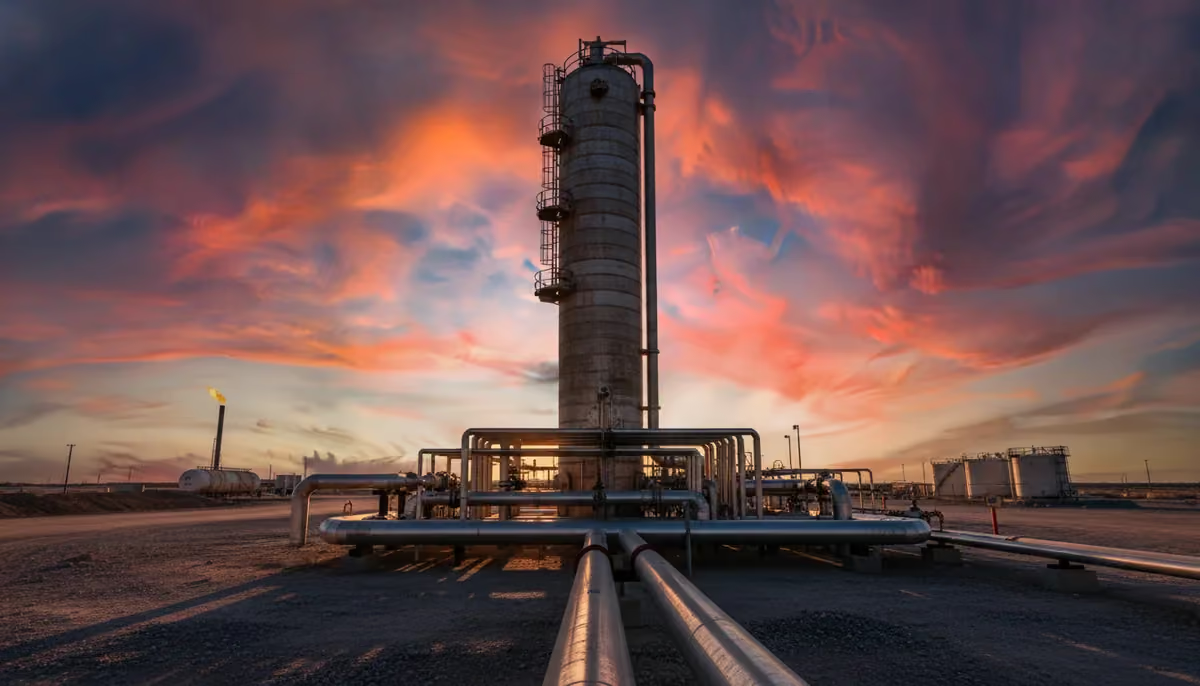
The physical asset being acquired is Cardinal Midstream Partners' cryogenic processing plant complex in Loving County, Texas Loving County sits in the heart of the northern Delaware Basin, one of the most productive natural gas and oil plays in the United States. A cryogenic plant (one that uses ultra-low temperatures, typically below minus 100°C, to separate methane from heavier hydrocarbon liquids) is the most capital intensive and technically capable processing configuration available. Cardinal's complex sits on roughly 75 acres and is designed to handle approximately 320 MMcf/d of inlet gas the raw, unprocessed gas arriving from wellheads via gathering pipeline. Alongside the plant, Cardinal brings roughly 145 miles of low and high-pressure gathering pipelines the arteries that physically collect gas from individual wells and route it to processing plus two residue gas takeaway connections (for processed, pipeline-quality gas) and four NGL takeaway connections (for the natural gas liquids propane, butane, ethane separated during cryogenic processing). These connections to downstream markets are often harder to replicate than the processing plant itself.
The financing structure is where the intelligence is. San Mateo Midstream a joint venture (JV) that is 51% owned by Matador Resources and 49% owned by Five Point Infrastructure will fund the acquisition through a new term loan of up to $650 million drawn under San Mateo's existing credit facility. Matador describes the transaction as "cash neutral" at the parent level, meaning no new equity cheque leaves Matador's own treasury. But the debt sits at the JV level, not on Matador's consolidated balance sheet. This structural placement matters: Five Point's 49% stake in San Mateo means it absorbs a proportionate share of the debt service, yet Matador, as the 51% controlling partner, drives operational and commercial decisions. More importantly, Matador is simultaneously counting on distributions from San Mateo to help service that same loan a circularity that creates real sensitivity to volume performance. If the nine new third-party customers do not ramp as projected, distributions compress precisely when debt obligations do not.
Run the revenue arithmetic and the deal logic clarifies. At typical Delaware Basin gathering and processing fees which range from approximately $0.40 to $0.80 per thousand cubic feet (Mcf) of gas handled Cardinal's 320 MMcf/d of designed inlet capacity, if fully utilised, would generate between $46 million and $93 million per year in incremental fee-based EBITDA (earnings before interest, taxes, depreciation, and amortisation the standard measure of cash-generating power for infrastructure assets). At a $752 million acquisition price, that implies a purchase multiple of roughly 8 to 16 times EBITDA depending on utilisation. Full utilisation is the optimistic case. The nine incoming customers represent contracted dedications that have not been publicly disclosed in volume or term detail. A midstream operator stress-testing this deal should model at 60–70% utilisation in year one approximately $28–55 million of incremental EBITDA against annual debt service on a $650 million term loan that, at current secured lending rates of approximately 6.5–7%, implies interest costs alone of $42–45 million per year. The margin of comfort is not wide.
On the sell side, EnCap Flatrock Midstream the private equity firm that built Cardinal exits what by all physical metrics is a high-quality asset in a high-growth basin. The timing is deliberate: Delaware Basin gas production is growing rapidly as operators develop the Wolfcamp and Bone Spring formations, and private midstream infrastructure in dedicated gathering corridors commands premium valuations from strategic buyers like Matador who need controlled infrastructure to support their own upstream drilling programmes. EnCap Flatrock realises a clean exit at a moment when buyer appetite for Delaware Basin midstream is structurally elevated. Whether they exit at peak valuation depends on whether Delaware Basin throughput continues its trajectory through 2027–2028; if it does, $752 million may prove conservative. On the buy side, San Mateo secures not just the physical plant but nine commercial relationships customers who were previously flowing gas through a competitor's system and will now be locked into San Mateo's fee structures. Third-party volumes are the currency of midstream valuation.
The competitive implications differ sharply by operator scale. For a large integrated midstream operator a Williams Companies, a Targa Resources, or a large privately backed gatherer with its own derivatives overlay and balance sheet depth the Cardinal acquisition signals that San Mateo is now a serious third-party competitor across the northern Delaware, not just a captive gatherer for Matador's own acreage. Acreage dedications (contractual commitments by a producer to route all gas from a defined area through a specific gatherer) that come up for renewal in the 2027–2029 window will now face a San Mateo bid supported by Cardinal's physical footprint. Incumbency advantage erodes where two gathering systems overlap. For a smaller regional midstream operator a single-plant processor or a sub 100 mile gatherer serving a handful of producers in Eddy or Lea County, New Mexico the practical signal is more immediate: San Mateo can now offer bundled gathering, processing, residue takeaway, and NGL marketing across a wider corridor. Competing for new producer dedications on price alone, without equivalent connectivity, becomes structurally harder.
The specific signal to watch is San Mateo's Q3 2026 volume disclosure, expected in Matador's third-quarter earnings release approximately October–November 2026. That will be the first post-close data point on whether the nine new Cardinal customers are flowing at or above pre-acquisition rates, and whether incremental third-party volumes are materialising on the expanded 145 mile pipeline system. Watch also the Hart Energy Midstream Monitor's monthly Delaware Basin throughput data if basin-wide processing utilisation stays above 85% through Q3 2026, the volume assumptions underpinning San Mateo's debt service calculus are well-supported. If utilisation softens toward 70%, the circularity in the financing structure distributions funding the loan that funded the deal moves from theoretical risk to live pressure. The close date of July 31, 2026, gives the market a clean before and after comparison by the time autumn earnings season arrives.

.jpg)

'%3e%3cg id='Final-Copy-2_2_' transform='translate(1275.000000, 200.000000)'%3e%3cpath class='st0' d='M7.4,12.8h6.8l3.1-11.6H7.4C4.2,1.2,1.6,3.8,1.6,7S4.2,12.8,7.4,12.8z'/%3e%3c/g%3e%3c/g%3e%3c/g%3e%3cg id='final---dec.11-2020'%3e%3cg id='_x30_208-our-toggle' transform='translate(-1275.000000, -200.000000)'%3e%3cg id='Final-Copy-2' transform='translate(1275.000000, 200.000000)'%3e%3cpath class='st1' d='M22.6,0H7.4c-3.9,0-7,3.1-7,7s3.1,7,7,7h15.2c3.9,0,7-3.1,7-7S26.4,0,22.6,0z M1.6,7c0-3.2,2.6-5.8,5.8-5.8 h9.9l-3.1,11.6H7.4C4.2,12.8,1.6,10.2,1.6,7z'/%3e%3cpath id='x' class='st2' d='M24.6,4c0.2,0.2,0.2,0.6,0,0.8l0,0L22.5,7l2.2,2.2c0.2,0.2,0.2,0.6,0,0.8c-0.2,0.2-0.6,0.2-0.8,0 l0,0l-2.2-2.2L19.5,10c-0.2,0.2-0.6,0.2-0.8,0c-0.2-0.2-0.2-0.6,0-0.8l0,0L20.8,7l-2.2-2.2c-0.2-0.2-0.2-0.6,0-0.8 c0.2-0.2,0.6-0.2,0.8,0l0,0l2.2,2.2L23.8,4C24,3.8,24.4,3.8,24.6,4z'/%3e%3cpath id='y' class='st3' d='M12.7,4.1c0.2,0.2,0.3,0.6,0.1,0.8l0,0L8.6,9.8C8.5,9.9,8.4,10,8.3,10c-0.2,0.1-0.5,0.1-0.7-0.1l0,0 L5.4,7.7c-0.2-0.2-0.2-0.6,0-0.8c0.2-0.2,0.6-0.2,0.8,0l0,0L8,8.6l3.8-4.5C12,3.9,12.4,3.9,12.7,4.1z'/%3e%3c/g%3e%3c/g%3e%3c/g%3e%3c/g%3e%3c/svg%3e) Privacy Choices
Privacy Choices