.avif)
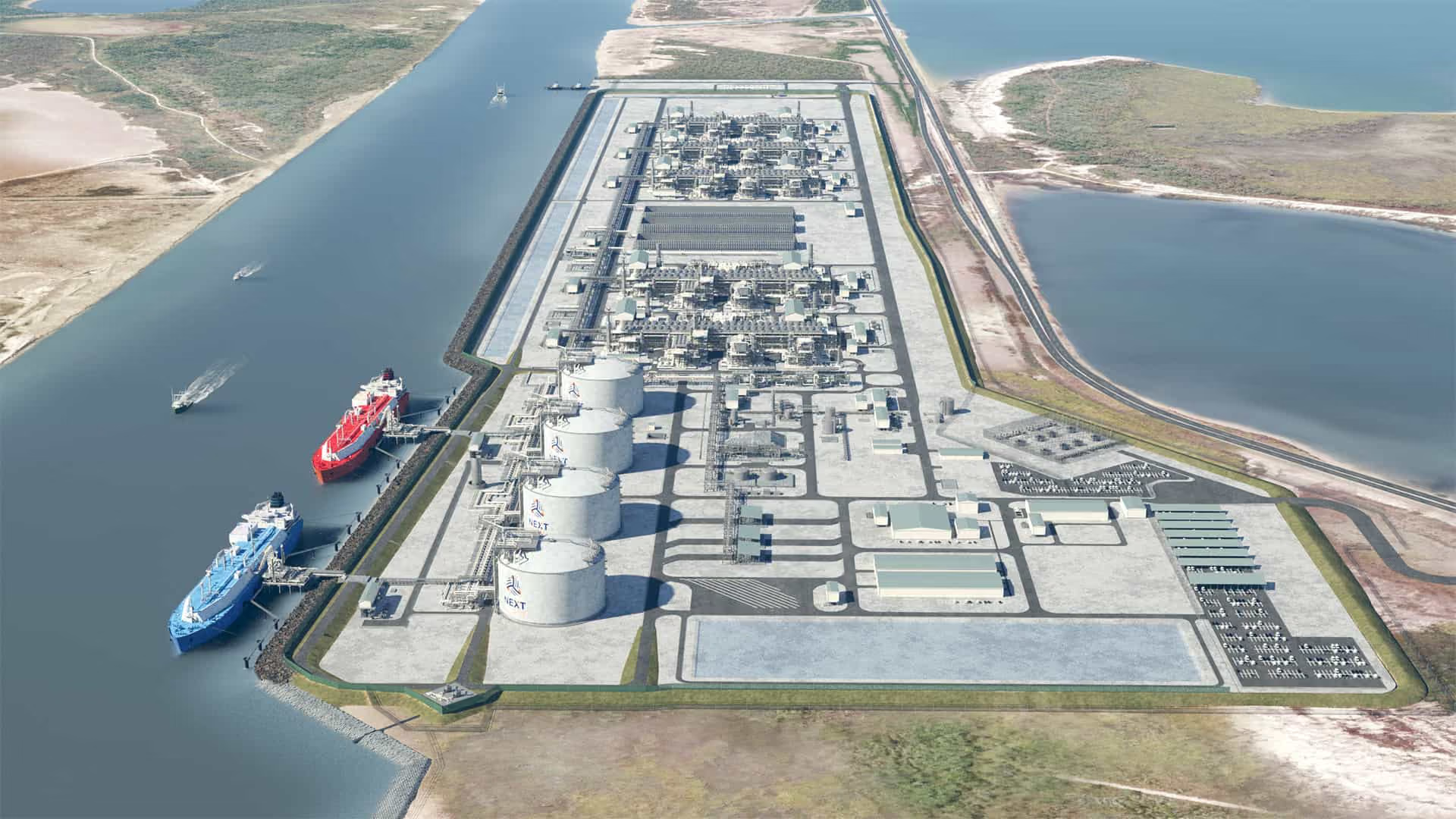
Abu Dhabi's XRG has locked in equity economics on approximately 5.7 MTPA of U.S. LNG output around $3–5 per MMBtu of net margin per cargo at current spreads effective from commercial production commencing in 2027, reshaping how a meaningful slice of Rio Grande LNG's capacity will reach global markets.
The deal's structure matters as much as its size. XRG already held an indirect 11.7% stake in Rio Grande LNG Trains 1–3 through an earlier transaction. The new acquisition adds a 7.6% interest in Trains 4 and 5, held via an investment vehicle managed by Global Infrastructure Partners (GIP) a major infrastructure fund now operating as a BlackRock affiliate. That GIP intermediation is not a technicality. When equity is held through a managed fund vehicle rather than a direct project agreement, the investor's governance rights, offtake linkage, and dispute resolution position are all mediated through the fund's structure. XRG does not sit at the project table directly for Trains 4 and 5 in the same way a direct equity partner would. Trains 4 and 5 are still under construction and trail Trains 1–3 materially in completion timeline; first gas across the facility is targeted for the second half of 2026, with full LNG production on all trains commencing in 2027. Rio Grande LNG is located at Brownsville, Texas, on the Gulf of Mexico one of the southernmost U.S. LNG export points and at full build-out is planned to reach approximately 30 MTPA (million tonnes per annum) of liquefaction capacity, making it one of the largest single LNG export facilities in the world.
The margin anatomy embedded in XRG's position is worth decomposing precisely, because the numbers are what make this strategically significant. Henry Hub the U.S. natural gas pricing benchmark, located in Louisiana, which sets the feedstock cost for American LNG liquefaction is currently trading around $3.50 per MMBtu (million British thermal units, the standard energy content measure for gas). JKM the Japan-Korea Marker, the spot price benchmark for LNG delivered to Northeast Asia is currently in the $12–14/MMBtu range. Liquefaction tolling (the fee charged to convert gas to liquid form for export) plus shipping costs absorbs roughly $4–5/MMBtu depending on route. That leaves a net margin of $3–5/MMBtu at equity cost basis. XRG's 19.3% share of 30 MTPA equates to roughly 5.7 MTPA of entitlement. At a mid-case $4/MMBtu net margin, across 5.7 MTPA, the annual margin value at full production is approximately $760 million per year before financing costs, but illustrating why Gulf sovereign capital has moved aggressively into U.S. LNG equity rather than simply signing long-term supply contracts.
On the buy side, the immediate question is what this means for LNG cargo availability in spot and short-term markets. Equity LNG production tied to a sovereign investor's own supply strategy tends to flow to preferred destinations rather than being optimised against the daily spot price. XRG's UAE base, combined with its stated focus on South Asian and broader Asian market access, suggests Rio Grande LNG cargoes carrying XRG's equity entitlement may preferentially route to the Arabian Gulf, India, or Pakistan rather than entering the Atlantic spot pool. For an Asian utility buyer a Japanese electric power company, an Indian state gas importer this is broadly positive: it signals committed, creditworthy supply from a U.S. facility with a Brownsville to Asia routing via the Panama Canal of roughly 9,000 nautical miles (approximately 20–22 days at laden speed). For a European portfolio buyer counting on Atlantic Basin LNG flexibility, the calculus is tighter: each tonne of U.S. LNG tied to sovereign equity routing is one tonne less available for opportunistic European tender.
On the sell side, the pressure concentrates among spot LNG traders holding flexible cargo positions. The LNG spot market cargoes not committed under long-term contracts and available for immediate or near-term delivery has historically been where independent traders and trading arms of energy majors extracted their margin, buying when supply was loose and selling into demand spikes. As more U.S. LNG capacity is absorbed into equity positions held by national oil companies and sovereign energy vehicles, the share of genuinely uncommitted, flexible supply shrinks. A mid-sized independent LNG trader one operating without the balance sheet to hold multiple floating cargoes or the long-term offtake agreements that anchor a major faces a structurally tighter opportunity set. The arbitrage windows that allowed a regional trader to buy a U.S. cargo at spot and deliver it to a premium Asian buyer still exist, but the pool of available cargoes is narrowing with each new equity deal of this type.
For a large integrated trader or national oil company trading arm a Vitol, Shell's LNG desk, or a trading subsidiary of a Gulf NOC the correct response is to treat XRG's Trains 4 and 5 construction timeline as a live execution risk and price that risk into any forward position. Trains 4 and 5 at Rio Grande LNG are still under construction. Texas Gulf Coast LNG projects have a documented history of contractor cost pressures and schedule slippage Sabine Pass, Corpus Christi, and Freeport LNG all experienced construction delays of six months to two years versus original schedules. A swap position on JKM basis (buying JKM forward and selling Henry Hub forward) locks in the spread but leaves the trader exposed to delivery timing risk if trains slip. The hedge instrument of choice for a well-resourced desk is a combination of JKM-TTF basis swap TTF is the Dutch Title Transfer Facility, the European gas benchmark and a freight option on LNG tanker rates, which can spike sharply when multiple trains commission simultaneously and compete for vessel availability. For a smaller regional LNG importer or gas utility without derivatives access, the practical equivalent is to pursue bilateral term supply discussions now, before 2027 production commences, specifying flexible destination clauses explicitly because once XRG's equity volumes are committed to preferred routes, renegotiating access becomes considerably harder.
Observers should track two specific signals against a 12 month horizon. First, watch Spark LNG freight rates published daily by Spark Commodities on the US Gulf Coast to Northeast Asia route (Brownsville/Sabine Pass to Fubuki/Sodegaura). A sustained move above $80,000 per day on two-stroke TFDE vessels (modern LNG carriers using dual-fuel propulsion) in the second half of 2026 would signal that Train 1–3 commissioning is pulling vessel supply tight ahead of Trains 4–5 startup widening the window for independent traders to capture freight driven arbitrage. Second, monitor CFIUS the Committee on Foreign Investment in the United States, the U.S. government body that reviews national security implications of foreign investment disposition on any further Gulf sovereign equity acquisitions at U.S. LNG facilities. The regulatory clearance XRG received here establishes a precedent; a rejection or conditions imposed on a comparable deal in the next 12 months would signal a tightening of the aperture and limit further supply lock-up by sovereign buyers. Both signals are available to operators of any size without proprietary data systems.

.jpg)


'%3e%3cg id='Final-Copy-2_2_' transform='translate(1275.000000, 200.000000)'%3e%3cpath class='st0' d='M7.4,12.8h6.8l3.1-11.6H7.4C4.2,1.2,1.6,3.8,1.6,7S4.2,12.8,7.4,12.8z'/%3e%3c/g%3e%3c/g%3e%3c/g%3e%3cg id='final---dec.11-2020'%3e%3cg id='_x30_208-our-toggle' transform='translate(-1275.000000, -200.000000)'%3e%3cg id='Final-Copy-2' transform='translate(1275.000000, 200.000000)'%3e%3cpath class='st1' d='M22.6,0H7.4c-3.9,0-7,3.1-7,7s3.1,7,7,7h15.2c3.9,0,7-3.1,7-7S26.4,0,22.6,0z M1.6,7c0-3.2,2.6-5.8,5.8-5.8 h9.9l-3.1,11.6H7.4C4.2,12.8,1.6,10.2,1.6,7z'/%3e%3cpath id='x' class='st2' d='M24.6,4c0.2,0.2,0.2,0.6,0,0.8l0,0L22.5,7l2.2,2.2c0.2,0.2,0.2,0.6,0,0.8c-0.2,0.2-0.6,0.2-0.8,0 l0,0l-2.2-2.2L19.5,10c-0.2,0.2-0.6,0.2-0.8,0c-0.2-0.2-0.2-0.6,0-0.8l0,0L20.8,7l-2.2-2.2c-0.2-0.2-0.2-0.6,0-0.8 c0.2-0.2,0.6-0.2,0.8,0l0,0l2.2,2.2L23.8,4C24,3.8,24.4,3.8,24.6,4z'/%3e%3cpath id='y' class='st3' d='M12.7,4.1c0.2,0.2,0.3,0.6,0.1,0.8l0,0L8.6,9.8C8.5,9.9,8.4,10,8.3,10c-0.2,0.1-0.5,0.1-0.7-0.1l0,0 L5.4,7.7c-0.2-0.2-0.2-0.6,0-0.8c0.2-0.2,0.6-0.2,0.8,0l0,0L8,8.6l3.8-4.5C12,3.9,12.4,3.9,12.7,4.1z'/%3e%3c/g%3e%3c/g%3e%3c/g%3e%3c/g%3e%3c/svg%3e) Privacy Choices
Privacy Choices