.avif)
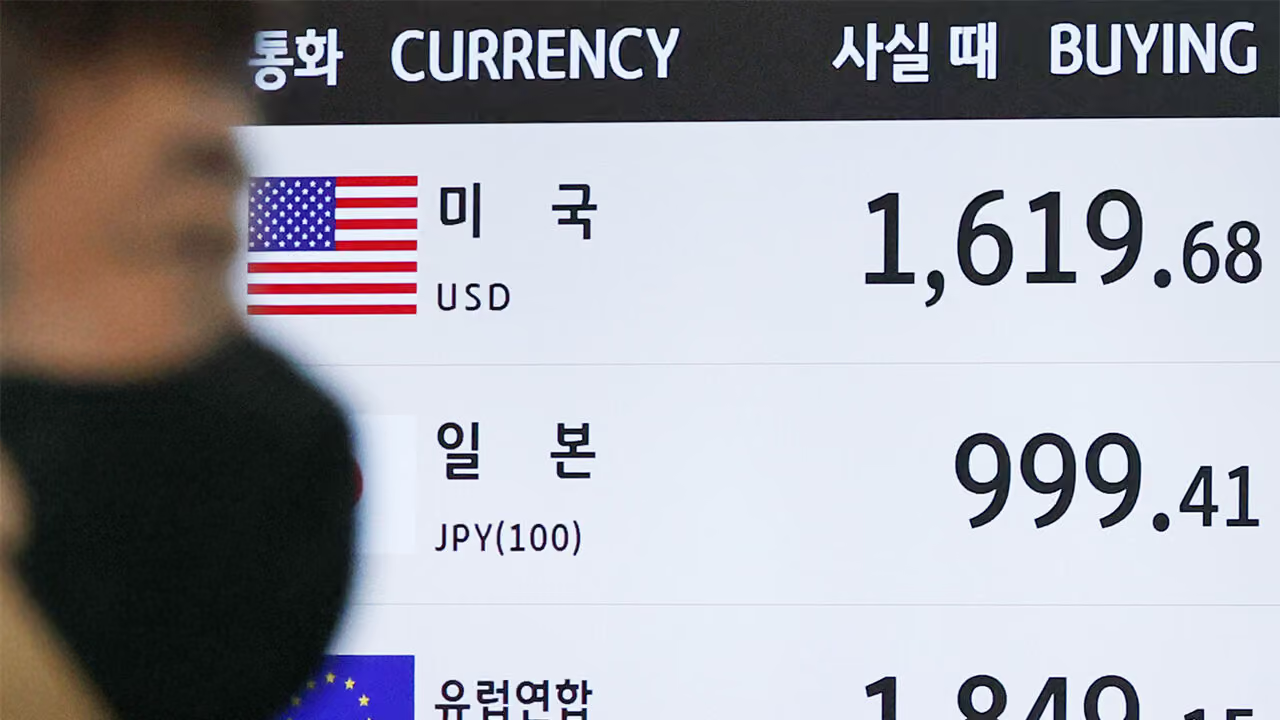
Korean SME importers facing USD denominated raw material contracts are absorbing an effective input cost increase of roughly 7–8% since January 2026 and Seoul's 14.9 trillion won emergency package, announced 3 July, is the government's most direct intervention yet to prevent that pressure from becoming a wave of small-business insolvencies.
The won South Korea's national currency has depreciated sharply this year, moving from 1,439 KRW per US dollar at end 2025 to 1,549 KRW in June 2026, a fall of roughly 7.7%. For a Korean plastics moulder buying $500,000 worth of petrochemical feedstock per month, that currency move adds approximately 55 million won to the monthly import bill money that cannot be recovered from domestic customers on short notice. The package responds to this with three instruments. First, the Export-Import Bank of Korea's crisis lending programme is expanded by 1 trillion won to a total of 8 trillion won. Second, a new "Ultra-Low Interest Coexistence Loan for Overcoming High Exchange Rates" is introduced a subsidised facility designed to reduce the borrowing cost of import financing below prevailing commercial rates. Third, and most structurally important, eligibility has been extended to firms whose raw material imports account for more than 20% of total sales, even if revenues or operating profits have not yet declined. That threshold is the package's sharpest tool: it targets companies whose margin erosion is embedded in costs, not yet visible in turnover figures.
On the buy side, Korean SME commodity importers food processors buying grain, manufacturers sourcing copper or aluminium, electronics assemblers purchasing chemical inputs gain access to financing that can bridge the gap between dollar denominated payment obligations and won denominated revenue. The critical structural problem, however, is timing. USD import contracts typically carry settlement windows of 30–60 days. State bank loan disbursement and guarantee approval processes run on multi-week administrative timelines. A firm that needs to settle a letter of credit a bank guarantee that triggers payment upon presentation of shipping documents by day 30 may not yet have received its facility approval by that date. On the sell side, commodity exporters shipping into Korea gain indirect relief: the package reduces the credit risk on Korean buyer receivables, because subsidised liquidity lowers the probability of payment default. Korean trade insurers and the Export-Import Bank intermediaries processing the expanded guarantee volumes also accumulate fee income from higher transaction throughput. The package's benefits, in other words, are not symmetrically distributed: the financing institutions gain durable revenue streams; the SME importer gains liquidity cushion that is real but time-lagged.
For a large integrated trading house a Daewoo International or a Samsung C&T commodity trading desk the package is operationally marginal. These operators already run internal FX hedging programmes using forward contracts (agreements to buy or sell currency at a fixed rate on a future date) and options, and maintain credit lines that dwarf the SME facility caps. Their relevant move is to monitor whether subsidised competition for import finance changes Korean counterparty behaviour specifically, whether SMEs extend payment terms or increase order volumes once liquidity pressure eases. For smaller regional operators a mid-sized Korean food importer, a provincial auto-parts manufacturer buying steel billet the practical priority is immediate eligibility assessment against the 20% of sales import threshold. A firm at 18% import intensity faces an eligibility cliff: identical margin pressure, no access. Those firms should document their import cost structures now, because the government has signalled that remaining funds from an earlier 23.7 trillion won package of which 13.8 trillion won is reportedly still undeployed plus an additional 1.1 trillion won, could be reallocated with adjusted criteria. Engaging industry associations to represent borderline cases is not bureaucratic box ticking; it is the margin conversation.
The forward signal to watch is the KRW/USD rate as reported daily by the Bank of Korea, specifically whether it stabilises below 1,520 or continues toward 1,580 over the next 30 days. If the won weakens further, the package's subsidy arithmetic deteriorates: ultra low interest won loans fund USD purchases at a moving exchange rate, so each additional point of won depreciation erodes the effective benefit of the interest rate discount. The interest rate differential between the subsidised facility and prevailing USD LIBOR equivalent commercial borrowing currently estimated at 150–200 basis points creates a genuine carry benefit only if the won holds. The deeper structural gap this package does not address is FX hedging capacity: most Korean SMEs do not use forward FX instruments, and the 14.9 trillion won programme builds no institutional infrastructure to change that. The package cushions the symptom. Observers should watch the Bank of Korea's daily KRW/USD fix and the Export-Import Bank's monthly disbursement data if uptake of the new loan facility runs below 30% of allocated capacity in August, the timing mismatch between commercial need and administrative process will have been confirmed in the numbers.
'%3e%3cg id='Final-Copy-2_2_' transform='translate(1275.000000, 200.000000)'%3e%3cpath class='st0' d='M7.4,12.8h6.8l3.1-11.6H7.4C4.2,1.2,1.6,3.8,1.6,7S4.2,12.8,7.4,12.8z'/%3e%3c/g%3e%3c/g%3e%3c/g%3e%3cg id='final---dec.11-2020'%3e%3cg id='_x30_208-our-toggle' transform='translate(-1275.000000, -200.000000)'%3e%3cg id='Final-Copy-2' transform='translate(1275.000000, 200.000000)'%3e%3cpath class='st1' d='M22.6,0H7.4c-3.9,0-7,3.1-7,7s3.1,7,7,7h15.2c3.9,0,7-3.1,7-7S26.4,0,22.6,0z M1.6,7c0-3.2,2.6-5.8,5.8-5.8 h9.9l-3.1,11.6H7.4C4.2,12.8,1.6,10.2,1.6,7z'/%3e%3cpath id='x' class='st2' d='M24.6,4c0.2,0.2,0.2,0.6,0,0.8l0,0L22.5,7l2.2,2.2c0.2,0.2,0.2,0.6,0,0.8c-0.2,0.2-0.6,0.2-0.8,0 l0,0l-2.2-2.2L19.5,10c-0.2,0.2-0.6,0.2-0.8,0c-0.2-0.2-0.2-0.6,0-0.8l0,0L20.8,7l-2.2-2.2c-0.2-0.2-0.2-0.6,0-0.8 c0.2-0.2,0.6-0.2,0.8,0l0,0l2.2,2.2L23.8,4C24,3.8,24.4,3.8,24.6,4z'/%3e%3cpath id='y' class='st3' d='M12.7,4.1c0.2,0.2,0.3,0.6,0.1,0.8l0,0L8.6,9.8C8.5,9.9,8.4,10,8.3,10c-0.2,0.1-0.5,0.1-0.7-0.1l0,0 L5.4,7.7c-0.2-0.2-0.2-0.6,0-0.8c0.2-0.2,0.6-0.2,0.8,0l0,0L8,8.6l3.8-4.5C12,3.9,12.4,3.9,12.7,4.1z'/%3e%3c/g%3e%3c/g%3e%3c/g%3e%3c/g%3e%3c/svg%3e) Privacy Choices
Privacy Choices