.avif)
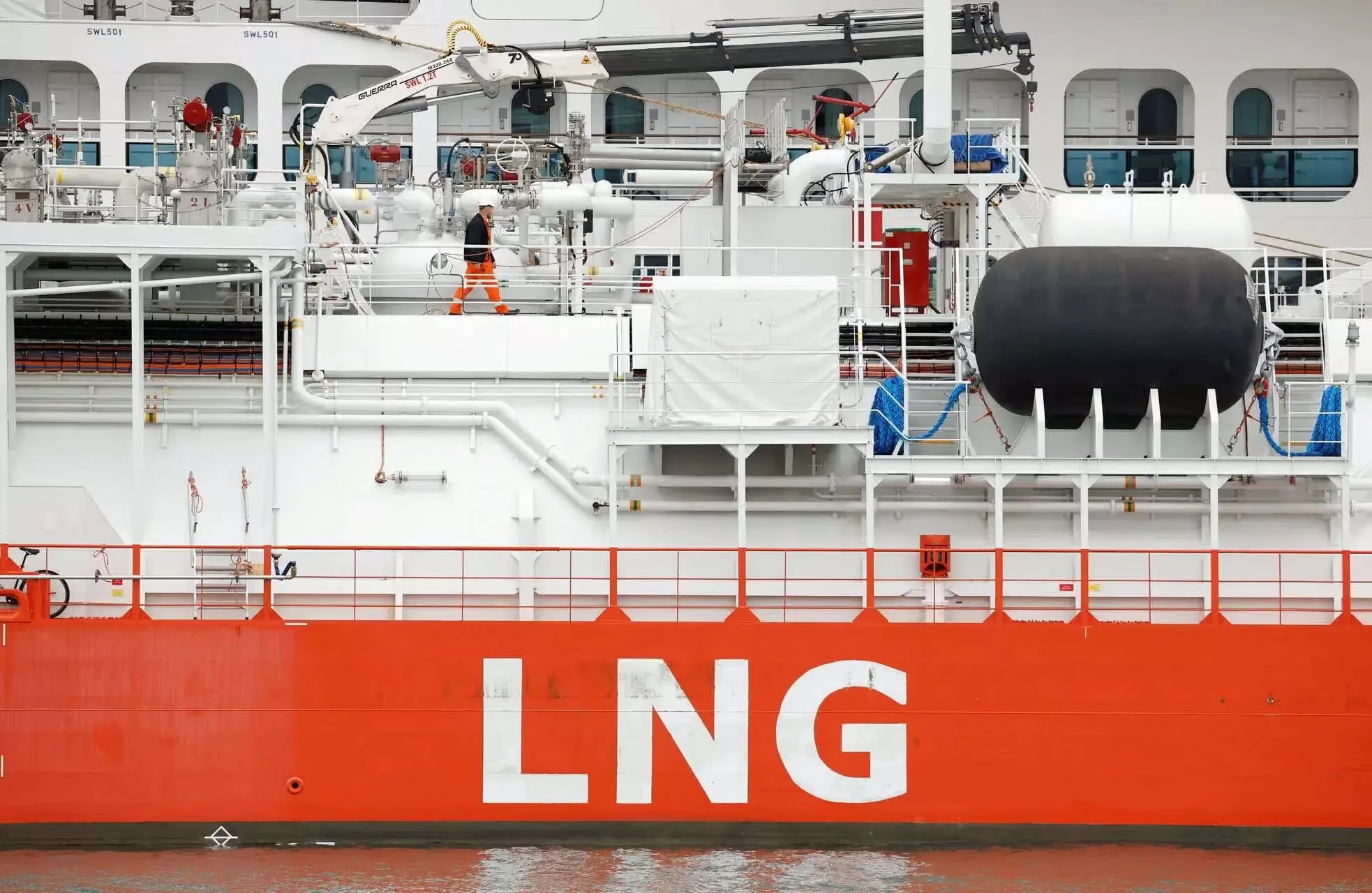
City gas distributors and fertilizer manufacturers in India stand to recover between 5% and 15% on gas procurement costs over the next one to two quarters, as the government's formal revocation of emergency gas controls on July 4, 2026 restores normal supply allocation and pricing across the country's LNG-dependent industries.
The emergency controls, introduced on March 9, 2026, were triggered by severe disruption to LNG flows through the Strait of Hormuz. When reports indicated that commercial shipping through the strait faced operational risk, India invoked sovereign emergency powers to reroute available gas supplies away from non-priority industrial users toward critical end-users: power generators, fertilizer plants, and city gas distribution networks. Suppliers, for their part, invoked force majeure a contractual clause that excuses a party from performance when events beyond their control make delivery impossible or commercially unreasonable suspending their delivery obligations without penalty. The four month emergency period imposed a two layer cost structure on downstream buyers: scarcity driven spot premiums on top of already elevated contracted volumes.
To understand what the emergency actually cost, consider a mid-sized city gas distributor say, a regional network serving 500,000 households and several hundred small commercial users. During the disruption, a distributor of this scale would typically source 0.3–0.5 million metric tonnes of LNG equivalent per year. Emergency spot procurement, when available, attracted premiums of $3–6 per million British thermal units (MMBtu the standard unit of energy used in global gas pricing) above the Japan-Korea Marker, or JKM the benchmark price for spot LNG delivered to Northeast Asia, widely used as a reference for South and Southeast Asian cargoes. At an average 0.4 MMTPA procurement volume, a $4/MMBtu emergency premium translates to approximately $55–65 million in additional annual cost, or $14–16 million per quarter. That is not a rounding error. It is a structural hit to operating margins that, for listed city gas companies like Indraprastha Gas and Mahanagar Gas, flows directly into earnings per share.
On the buy side, the normalization of allocation and pricing is unambiguously positive for fertilizer manufacturers. Urea and ammonia production is energy intensive: natural gas represents 70–80% of the cash cost of urea production. If JKM prices retrace to pre-crisis levels following Hormuz route normalization a reversion that is plausible but not guaranteed the gas linked input cost reduction could be worth $20–40 per metric tonne of fertilizer output, according to enrichment analysis. For a plant producing 1 million tonnes of urea annually, that is a $20–40 million annual cost swing. The fertilizer sector had limited ability to pass emergency input costs downstream because Indian fertilizer retail prices are regulated by the government, meaning producers absorbed the margin compression directly. Normalization restores their cost baseline without requiring a government pricing intervention.
On the sell side, the picture is more complex. LNG spot traders and brokers who built trading positions around Indian emergency demand premiums now face a reversion of the pricing floor that justified those positions. The emergency period created genuine scarcity demand: Indian buyers were willing to pay above market rates for available cargoes regardless of origin. As normal long-term contract flows from Qatar, the UAE, and Oman resume on the MEG to India route MEG referring to the Middle East Gulf, the primary LNG supply corridor for South Asian buyers spot premiums compress. Traders holding long positions in Asian spot LNG expecting sustained Indian demand will find the market moving against them. The JKM-TTF spread the difference between Asian spot LNG prices and the Title Transfer Facility benchmark used in European gas markets may also narrow as diverted cargoes return to their original Asian destinations, reducing the arbitrage opportunity that European buyers had quietly benefited from during the disruption period.
For large integrated operators the trading arms of national oil companies, or major commodity houses with derivatives access the normalization event offers a specific positioning opportunity. JKM forward contracts, traded on the Tokyo Commodity Exchange and available over the counter through major banks, can now be used to lock in post-normalization price levels before seasonal Asian demand rebuilds for winter. A large trader with access to physical cargo and financial derivatives can simultaneously fix forward sales at current JKM levels while sourcing spot cargoes at the compressed post-emergency price capturing the spread as the market re-equilibrates. The cost of a JKM swap for Q4 2026 delivery is currently a credible hedge vehicle for this purpose.
For smaller regional LNG importers and independent gas marketers without derivatives access, the practical equivalent is bilateral contract renegotiation. Any force majeure declaration made by a supplier during the March–July period remains legally active until formally withdrawn by that supplier the Indian government's revocation of sovereign emergency controls does not automatically extinguish a supplier's contractual FM claim. This is the legal gap that smaller operators must address immediately. A distributor who accepted force majeure notifications from suppliers without formal reservation of rights during the emergency period may find it harder to claim compensation for emergency procurement costs or to enforce delivery obligations retroactively. The priority action is to instruct legal counsel to issue formal notices to suppliers requesting FM withdrawal confirmation, and to document all spot procurement costs incurred during the emergency period as a foundation for any future claim or renegotiation.
The structural risk has not disappeared. The Hormuz reopening that triggered India's normalization decision reflects a de-escalation of regional tension, not its resolution. The last comparable disruption the Iran-Iraq Tanker War of the 1980s demonstrated that shipping routes through the strait can be threatened and re-threatened over multi-year periods, with freight rates tripling within weeks of each major escalation. India's emergency framework, now formally withdrawn, will need to be re-invoked by gazette notification if conditions deteriorate again, introducing a policy lag of days to weeks between a supply disruption event and the activation of protective allocation mechanisms. Buyers who normalise their procurement posture entirely returning to just-in-time inventory and minimal strategic reserves are exposed to that lag. India's energy security strategy explicitly includes diversification of import sources and domestic production expansion, but neither of these structural buffers materialises quickly enough to cover a sudden Hormuz closure.
For observers tracking this market, the signal to watch is the JKM spot price on a weekly basis through August and September 2026, specifically whether it holds below the $12–13/MMBtu range that characterized the pre-crisis baseline. A sustained move above $14/MMBtu would indicate that either regional demand is outpacing normalized supply recovery or that shipping disruption is re-emerging either of which would pressure India's city gas distributors before any new emergency framework could respond. The secondary signal is the public disclosure of force majeure withdrawal notices in quarterly filings from Indraprastha Gas and Mahanagar Gas, expected in their Q2 FY2027 results due September 2026. If FM clauses remain unresolved by that point, the contractual normalization that the government's July 4 announcement implies will not yet have reached the commercial layer where it actually matters.




'%3e%3cg id='Final-Copy-2_2_' transform='translate(1275.000000, 200.000000)'%3e%3cpath class='st0' d='M7.4,12.8h6.8l3.1-11.6H7.4C4.2,1.2,1.6,3.8,1.6,7S4.2,12.8,7.4,12.8z'/%3e%3c/g%3e%3c/g%3e%3c/g%3e%3cg id='final---dec.11-2020'%3e%3cg id='_x30_208-our-toggle' transform='translate(-1275.000000, -200.000000)'%3e%3cg id='Final-Copy-2' transform='translate(1275.000000, 200.000000)'%3e%3cpath class='st1' d='M22.6,0H7.4c-3.9,0-7,3.1-7,7s3.1,7,7,7h15.2c3.9,0,7-3.1,7-7S26.4,0,22.6,0z M1.6,7c0-3.2,2.6-5.8,5.8-5.8 h9.9l-3.1,11.6H7.4C4.2,12.8,1.6,10.2,1.6,7z'/%3e%3cpath id='x' class='st2' d='M24.6,4c0.2,0.2,0.2,0.6,0,0.8l0,0L22.5,7l2.2,2.2c0.2,0.2,0.2,0.6,0,0.8c-0.2,0.2-0.6,0.2-0.8,0 l0,0l-2.2-2.2L19.5,10c-0.2,0.2-0.6,0.2-0.8,0c-0.2-0.2-0.2-0.6,0-0.8l0,0L20.8,7l-2.2-2.2c-0.2-0.2-0.2-0.6,0-0.8 c0.2-0.2,0.6-0.2,0.8,0l0,0l2.2,2.2L23.8,4C24,3.8,24.4,3.8,24.6,4z'/%3e%3cpath id='y' class='st3' d='M12.7,4.1c0.2,0.2,0.3,0.6,0.1,0.8l0,0L8.6,9.8C8.5,9.9,8.4,10,8.3,10c-0.2,0.1-0.5,0.1-0.7-0.1l0,0 L5.4,7.7c-0.2-0.2-0.2-0.6,0-0.8c0.2-0.2,0.6-0.2,0.8,0l0,0L8,8.6l3.8-4.5C12,3.9,12.4,3.9,12.7,4.1z'/%3e%3c/g%3e%3c/g%3e%3c/g%3e%3c/g%3e%3c/svg%3e) Privacy Choices
Privacy Choices