.avif)
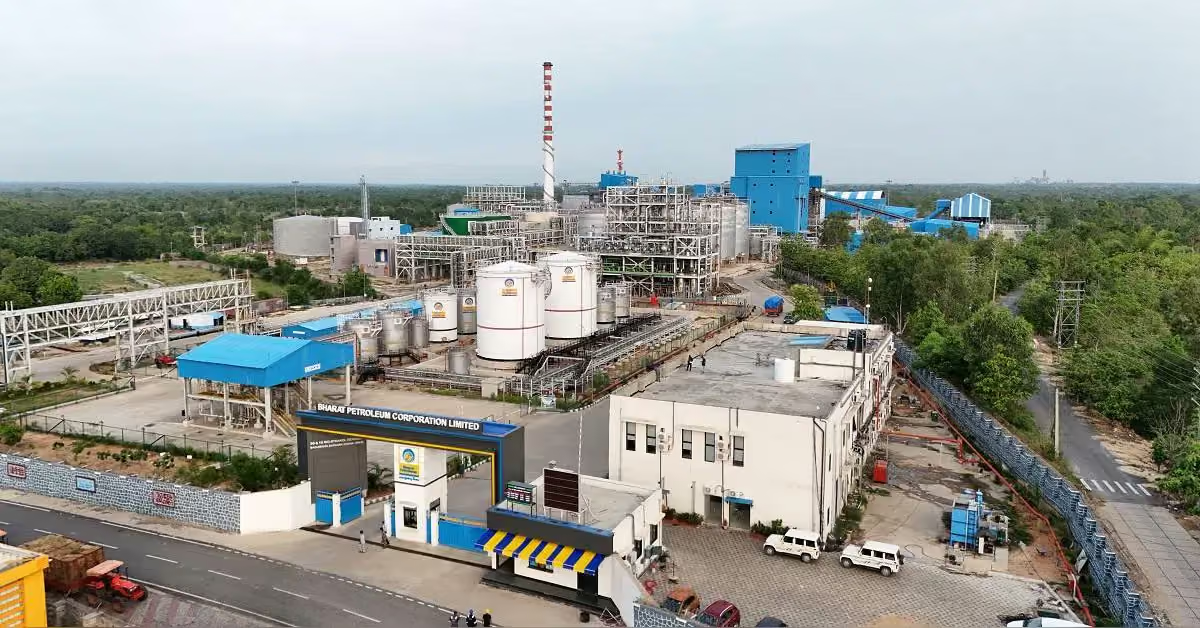
India's ethanol blending programme absorbs roughly 63 million additional litres of domestically produced fuel grade ethanol per year beginning July 2026 and the economics of producing that volume from paddy straw, not sugarcane, will determine whether this model is replicated or quietly retired.
BPCL's new integrated bio-ethanol refinery at Bargarh, in Odisha's rice-belt district of the same name, is India's first commercial facility to combine first generation (1G) and second generation (2G) ethanol production on a single site. The 1G pathway the conventional route converts broken rice (surplus grain fragments unsuitable for food markets) into fuel-grade ethanol through standard fermentation. The 2G pathway is the structural innovation: it uses paddy straw, the agricultural residue left in fields after rice harvest, as feedstock. Paddy straw is lignocellulosic meaning its energy content is locked inside cellulose and lignin structures that ordinary fermentation cannot break down. A pre-treatment stage using enzymes and heat is required to free those sugars before fermentation can begin. That pre-treatment is where the economics diverge sharply from anything India has built before. The plant processes approximately 480 tonnes of rice straw daily, sourced from roughly 1.6 lakh acres (around 160,000 acres) of surrounding farmland, at a capital cost of Rs 1,775 crore. That implies a capital intensity of approximately Rs 28 per litre of annual capacity meaningfully higher than 1G benchmarks, which typically run Rs 12–18 per litre in Indian conditions.
The margin anatomy here is the story the inauguration coverage omits. At the government's administered procurement price for 2G ethanol currently Rs 67.76 per litre and an estimated all-in production cost of Rs 55–65 per litre for the combined 1G/2G facility, BPCL operates with a gross margin of roughly Rs 3–13 per litre, or approximately $0.04–$0.16 per litre at current exchange rates. That margin is thin and entirely dependent on the administered price floor. Globally, 2G lignocellulosic ethanol has historically cost 40–60% more to produce than 1G equivalents a gap that has persisted despite two decades of pilot projects in the United States, Brazil, and Europe. India's Bargarh plant is the first in the country to attempt commercial-scale 2G production, meaning there is no domestic operating track record against which to test these cost assumptions. BPCL management will know within the first two operating quarters whether enzymatic conversion yields from Indian paddy straw match design specifications. If they don't if straw quality is inconsistent across the harvest catchment, or if enzyme costs run above plan the already narrow margin disappears.
On the buy side, Indian Oil Marketing Companies (OMCs) Indian Oil Corporation, BPCL, and HPCL are the mandated off-takers for domestically blended ethanol under the Ethanol Blended Petrol (EBP) programme. They are contractually obliged to procure at the administered price, which means their blending cost is determined by policy, not by the market. At E20 blending targets (20% ethanol in petrol by volume), each litre of 2G ethanol at Rs 67.76 displaces approximately 0.8 litres of imported petrol at current blending ratios. With petrol import parity in India running above Rs 80 per litre of refined product, the blending economics are, on paper, favourable to the OMC the administered ethanol price is below import parity. The structural benefit accrues at the national energy security level. The procurement risk for OMCs is supply reliability: a 2G facility processing agricultural residue faces seasonal feedstock availability constraints that a sugarcane-based distillery does not.
On the sell side, the Bargarh facility generates two revenue streams. The primary stream is fuel-grade ethanol sold to OMCs at the administered price. The secondary stream is DDGS distillers dried grains with solubles a protein rich animal feed co-product generated from the 1G broken-rice fermentation process. DDGS typically trades at Rs 14,000–18,000 per tonne in Indian markets, and for a plant processing several hundred tonnes of grain daily, this co-product revenue is not incidental it is a meaningful offset against variable costs. BPCL, as a national oil company with refining and marketing operations, has the balance-sheet depth to absorb initial operational losses while the 2G process stabilises. A smaller independent biofuel producer attempting to replicate this model without that backstop would face acute working capital pressure in the first 18 operating months.
For a large integrated operator an OMC like Indian Oil or HPCL considering whether to develop similar 1G+2G facilities under the JI-VAN scheme, the government programme (Jaiv Indhan-Vatavaran Anukool fasal awashesh Nivaran) that provides capital grant support for 2G ethanol projects the Bargarh plant is a live proof of concept whose operating data will be decisive. The unit economics question is: at what sustained conversion yield from paddy straw does the 2G stream become self-financing without permanent administered price dependence? The design yield assumption for cellulosic conversion in Indian conditions is roughly 280–300 litres of ethanol per tonne of dry straw. If Bargarh achieves that figure consistently over a full crop cycle, the model is replicable. If actual yields average 220–240 litres per tonne as some international 2G facilities have experienced in early operations the production cost rises by approximately Rs 8–12 per litre, and the margin turns negative at current administered prices.
For smaller regional operators state-level distilleries, agricultural cooperative processors, or regional fuel distributors considering participation in the EBP supply chain the Bargarh plant signals both an opportunity and a warning. The opportunity is structural: India's ethanol blending targets require supply volumes that centrally operated national company plants alone cannot fill. Regional distilleries with access to rice straw, sugarcane bagasse, or maize can participate in the 1G supply chain at far lower capital intensity. The warning is that 2G technology is not a bolt-on upgrade: it requires enzymatic pre-treatment infrastructure, consistent feedstock quality management, and technical expertise that is not yet widely available in India's distillery sector. The practical move for a regional cooperative is to lock in a 1G supply agreement with an OMC under the current procurement cycle procurement tenders typically run on annual cycles aligned to the sugar and grain harvest calendar and monitor Bargarh's operating data before committing capital to 2G capability.
The calibrated forward signal for observers is the BPCL quarterly operational disclosure for the Bargarh facility specifically, the reported ethanol production volume against installed capacity of 63 million litres per year, expected from Q3 FY2027 (October–December 2026) onwards. If the plant consistently operates above 75% utilisation rate in its first full crop-cycle year, the 2G conversion economics are broadly working. If utilisation tracks below 60% or if BPCL seeks an administered price revision before March 2027 that is the signal that paddy straw conversion costs have exceeded design assumptions and that the model requires structural policy support beyond current levels to remain commercially viable. Watch also for any revision to the JI-VAN scheme grant terms in the Union Budget FY2028 cycle: an upward revision in capital grant support would confirm that the government itself has concluded that 2G ethanol cannot yet stand on administered prices alone.
.jpg)


'%3e%3cg id='Final-Copy-2_2_' transform='translate(1275.000000, 200.000000)'%3e%3cpath class='st0' d='M7.4,12.8h6.8l3.1-11.6H7.4C4.2,1.2,1.6,3.8,1.6,7S4.2,12.8,7.4,12.8z'/%3e%3c/g%3e%3c/g%3e%3c/g%3e%3cg id='final---dec.11-2020'%3e%3cg id='_x30_208-our-toggle' transform='translate(-1275.000000, -200.000000)'%3e%3cg id='Final-Copy-2' transform='translate(1275.000000, 200.000000)'%3e%3cpath class='st1' d='M22.6,0H7.4c-3.9,0-7,3.1-7,7s3.1,7,7,7h15.2c3.9,0,7-3.1,7-7S26.4,0,22.6,0z M1.6,7c0-3.2,2.6-5.8,5.8-5.8 h9.9l-3.1,11.6H7.4C4.2,12.8,1.6,10.2,1.6,7z'/%3e%3cpath id='x' class='st2' d='M24.6,4c0.2,0.2,0.2,0.6,0,0.8l0,0L22.5,7l2.2,2.2c0.2,0.2,0.2,0.6,0,0.8c-0.2,0.2-0.6,0.2-0.8,0 l0,0l-2.2-2.2L19.5,10c-0.2,0.2-0.6,0.2-0.8,0c-0.2-0.2-0.2-0.6,0-0.8l0,0L20.8,7l-2.2-2.2c-0.2-0.2-0.2-0.6,0-0.8 c0.2-0.2,0.6-0.2,0.8,0l0,0l2.2,2.2L23.8,4C24,3.8,24.4,3.8,24.6,4z'/%3e%3cpath id='y' class='st3' d='M12.7,4.1c0.2,0.2,0.3,0.6,0.1,0.8l0,0L8.6,9.8C8.5,9.9,8.4,10,8.3,10c-0.2,0.1-0.5,0.1-0.7-0.1l0,0 L5.4,7.7c-0.2-0.2-0.2-0.6,0-0.8c0.2-0.2,0.6-0.2,0.8,0l0,0L8,8.6l3.8-4.5C12,3.9,12.4,3.9,12.7,4.1z'/%3e%3c/g%3e%3c/g%3e%3c/g%3e%3c/g%3e%3c/svg%3e) Privacy Choices
Privacy Choices