.avif)
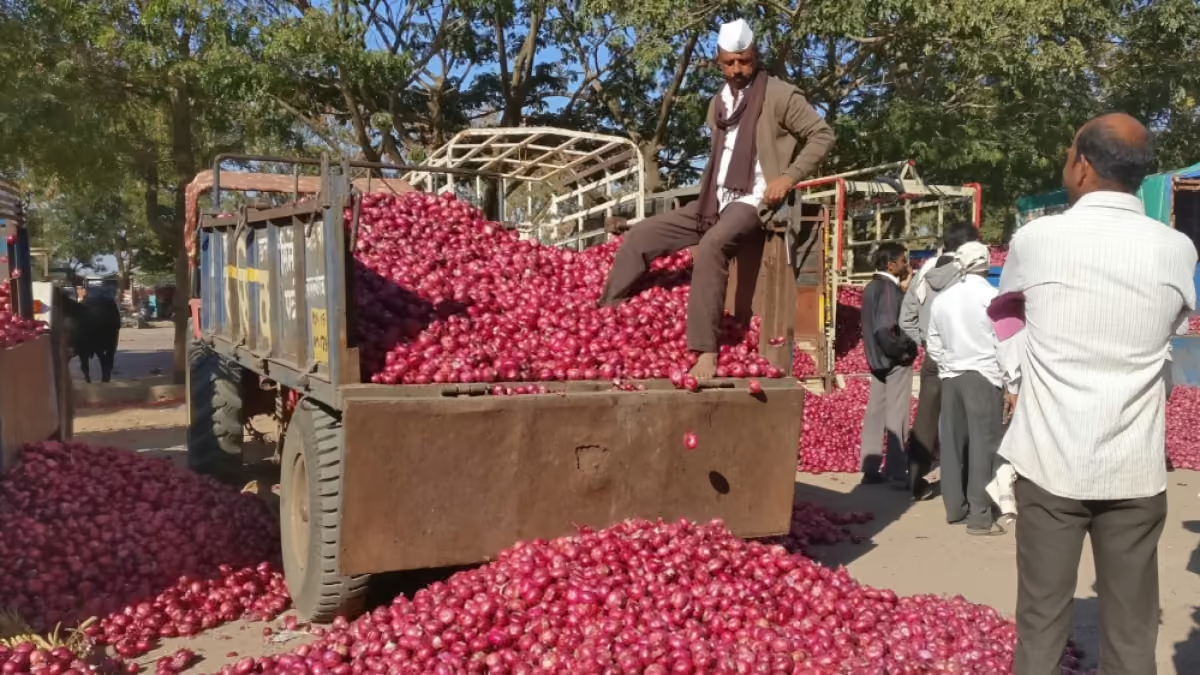
India's onion exporters and agricultural commodity traders face compressed margins starting immediately, as the government's fifth procurement price revision to Rs 2,125 per quintal (Rs 21.25/kg) collides with a near-total failure to actually accumulate buffer stock only around 2,000 metric tonnes procured since June 1, against a seasonal target of 2–3 lakh metric tonnes while competing supply from Pakistan and China simultaneously erodes India's export pricing power in Gulf and Asian markets.
The Price Stabilisation Fund (PSF) a government mechanism that buys onions from farmers through designated agencies NAFED (National Agricultural Cooperative Export and Development Authority) and NCCF (National Cooperative Exports Limited) to build buffer stocks for lean-season release is the instrument at the centre of this story. A quintal is 100 kilograms, making the procurement price Rs 21.25/kg. The problem is not the announced number. The problem is the gap between announcement and execution. Maharashtra's mandi (regulated wholesale market) modal price the price at which the largest volume of trades actually clear sits around Rs 18/kg. In theory, the government's Rs 21.25/kg offer should be attracting farmers and traders. In practice, procurement has stalled. Here is why: when a farmer or aggregator sells to NAFED or NCCF, they absorb transport costs to a designated procurement centre, agent commissions, and handling charges that typically erode Rs 3–5/kg from the headline price. Net farmer realisation under the government scheme is likely Rs 16–18/kg not better than the mandi, and with far more paperwork. The procurement price is not the effective price.
Consider the worked example to understand the scale of the problem. NAFED's seasonal target implies procuring roughly 2–3 lakh metric tonnes (200,000–300,000 MT) across the rabi and kharif seasons to maintain a functional buffer. At 2,000 MT procured by early July, that is less than 1% of the lower target. A buffer stock of 2,000 MT against India's daily mandi arrivals exceeding 50,000 MT nationwide with Maharashtra alone contributing over 30,000 MT per day represents fewer than one hour of national throughput. Any claim that buffer stock adequacy is secured must be read carefully: current adequacy rests on last season's carryover inventory, not fresh procurement. Carryover stocks age and deteriorate; fresh procurement is what sustains lean-season releases from October onwards, when the kharif crop is not yet in market. Nashik, Maharashtra's dominant onion belt and India's largest producing region, has also reported approximately a 15 day delay in kharif sowing the rainy-season planting cycle which, if weather does not recover, could push the next major crop arrival toward December rather than November, tightening the October–November window further.
On the buy side, domestic bulk buyers institutional caterers, food processors, and export packers currently benefit from the disconnect between the government's headline price and actual mandi prices. With modal Maharashtra prices around Rs 18/kg and daily arrivals robust, procurement costs remain manageable through August. The concern begins in October. On the sell side, Indian onion exporters face a two-front compression. June exports ran at approximately 1.5 lakh metric tonnes (150,000 MT); that pace is expected to soften through July–August as Pakistani and Chinese seasonal supplies enter the Gulf, Sri Lanka, and Far East markets at competitive rates. FOB (free on board the price at which goods are handed to the buyer at the port of origin, excluding freight) margins on Indian onions to Gulf destinations, which had benefited from relatively thin competition in May–June, are now being undercut. For a mid-sized Indian onion exporter shipping a 500-MT container load to Dubai, a $10–15/MT drop in achievable FOB price plausible in a three-way competitive market erases much of the margin on a cargo whose landed cost including packing and cold-chain handling runs Rs 22–26/kg. Large integrated traders with derivatives or forward contract access can hedge FOB exposure bilaterally through fixed-price forward sales agreements with Gulf importers. Smaller exporters and regional consolidators without that access should lock current-level term pricing with established Gulf buyers now, before Pakistani and Chinese volume peaks in late July.
For observers tracking whether this buffer stock failure becomes a lean-season price event, the signal to watch is NAFED's weekly procurement disclosure against the Rs 2,125/quintal benchmark through the month of July. If cumulative procurement does not reach 50,000 MT by July 31 less than 2% of the lower seasonal target the government will face a choice between a sixth price revision (likely above Rs 22/kg to clear logistics friction) or accepting that lean season buffer releases will draw from ageing carryover stock, with quality degradation risk. A sixth revision above mandi levels would open a genuine arbitrage: traders supplying NAFED and NCCF at above market rates. Watch also the Lasalgaon APMC (Agricultural Produce Market Committee) daily modal price report Lasalgaon in Nashik district is India's largest onion wholesale market and the most reliable single price reference for any sustained move above Rs 20/kg before September, which would signal that mandi prices are converging upward toward the procurement offer and that buffer accumulation has genuinely begun.
.jpg)
.avif)
'%3e%3cg id='Final-Copy-2_2_' transform='translate(1275.000000, 200.000000)'%3e%3cpath class='st0' d='M7.4,12.8h6.8l3.1-11.6H7.4C4.2,1.2,1.6,3.8,1.6,7S4.2,12.8,7.4,12.8z'/%3e%3c/g%3e%3c/g%3e%3c/g%3e%3cg id='final---dec.11-2020'%3e%3cg id='_x30_208-our-toggle' transform='translate(-1275.000000, -200.000000)'%3e%3cg id='Final-Copy-2' transform='translate(1275.000000, 200.000000)'%3e%3cpath class='st1' d='M22.6,0H7.4c-3.9,0-7,3.1-7,7s3.1,7,7,7h15.2c3.9,0,7-3.1,7-7S26.4,0,22.6,0z M1.6,7c0-3.2,2.6-5.8,5.8-5.8 h9.9l-3.1,11.6H7.4C4.2,12.8,1.6,10.2,1.6,7z'/%3e%3cpath id='x' class='st2' d='M24.6,4c0.2,0.2,0.2,0.6,0,0.8l0,0L22.5,7l2.2,2.2c0.2,0.2,0.2,0.6,0,0.8c-0.2,0.2-0.6,0.2-0.8,0 l0,0l-2.2-2.2L19.5,10c-0.2,0.2-0.6,0.2-0.8,0c-0.2-0.2-0.2-0.6,0-0.8l0,0L20.8,7l-2.2-2.2c-0.2-0.2-0.2-0.6,0-0.8 c0.2-0.2,0.6-0.2,0.8,0l0,0l2.2,2.2L23.8,4C24,3.8,24.4,3.8,24.6,4z'/%3e%3cpath id='y' class='st3' d='M12.7,4.1c0.2,0.2,0.3,0.6,0.1,0.8l0,0L8.6,9.8C8.5,9.9,8.4,10,8.3,10c-0.2,0.1-0.5,0.1-0.7-0.1l0,0 L5.4,7.7c-0.2-0.2-0.2-0.6,0-0.8c0.2-0.2,0.6-0.2,0.8,0l0,0L8,8.6l3.8-4.5C12,3.9,12.4,3.9,12.7,4.1z'/%3e%3c/g%3e%3c/g%3e%3c/g%3e%3c/g%3e%3c/svg%3e) Privacy Choices
Privacy Choices