.avif)
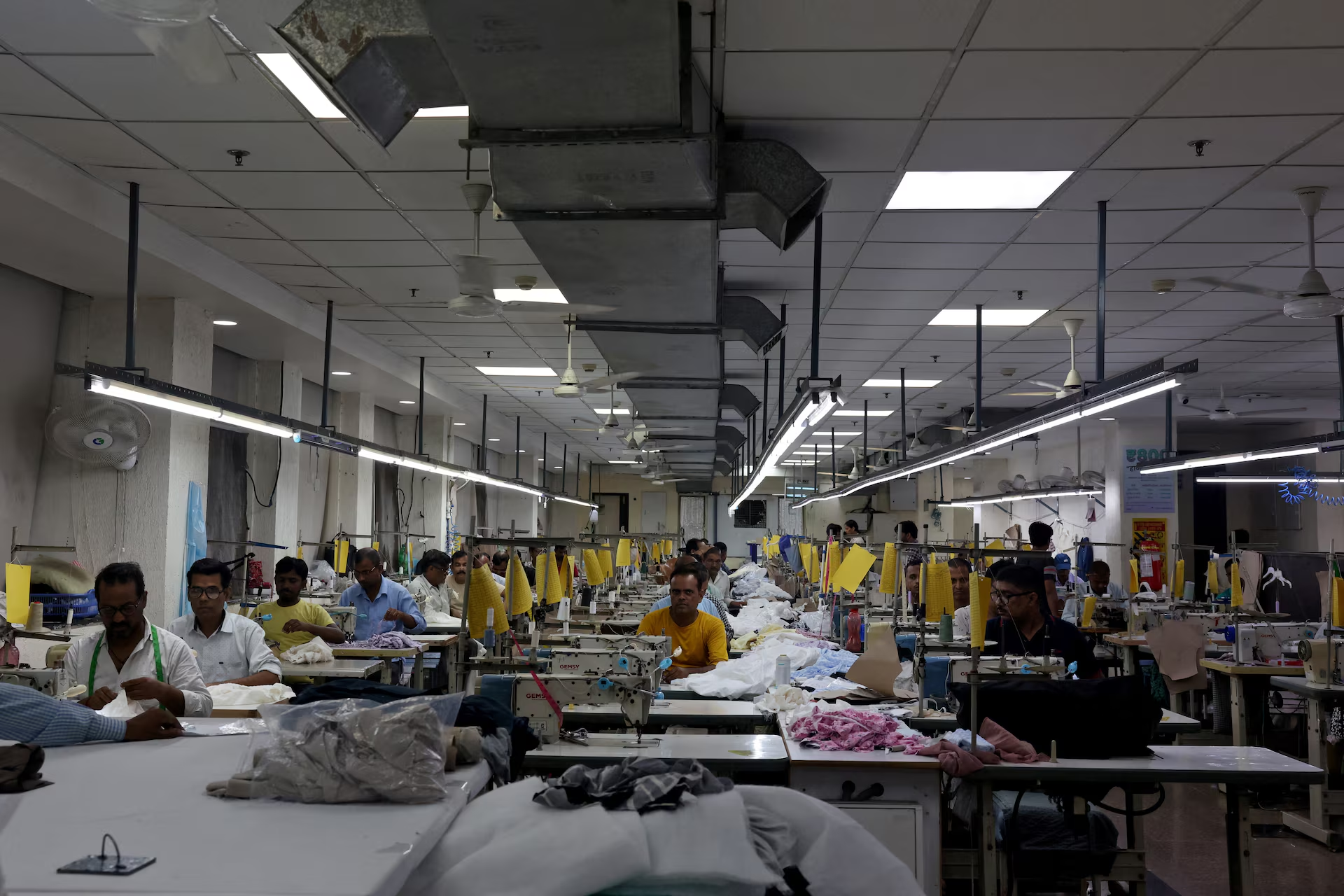
Bulk commodity exporters shipping into India face a measurably softer demand environment from June 2026, with the HSBC India composite PMI the Purchasing Managers' Index, a monthly survey based measure of private sector activity where any reading above 50 signals expansion falling to 57.4, its weakest reading in three months. That headline number still describes an expanding economy, but the directional shift inside it matters more to exporters than the absolute level: manufacturing export orders, a reliable leading indicator of import demand for industrial inputs, grew at their slowest pace since March 2023. For bulk commodity exporters of chemicals, fertiliser precursors, metallurgical coal, or edible oils who have built volume assumptions around India's recent growth trajectory, the June data is the first credible signal that order books may thin over the next 60–90 days.
The PMI's internal architecture reveals where the cooling is concentrated. Purchasing activity the rate at which Indian manufacturers buy inputs rose at its slowest pace in two and a half years, directly compressing near-term import pull. Inventories of finished goods declined, which sounds counterintuitive until you understand the mechanism: when manufacturers expect softer demand ahead, they run down finished goods stocks rather than accumulate them, and simultaneously slow raw material procurement. The order to inventory ratio did tick up marginally, preserving some pipeline signal, but the pace of new orders was the weakest in months. For an exporter of, say, chemical intermediates or industrial grade urea, the practical implication is that Indian buyers are likely to defer spot purchase decisions, push back on volume commitments, and lean harder on existing contract positions rather than open new ones.
Here is what the margin compression looks like in practice. Consider a mid-sized Southeast Asian exporter of paraxylene a petrochemical feedstock used in polyester production shipping a 5,000 tonne cargo to a private-sector Indian textile manufacturer. At a delivered margin of $35–40 per metric tonne (MT), the trade is viable. Softer Indian manufacturing demand, coinciding with three consecutive months of easing input cost inflation (input costs across the Indian private sector rose at their slowest pace in five months in June), means Indian buyers now have both the incentive and the negotiating leverage to demand a $10–15/MT price concession. That single shift moves the trade from thin but viable to marginal, particularly when freight costs on a small parcel voyage from Straits ports to Mumbai or Hazira are running $18–22/MT. The margin evaporates. The cargo either waits for a better window or seeks alternative destinations Southeast Asia, Europe, or East Africa each of which carries its own basis risk.
The buy-side and sell-side positions here diverge sharply. On the buy side, Indian private sector importers mid-sized manufacturers of textiles, plastics, and light industrial goods gain a rare window of pricing leverage. Easing input cost inflation means their landed cost economics have improved by an estimated 2–4% depending on commodity class, and weakening demand gives them cover to renegotiate quarterly supply contracts downward. They will use it. On the sell side, bulk commodity exporters and their trading intermediaries face a compression of absorption: fixed production and logistics costs do not decline with volume, so a 10–15% softening in order pace hits margins disproportionately. A chemical plant running at 85% capacity rather than 95% does not save 10% of its costs it saves perhaps 3–4%, while its per-unit cost rises across the remaining volume.
Not all commodity flows into India transmit the PMI signal equally, and this asymmetry is critical for exporters to understand. State-directed procurement which accounts for the bulk of India's crude oil imports (approximately 5 million barrels per day), urea fertiliser, and palm oil operates on government mandates, long-term contracts, and strategic buffer requirements. Indian Oil Corporation, BPCL, and HPCL do not adjust crude import volumes in response to a single month's PMI reading. National Cooperative Exports Limited and state-run fertiliser entities procure urea against kharif and rabi agricultural season requirements, not private sector sentiment surveys. The PMI driven demand softening therefore hits discretionary industrial commodity imports hardest: specialty chemicals, polymer feedstocks, metal alloys, and consumer-facing food ingredients. Exporters in those categories are directly exposed. Exporters of crude, urea, or edible oils into state channels are largely insulated in the near term.
For large integrated traders a Trafigura, Louis Dreyfus, or an Asian national oil company's trading arm the appropriate response is to review their India-specific basis positions. Basis risk here means the spread between global benchmark prices (say, ICE Brent for naphtha, or CBOT soybeans for edible oils) and Indian import parity prices, adjusted for freight. If services export resilience supports a relatively firm INR the Indian rupee while manufacturing demand softness cools commodity import volumes, a temporary compression of import parity premiums may open a short-window arbitrage for basis traders. Large operators with derivatives access can hedge this through India specific freight forward agreements (FFAs) on the relevant routes, or through over the counter options on commodity differentials. For smaller regional operators a mid-sized Indonesian palm oil trader, a Vietnamese chemical distributor, a Sri Lankan fertiliser importer-exporter the practical equivalent is simpler but no less important: do not commit to new volume at current price levels on the assumption that Indian buyers will absorb at prevailing terms. Fix pricing bilaterally, shorten contract duration to 30–45 days rather than quarterly, and maintain the flexibility to redirect cargo if Indian buyers push below breakeven.
The signal to watch is specific and time-bound. Monitor the HSBC India Manufacturing PMI published on the first business day of each month for any further deterioration in the new export orders sub-index below its current reading. A second consecutive monthly decline would confirm a demand deceleration rather than a one-month statistical fluctuation, and would justify revising India volume assumptions for Q3 2026 procurement planning. Alongside that, track the INR/USD rate and India's Directorate General of Commercial Intelligence and Statistics (DGCI&S) monthly import data for the chemicals and petroleum categories, which typically releases with a 45-day lag. If the July PMI new orders sub-index holds above 54 and the INR remains firm, the current softening is a pause within a still-expanding cycle exporters should hold positions but negotiate conservatively. If the sub-index falls further, it is time to reprice, redirect, and wait.



.jpg)
.jpg)


'%3e%3cg id='Final-Copy-2_2_' transform='translate(1275.000000, 200.000000)'%3e%3cpath class='st0' d='M7.4,12.8h6.8l3.1-11.6H7.4C4.2,1.2,1.6,3.8,1.6,7S4.2,12.8,7.4,12.8z'/%3e%3c/g%3e%3c/g%3e%3c/g%3e%3cg id='final---dec.11-2020'%3e%3cg id='_x30_208-our-toggle' transform='translate(-1275.000000, -200.000000)'%3e%3cg id='Final-Copy-2' transform='translate(1275.000000, 200.000000)'%3e%3cpath class='st1' d='M22.6,0H7.4c-3.9,0-7,3.1-7,7s3.1,7,7,7h15.2c3.9,0,7-3.1,7-7S26.4,0,22.6,0z M1.6,7c0-3.2,2.6-5.8,5.8-5.8 h9.9l-3.1,11.6H7.4C4.2,12.8,1.6,10.2,1.6,7z'/%3e%3cpath id='x' class='st2' d='M24.6,4c0.2,0.2,0.2,0.6,0,0.8l0,0L22.5,7l2.2,2.2c0.2,0.2,0.2,0.6,0,0.8c-0.2,0.2-0.6,0.2-0.8,0 l0,0l-2.2-2.2L19.5,10c-0.2,0.2-0.6,0.2-0.8,0c-0.2-0.2-0.2-0.6,0-0.8l0,0L20.8,7l-2.2-2.2c-0.2-0.2-0.2-0.6,0-0.8 c0.2-0.2,0.6-0.2,0.8,0l0,0l2.2,2.2L23.8,4C24,3.8,24.4,3.8,24.6,4z'/%3e%3cpath id='y' class='st3' d='M12.7,4.1c0.2,0.2,0.3,0.6,0.1,0.8l0,0L8.6,9.8C8.5,9.9,8.4,10,8.3,10c-0.2,0.1-0.5,0.1-0.7-0.1l0,0 L5.4,7.7c-0.2-0.2-0.2-0.6,0-0.8c0.2-0.2,0.6-0.2,0.8,0l0,0L8,8.6l3.8-4.5C12,3.9,12.4,3.9,12.7,4.1z'/%3e%3c/g%3e%3c/g%3e%3c/g%3e%3c/g%3e%3c/svg%3e) Privacy Choices
Privacy Choices