.avif)
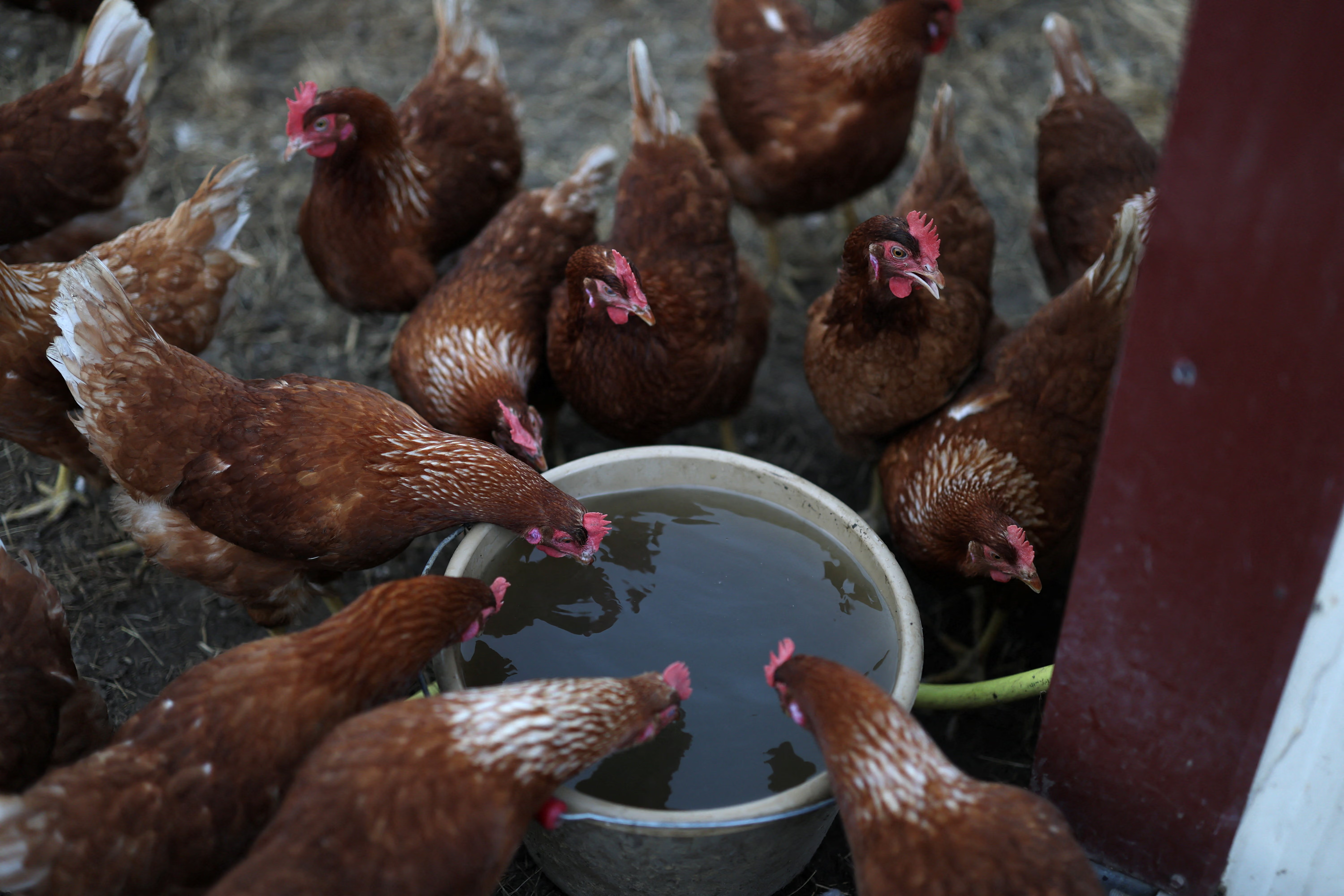
French grain traders and protein integrators face a compounding margin crisis starting now: a 30% corn crop loss, 2.5–3 million broiler chickens dead in late June alone, and processing infrastructure on the verge of collapse all simultaneously, with Q4 demand approaching.
France's 2026 heatwave is not primarily a weather story. It is a supply chain fracture event, and the fracture lines run through three commodities at once: feed grains, poultry protein, and less visibly the cold-chain and rendering infrastructure that underpins the entire western French livestock economy. Corn futures on CBOT (the Chicago Board of Trade the principal global benchmark for corn pricing) have risen more than 10% since mid-June, a move that translates to approximately $20–25 per metric tonne of margin expansion for sellers with open long positions. For buyers feed mills, integrated poultry producers, livestock cooperatives that same $20–25/MT is a direct cost increase on every tonne of feed grain they must source between now and harvest. With French domestic corn yields impaired and the unirrigated share of the corn area (more than two-thirds of total plantings) now confirmed as severely damaged, this is not a temporary spike. It is a structural repricing of the French domestic grain basis for the remainder of 2026.
The margin anatomy of this crisis is easier to read once you separate the three distinct damage layers. Layer one is crop: approximately 30% of the French corn crop is lost, 50% of carrot production is impaired, and 60% of the hops harvest is affected. These are yield losses on standing acreage with fixed cost bases meaning French corn farmers still owe the same land rents, machinery finance payments, and input loans against a revenue pool that has just contracted by nearly a third. Layer two is livestock: late-June broiler mortality of 2.5–3 million birds in Brittany alone at approximately €2–3 per bird in live weight value represents €5–9 million in direct losses for that single region's integrators, before any processing or disposal cost is included. Layer three, and the one least priced into current markets, is infrastructure: western France hosts roughly 70% of national pig production and 30% of dairy, concentrated geographically in Brittany and pays Normandie. When an emergency carcass disposal plan is activated in Gers a department better known for Armagnac and foie gras it signals that abattoir throughput and rendering capacity, not farm mortality itself, is the binding constraint.
The processing infrastructure collapse deserves the most attention from grain traders and protein buyers because it will outlast the heat. Consider the mechanics: a rendering plant a facility that processes dead animals into fat, meal, and other by-products operates at designed throughput. When mortality events arrive at three to five times normal daily rates, the backlog does not clear when temperatures fall. Biosecurity protocols require rapid disposal within 24–48 hours of death; refrigeration capacity at farm level is negligible for broiler sheds running at 40–41°C; and cold-chain logistics between farm, abattoir, and rendering are already under strain. The consequence is that even if France returns to 30°C next week, the disruption to pork and poultry supply chains will persist for four to six weeks as the system clears backlog, restores biosecurity status to affected sheds, and resumes normal throughput. Protein buyers sourcing French pork or poultry on spot terms should not assume supply normalises with the weather. It will not.
On the buy side, French feed mills and integrated broiler producers face the most immediate pressure. A mid-sized French poultry integrator running 500,000 birds in a continuous cycle a standard operation in Brittany sources approximately 1,200–1,500 tonnes of feed grain per month. At the pre-crisis MATIF (Marché à Terme International de France the Paris based derivatives exchange for European agricultural commodities) corn price of roughly €210/MT, monthly feed costs were approximately €250,000–315,000. A 10% basis rise to €231/MT lifts that monthly bill by €25,000–31,500 real money for an operation already absorbing mortality losses. If the operator carries no forward price cover, every tonne of feed purchased on spot between now and September arrives at a higher cost against a smaller flock to feed it. Margin compression at this scale, across dozens of integrators simultaneously, creates the conditions for distress sales of surviving inventory and accelerated flock size reduction both of which soften near-term wholesale poultry prices even as feed costs rise.
On the sell side, the clearest winners at this moment are non-French grain exporters holding deliverable positions into French or Rotterdam ports. Ukrainian and Romanian corn, moving through the Danube corridor the inland waterway system connecting Black Sea origins to Central European markets or via Constanța (Romania's primary Black Sea export terminal) to Rotterdam, is now competitive against elevated French domestic prices. A Black Sea corn cargo delivered CIF (cost, insurance, and freight meaning the seller bears cost and risk until the cargo arrives at the destination port) Rouen can absorb freight costs of approximately $18–22/MT and still clear a profitable landed margin against current French basis levels. For EU competing poultry exporters Dutch, Belgian, and German integrators the withdrawal of French supply creates a spot premium opportunity, but only for operators who can reroute existing volume to French retail and foodservice buyers quickly. That window is likely four to eight weeks before French operators begin restocking flocks.
For a large integrated trading house a Dreyfus, Vitol Agriculture, or a national grain trading arm the strategic instrument here is a MATIF corn long combined with a basis trade against Black Sea origins. MATIF corn the European benchmark futures contract for feed-quality wheat and corn has already moved. The additional arbitrage is in the spread between French domestic prices and importable origin prices: if that spread widens further as Q4 demand competes for available supply, the trader who has locked in Black Sea supply and holds MATIF exposure simultaneously captures margin on both legs. The cost of entry is manageable while the basis trade is still forming; it narrows significantly once the market fully prices the import substitution story. For a smaller regional operator a French grain cooperative, a mid-sized feed compounder without derivatives access the practical equivalent is to approach Ukrainian or Romanian exporters now for bilateral fixed-price supply contracts for Q3 and Q4 delivery, before spot competition intensifies. Fixing terms bilaterally on a portion of anticipated import needs even 30–40% of projected Q4 requirement removes the worst-case upside exposure from an already compressed margin environment.
The historical precedent worth anchoring to is the 2003 European heatwave, which killed approximately 52,000 people across the continent and reduced French grain harvests by 20–30%. Corn prices on European exchanges rose sharply into Q4 2003, and French import demand for Black Sea grain surged in a pattern now replicating itself twenty-three years later. The key structural difference in 2026 is that the French livestock concentration is higher Brittany's broiler and pork density has increased significantly since 2003 meaning the geographic exposure of processing infrastructure to a single climate event is materially greater. The 2003 event resolved within one season. The 2026 version carries a longer structural tail because infrastructure damage and biosecurity recovery timelines are not priced into annual crop models.
The specific, time-bound signal for observers to watch is the MATIF September corn futures contract versus the CIF Rouen import price published daily by Stratégie Grains and France AgriMer (the French national agricultural market observatory). If the spread between French domestic corn and importable origin widens beyond €25/MT by mid-July, it confirms that import substitution is now economic at scale and that Black Sea origination is flowing. A second signal: the French Ministry of Agriculture's weekly crop condition report, due each Monday through August, will show whether the corn crop deterioration is stabilising or deepening. A third consecutive reading below 50% good to excellent on that report, combined with below average rainfall forecasts from Météo-France, would constitute a material escalation signal one that justifies moving from monitoring posture to active procurement action before Q4 supply competition intensifies.

.jpg)
.avif)
'%3e%3cg id='Final-Copy-2_2_' transform='translate(1275.000000, 200.000000)'%3e%3cpath class='st0' d='M7.4,12.8h6.8l3.1-11.6H7.4C4.2,1.2,1.6,3.8,1.6,7S4.2,12.8,7.4,12.8z'/%3e%3c/g%3e%3c/g%3e%3c/g%3e%3cg id='final---dec.11-2020'%3e%3cg id='_x30_208-our-toggle' transform='translate(-1275.000000, -200.000000)'%3e%3cg id='Final-Copy-2' transform='translate(1275.000000, 200.000000)'%3e%3cpath class='st1' d='M22.6,0H7.4c-3.9,0-7,3.1-7,7s3.1,7,7,7h15.2c3.9,0,7-3.1,7-7S26.4,0,22.6,0z M1.6,7c0-3.2,2.6-5.8,5.8-5.8 h9.9l-3.1,11.6H7.4C4.2,12.8,1.6,10.2,1.6,7z'/%3e%3cpath id='x' class='st2' d='M24.6,4c0.2,0.2,0.2,0.6,0,0.8l0,0L22.5,7l2.2,2.2c0.2,0.2,0.2,0.6,0,0.8c-0.2,0.2-0.6,0.2-0.8,0 l0,0l-2.2-2.2L19.5,10c-0.2,0.2-0.6,0.2-0.8,0c-0.2-0.2-0.2-0.6,0-0.8l0,0L20.8,7l-2.2-2.2c-0.2-0.2-0.2-0.6,0-0.8 c0.2-0.2,0.6-0.2,0.8,0l0,0l2.2,2.2L23.8,4C24,3.8,24.4,3.8,24.6,4z'/%3e%3cpath id='y' class='st3' d='M12.7,4.1c0.2,0.2,0.3,0.6,0.1,0.8l0,0L8.6,9.8C8.5,9.9,8.4,10,8.3,10c-0.2,0.1-0.5,0.1-0.7-0.1l0,0 L5.4,7.7c-0.2-0.2-0.2-0.6,0-0.8c0.2-0.2,0.6-0.2,0.8,0l0,0L8,8.6l3.8-4.5C12,3.9,12.4,3.9,12.7,4.1z'/%3e%3c/g%3e%3c/g%3e%3c/g%3e%3c/g%3e%3c/svg%3e) Privacy Choices
Privacy Choices