.avif)
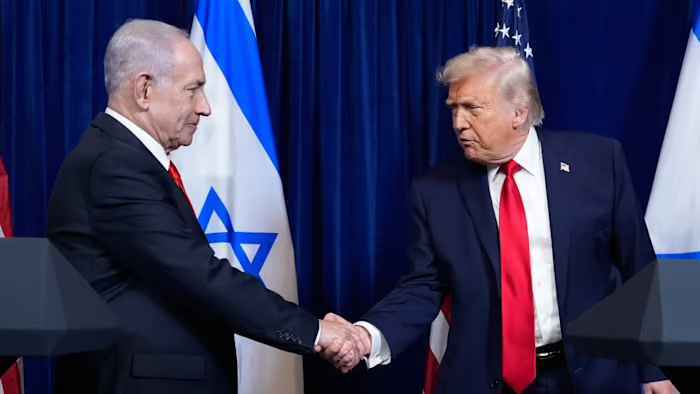
Crude oil traders pricing Iranian supply back into their 2026 forward books face a sequencing trap: diplomatic signals from the Netanyahu-Trump meeting and the Doha mediation track are generating price softening expectations, but any actual increment of Iranian crude reaching market is realistically 6–18 months away and that gap is where margin will be lost or made in the coming weeks.
The core commercial issue is the distance between political noise and physical supply. The Doha MoU a memorandum of understanding, meaning a framework agreement without binding legal force reportedly made positive progress in Qatar-Pakistan mediated talks on July 1, according to sources close to the negotiations. The document covers 14 points governing Iran's nuclear programme, and the next negotiating round is delayed pending funeral proceedings for the former Iranian Supreme Leader. That delay matters operationally. Even if the MoU is signed in its current form, sanctions relief the legal mechanism by which frozen Iranian crude exports return to market requires U.S. Congressional notification, verified compliance steps under International Atomic Energy Agency (IAEA) monitoring, and a sequenced unwinding of OFAC (Office of Foreign Assets Control, the U.S. Treasury body that enforces sanctions) designations. Historically, that process has taken 6–18 months from agreement to first compliant cargo. The diplomatic calendar and the supply calendar are not the same calendar.
The physical supply chain implication is direct. Iranian crude primarily sour, medium gravity barrels moves predominantly to Chinese independent refiners, known in the market as "teapots," on shadow tankers that operate outside Western insurance frameworks. The Brent-Dubai spread the price difference between North Sea Brent crude and Middle Eastern Dubai crude currently reflects some Iranian volume already reaching market through these channels. If a formal deal is struck and Iranian barrels become sanctions compliant, compliant buyers South Korean and Japanese refiners, Indian state oil companies could re-enter the Iranian supply chain. That would add genuine demand pressure to the Dubai benchmark, compressing the Brent-Dubai spread further. But that compression is months away, not weeks. Traders pricing it in now are front-running a supply event that has not been scheduled, let alone delivered. Meanwhile, Israel has signalled it will continue military operations against Hezbollah independent of the Lebanon ceasefire framework, according to reports, keeping Hormuz and Red Sea risk structurally present. War-risk insurance surcharges the additional premium tanker operators pay to transit conflict proximate waters remain elevated on Levant and Red Sea routes without a corresponding freight rate increase to absorb them.
On the buy side, Asian refinery procurement managers holding spot exposure to sour crude should treat current spread softness as a pricing opportunity, not a signal to extend coverage. A mid-sized South Korean refiner buying 1 million barrels of Dubai linked crude at a current Brent-Dubai spread of approximately $2.50/barrel saves roughly $2.5 million per cargo relative to Brent priced alternatives but that spread could widen sharply if diplomatic progress stalls and Iranian shadow barrels are re-sanctioned or rerouted. On the sell side, Gulf NOCs (national oil companies, state-owned energy enterprises) pricing their official selling prices the OSP, the monthly benchmark price at which NOCs sell to term customers against Dubai face margin compression if Iranian supply expectations depress the sour crude complex without the physical barrels actually arriving. For large integrated traders such as Vitol or Trafigura, the instrument is options volatility: implied volatility on Brent options has softened on diplomatic optimism, making this a viable moment to buy protection cheaply before the next disruption headline. For a smaller regional fuel importer without derivatives access, the practical equivalent is locking bilateral fixed-price terms with Gulf suppliers now, before any renewed escalation reprices the risk premium back into spot cargoes.
The single most useful forward signal for observers is the Brent-Dubai spread as reported daily on the Platts (S&P Global Commodity Insights) price assessment window, tracked over the next 30 days. If the spread narrows below $1.50/barrel, markets are pricing Iranian sour volumes as imminent and the sequencing reality described above suggests that pricing is premature and potentially reversible. Watch also for any IAEA Board of Governors statement, scheduled meetings of which are published on the IAEA website, confirming or denying Iranian compliance steps: that is the gating event that determines whether sanctions unwinding can legally begin. Until that confirmation exists, the diplomatic track is signal, not supply. Crude oil traders who separate those two categories will preserve margin; those who conflate them will not.



.jpg)



'%3e%3cg id='Final-Copy-2_2_' transform='translate(1275.000000, 200.000000)'%3e%3cpath class='st0' d='M7.4,12.8h6.8l3.1-11.6H7.4C4.2,1.2,1.6,3.8,1.6,7S4.2,12.8,7.4,12.8z'/%3e%3c/g%3e%3c/g%3e%3c/g%3e%3cg id='final---dec.11-2020'%3e%3cg id='_x30_208-our-toggle' transform='translate(-1275.000000, -200.000000)'%3e%3cg id='Final-Copy-2' transform='translate(1275.000000, 200.000000)'%3e%3cpath class='st1' d='M22.6,0H7.4c-3.9,0-7,3.1-7,7s3.1,7,7,7h15.2c3.9,0,7-3.1,7-7S26.4,0,22.6,0z M1.6,7c0-3.2,2.6-5.8,5.8-5.8 h9.9l-3.1,11.6H7.4C4.2,12.8,1.6,10.2,1.6,7z'/%3e%3cpath id='x' class='st2' d='M24.6,4c0.2,0.2,0.2,0.6,0,0.8l0,0L22.5,7l2.2,2.2c0.2,0.2,0.2,0.6,0,0.8c-0.2,0.2-0.6,0.2-0.8,0 l0,0l-2.2-2.2L19.5,10c-0.2,0.2-0.6,0.2-0.8,0c-0.2-0.2-0.2-0.6,0-0.8l0,0L20.8,7l-2.2-2.2c-0.2-0.2-0.2-0.6,0-0.8 c0.2-0.2,0.6-0.2,0.8,0l0,0l2.2,2.2L23.8,4C24,3.8,24.4,3.8,24.6,4z'/%3e%3cpath id='y' class='st3' d='M12.7,4.1c0.2,0.2,0.3,0.6,0.1,0.8l0,0L8.6,9.8C8.5,9.9,8.4,10,8.3,10c-0.2,0.1-0.5,0.1-0.7-0.1l0,0 L5.4,7.7c-0.2-0.2-0.2-0.6,0-0.8c0.2-0.2,0.6-0.2,0.8,0l0,0L8,8.6l3.8-4.5C12,3.9,12.4,3.9,12.7,4.1z'/%3e%3c/g%3e%3c/g%3e%3c/g%3e%3c/g%3e%3c/svg%3e) Privacy Choices
Privacy Choices