.avif)
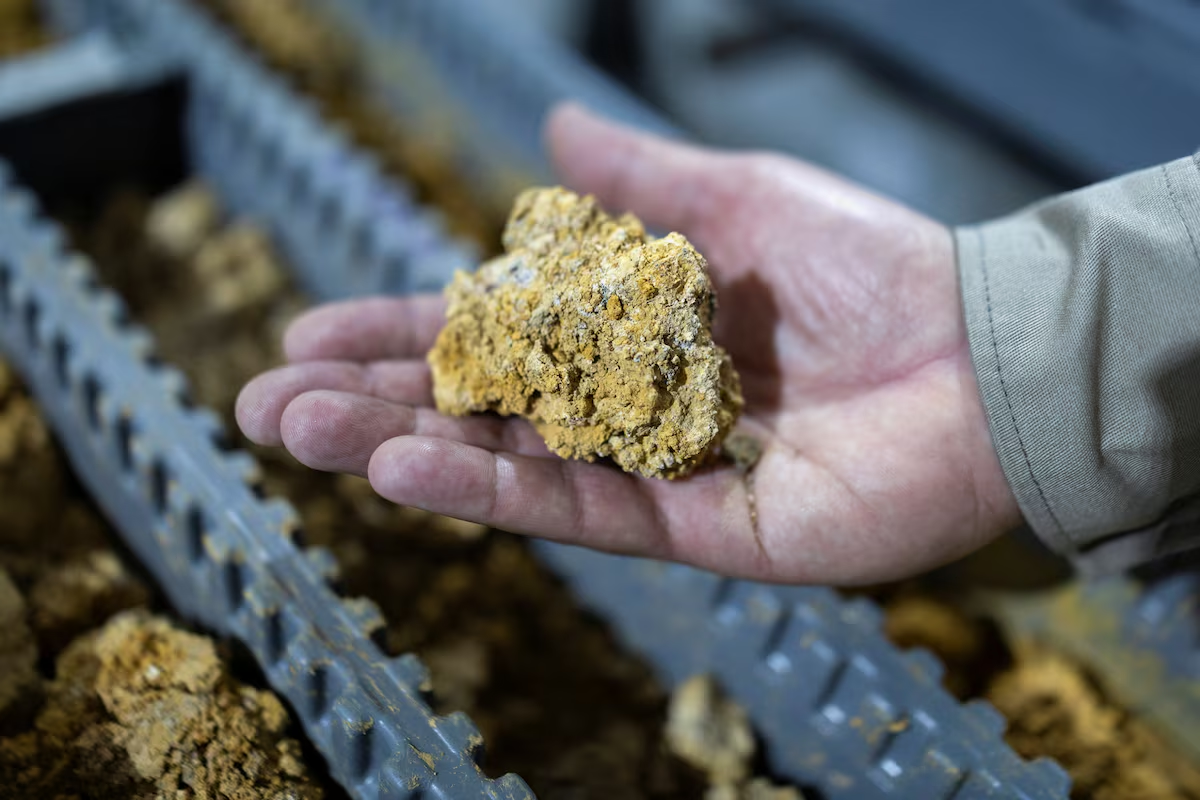
Rare earth magnet manufacturers sourcing outside China face a structural repricing of their supply chains beginning now as Energy Fuels' $1.9 billion acquisition of Vacuumschmelze (VAC) and the UK's £20 million Magnet Hub commitment signal that Western governments and corporates are moving from policy aspiration to capital deployment in rare earth magnets.
The deal's anatomy matters more than its headline number. Energy Fuels is paying $718 million in cash, issuing approximately 65.85 million shares, and absorbing roughly $140 million in adjusted net debt a structure that ties shareholder value directly to VAC's ability to scale magnet output. VAC's Sumter, South Carolina facility currently produces 2,000 tonnes per annum (tpa) of rare earth permanent magnets the high-performance magnets used in electric vehicle motors, wind turbine generators, and defence guidance systems. The expansion roadmap runs to 4,000 tpa, then 12,000 tpa, at which point the combined entity projects a run-rate EBITDA earnings before interest, tax, depreciation, and amortisation, the standard measure of operational cash generation of approximately $400 million per year. At 2,000 tpa today, that number is a fraction of that target. The distance between current reality and projected return is not financial engineering. It is a physical supply chain problem.
The supply chain Energy Fuels is attempting to assemble runs across four countries and at least five processing stages. Monazite a phosphate mineral bearing neodymium, praseodymium, dysprosium, and terbium, the four rare earth elements (REEs) critical to high-performance magnets is mined as a by product of mineral sands operations in Australia. That raw mineral travels to Energy Fuels' White Mesa Mill in Utah, the only operating conventional uranium mill in the United States, where it is processed into a mixed rare earth carbonate a bulk intermediate that contains all the rare earths together, unseparated. That carbonate must then be chemically separated into individual rare earth oxides (REOs) before it becomes usable feed for magnet-grade alloys. Metal and alloy production is planned for South Korea. Magnet manufacturing occurs at Sumter and at VAC's European facilities. Each link in this chain represents capital, qualification time, and execution risk. No single link is currently operating at the scale the $400 million EBITDA projection requires.
Here is where the margin anatomy becomes precise. Mixed rare earth carbonate is worth approximately $3,000–4,000 per tonne. Separated neodymium-praseodymium (NdPr) oxide the primary magnet feed trades at roughly $50,000–70,000 per tonne depending on purity and market conditions. The separation step, known as solvent extraction, converts the bulk carbonate into individually purified oxides and captures most of the value uplift in the REE chain. Energy Fuels does not currently operate a commercial rare earth separation facility. The White Mesa Mill produces mixed carbonate, not separated oxides. To put this in operational terms: a 12,000 tpa magnet facility consuming NdPr oxide at magnet-grade purity would require approximately 3,000–4,000 tonnes of separated NdPr oxide annually. No fully operational, commercially scaled Western separation facility exists today to supply that volume outside China. The $400 million EBITDA projection is therefore contingent on solving a separation bottleneck that the VAC acquisition itself does not resolve. That gap is the most important single fact in this transaction.
For magnet manufacturers on the buy side, the immediate question is not whether this deal closes but what it means for feedstock sourcing over the next 24–48 months. Today, the dominant supply route for magnet-grade REOs runs from Chinese rare earth mines through Chinese separation plants controlled by state entities including China Northern Rare Earth Group to Chinese alloy producers, and then to magnet manufacturers globally. That route is efficient, integrated, and priced to reflect Chinese domestic policy as much as global supply and demand. A manufacturer in Germany or Japan sourcing NdPr oxide ex-China today pays a price set partly by Chinese export quotas and partly by global spot markets. As Western separation capacity grows slowly and as demand for non-Chinese origin material increases among defence primes and EV OEMs (original equipment manufacturers) subject to supply-chain localisation requirements, the price spread between Chinese domestic NdPr and Western ex-China NdPr is likely to widen. Buyers locking in long-term offtake agreements contracts to purchase a fixed volume at a fixed or formula price over multiple years with Western producers now are buying insurance against that spread widening. The cost of that insurance is paying a premium over current Chinese spot pricing.
On the sell side, Chinese magnet exporters and their upstream separation suppliers face a structural, if slow-moving, margin erosion in Western OEM markets. The mechanism is not immediate displacement China processes over 85% of the world's rare earth oxides and that share will not fall quickly. The mechanism is preferential procurement: defence contractors in the US and UK are already subject to restrictions on Chinese origin rare earth materials in certain applications, and automotive OEMs under EU and US battery supply chain regulations are under increasing pressure to document REE provenance. Each Western OEM contract that migrates to a VAC-type integrated Western supply chain is a permanent volume loss for the Chinese export channel. Over a five to ten year horizon, that structural shift compresses margin for Chinese exporters in premium Western segments even if overall Chinese output and domestic consumption continue to grow.
For large integrated operators a major defence prime with long-cycle procurement programmes, or an automotive group sourcing magnets for electric drivetrains at scale the VAC acquisition creates a qualified Western supply option that did not previously exist at this scale. The practical instrument is a multi year offtake agreement with Energy Fuels–VAC, structured to phase in volume as Sumter expands from 2,000 to 4,000 tpa. The cost of entry is accepting a price premium over Chinese spot currently estimated at 20–40% for certified Western-origin NdPr-based magnets in exchange for supply chain auditability and regulatory compliance certainty. For smaller regional magnet manufacturers a mid-sized European motor manufacturer, an independent UK defence sub-contractor without the balance sheet to lock in multi-year offtakes, the practical equivalent is to engage immediately with the UK's Magnet Hub tender process, which closes for grant applications by March 2030, and to begin qualifying VAC as an approved supplier now, before the expansion ramp creates a queue.
The UK's £20 million Magnet Hub commitment, drawn from the £50 million Critical Minerals Programme administered by the Department for Business and Trade, is smaller than it sounds in the context of the capital required to build competitive rare earth separation and magnet manufacturing at scale. For context, Energy Fuels is spending $1.9 billion on a single acquisition. The Magnet Hub's value is not in its grant quantum but in its role as a qualification anchor a state backed facility that can certify magnet manufacturing processes and attract private co-investment. Power Minerals' acquisition of the Morro do Ferro project in southern Brazil targeting bastnasite and cerianite mineralisation types bearing magnet REEs adds another upstream data point to the emerging Western supply picture, though it remains at drilling stage and is years from production. The project's reported exceptional grades are encouraging, but grade alone does not build a supply chain.
Observers should watch two specific signals. First, monitor Energy Fuels' quarterly operational disclosures for any announcement of a partnership or capital commitment toward a US based rare earth separation facility this is the single most important missing link in the mine to magnet chain, and any credible announcement would materially advance the $400 million EBITDA timeline. The relevant benchmark is the NdPr oxide spot price on the Shanghai Metals Market (SMM) index, tracked weekly; a sustained widening of the premium between SMM NdPr spot and Western ex-China offtake prices above 35% would signal that supply tightness in the non-Chinese channel is becoming acute. Second, watch the UK Magnet Hub competitive tender outcome, expected before the end of 2026 the identity of the winning facility operator will indicate whether the UK is building genuine industrial capability or a research showcase. That distinction determines whether the £20 million attracts the private co-investment the programme anticipates, or stands alone.




'%3e%3cg id='Final-Copy-2_2_' transform='translate(1275.000000, 200.000000)'%3e%3cpath class='st0' d='M7.4,12.8h6.8l3.1-11.6H7.4C4.2,1.2,1.6,3.8,1.6,7S4.2,12.8,7.4,12.8z'/%3e%3c/g%3e%3c/g%3e%3c/g%3e%3cg id='final---dec.11-2020'%3e%3cg id='_x30_208-our-toggle' transform='translate(-1275.000000, -200.000000)'%3e%3cg id='Final-Copy-2' transform='translate(1275.000000, 200.000000)'%3e%3cpath class='st1' d='M22.6,0H7.4c-3.9,0-7,3.1-7,7s3.1,7,7,7h15.2c3.9,0,7-3.1,7-7S26.4,0,22.6,0z M1.6,7c0-3.2,2.6-5.8,5.8-5.8 h9.9l-3.1,11.6H7.4C4.2,12.8,1.6,10.2,1.6,7z'/%3e%3cpath id='x' class='st2' d='M24.6,4c0.2,0.2,0.2,0.6,0,0.8l0,0L22.5,7l2.2,2.2c0.2,0.2,0.2,0.6,0,0.8c-0.2,0.2-0.6,0.2-0.8,0 l0,0l-2.2-2.2L19.5,10c-0.2,0.2-0.6,0.2-0.8,0c-0.2-0.2-0.2-0.6,0-0.8l0,0L20.8,7l-2.2-2.2c-0.2-0.2-0.2-0.6,0-0.8 c0.2-0.2,0.6-0.2,0.8,0l0,0l2.2,2.2L23.8,4C24,3.8,24.4,3.8,24.6,4z'/%3e%3cpath id='y' class='st3' d='M12.7,4.1c0.2,0.2,0.3,0.6,0.1,0.8l0,0L8.6,9.8C8.5,9.9,8.4,10,8.3,10c-0.2,0.1-0.5,0.1-0.7-0.1l0,0 L5.4,7.7c-0.2-0.2-0.2-0.6,0-0.8c0.2-0.2,0.6-0.2,0.8,0l0,0L8,8.6l3.8-4.5C12,3.9,12.4,3.9,12.7,4.1z'/%3e%3c/g%3e%3c/g%3e%3c/g%3e%3c/g%3e%3c/svg%3e) Privacy Choices
Privacy Choices