.avif)
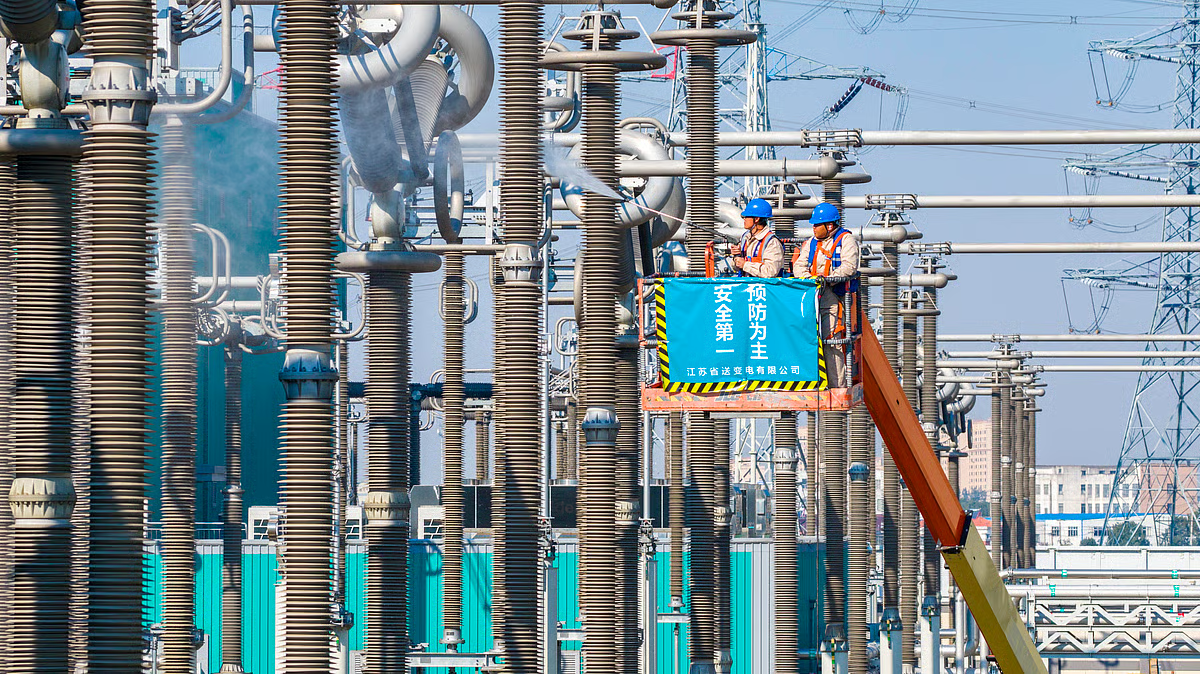
Indian power equipment manufacturers listed on domestic exchanges lost up to 9% of their market value on 3 July 2026 in a single session after the Finance Ministry formalised a two-year exemption permitting four Chinese linked power equipment companies to compete in government tenders from which they had been effectively excluded since the 2020 India-China border standoff in the Galwan Valley.
The four entities granted the exemption are TBEA Energy India, Nanjing Electric India, New Northeast Electric India, and Taikai Electric (India) each an Indian registered subsidiary of a Chinese parent manufacturer. The June 24 order under which the exemption operates does not represent a blanket reversal of the 2020 security framework: Chinese origin bidders for government contracts must still register with a designated government panel and obtain political and security clearances before they can submit a compliant bid. The exemption removes one layer of exclusion; it does not remove all of them. That distinction matters enormously for anyone trying to translate the policy change into a practical timeline for actual competitive bidding.
The market reaction priced immediate competition. The physical reality is substantially more deferred. None of the four entities can submit an operational tender until clearances are individually processed a procedure that, according to market participants familiar with the post-2020 framework, has historically been slow and opaque. The clearance timeline is unknown and could consume a large portion of the two-year exemption window itself. Investors sold GE Vernova T&D down approximately 7.8%, CG Power and Hitachi Energy India down roughly 7.5% each, and GE Power India Ltd hit its lower circuit at Rs 873.75 with unfilled sell orders meaning there were no buyers willing to absorb remaining sell pressure at that price, a liquidity signal characteristic of small-cap stocks during sharp sentiment shifts. The gap between the policy headline and the operational reality is where much of the near-term margin risk is being miscalculated.
To understand where the genuine margin pressure concentrates, it helps to decompose the Indian power equipment market into two distinct segments. The first is standard high-voltage (HV) transformers and switchgear the bulk procurement workhorses of grid expansion programmes run by Power Grid Corporation of India and state utilities. These are specification driven, price sensitive tenders where Chinese manufacturers have historically undercut Indian and Western incumbents by 15–25%. The second segment is high-voltage direct current (HVDC) infrastructure large, technically complex interconnects that require specialised engineering, long commissioning support, and deep integration with grid control systems. HDFC Securities analysts indicate the Chinese exemption is unlikely to derail HVDC projects, where domestic incumbents hold sizable existing order books. The margin risk is real but geographically concentrated within the procurement landscape: standard equipment faces compression; HVDC remains, for now, a protected margin pocket.
Work the numbers on the standard transformer segment. A 400kV power transformer procured under a Power Grid Corporation tender currently prices at approximately ₹8–10 crore per unit from established Indian or European technology manufacturers. Chinese origin equipment based on comparable tender outcomes in markets where Chinese bidders have operated freely typically lands 15–20% below that range, implying a delivered price of ₹6.4–8.5 crore. For a procurement desk buying 50 such units in a single tender cycle, that differential represents ₹75–80 crore in potential capex savings. On the sell side, for a manufacturer like CG Power or Hitachi Energy India where government tender revenue contributes meaningfully to the top line, a 15–20% price compression forced by competitive Chinese bids translates directly into EBIT margin (earnings before interest and taxes operating profitability before financing costs) compression of 200–400 basis points on that revenue line. One basis point is one-hundredth of one percentage point. At current revenue scales, 200–400 basis points is not a rounding error. It is the difference between a healthy equipment business and a restructuring conversation.
On the buy side, Power Grid Corporation and state utility procurement desks are the structural beneficiaries of this policy change, assuming the clearance timelines resolve within the two-year window. Competitive pressure from four additional qualified Chinese bidders should compress tender prices by 10–20% on standard HV transformers and switchgear delivering direct capex savings that can be redeployed into accelerating the pace of grid expansion. For context, India's planned transmission capacity addition under the current national electricity plan requires several trillion rupees of equipment procurement over the next five years; a 10% input cost reduction on that programme is a fiscally material outcome. On the sell side, the incumbents GE Vernova T&D, CG Power, Hitachi Energy India face a more surgical challenge than the broad equity sell-off implied. Their HVDC order books are insulated. Their standard equipment tender exposure is not. The strategic response is to accelerate differentiation on service, localisation content, and financing support dimensions where Chinese subsidiaries operating through newly cleared Indian entities will have limited track record.
For a large integrated engineering and procurement contractor an L&T, a Sterlite Power, a Techno Electric the picture is more nuanced. These operators buy equipment as inputs into EPC (engineering, procurement, and construction full turnkey project delivery) contracts. If Chinese competition reduces equipment input costs, their own bid competitiveness improves and their procurement margin expands, provided they are not also holding long positions in the equity of equipment manufacturers. Large operators with structured supply agreements can hedge exposure by locking bilateral supply terms with incumbents at current prices before Chinese competition materialises operationally. For smaller regional EPC contractors or independent power producers sourcing equipment outside the large national tender framework, the more practical near-term action is to introduce a price discovery clause in current procurement negotiations: request Chinese subsidiary quotations even if clearances are pending, using the policy signal as leverage to renegotiate existing bilateral pricing. The leverage is real even before a single Chinese bid is formally submitted.
IIFL Research, which flagged this policy risk months before the June 24 order, expects that Power Grid Corporation's parallel effort to broaden its domestic vendor base will reinforce demand for incumbents in HVDC applications specifically, with GE Vernova T&D and Siemens Energy named as preferred positioning. That analyst framing carries a structural logic: HVDC projects involve 10–15 year operational relationships, grid code compliance obligations, and local content requirements that favour vendors with established Indian engineering and service infrastructure. The two-year exemption is explicitly not a precedent for other Chinese companies the order language is unambiguous on this point. The test embedded in this policy is whether Indian equipment manufacturers can absorb competitive pressure in standard procurement while retaining pricing power in technically differentiated segments. The answer will be visible in order book composition disclosures over the next two to four quarters.
The single most important time-bound signal to monitor is not the equity price of the incumbents but the clearance processing timeline for the four named entities. Observers should track Power Grid Corporation's published tender outcomes specifically, whether any of the four Chinese subsidiaries appear as qualified bidders in HV transformer tenders issued after October 2026. If none of the four appear as qualified bidders in tenders issued within six months of the June 24 order, the effective competitive impact is deferred by at least 12 months and the equity sell-off will prove to have been technically premature. If one or more entities are listed as qualified bidders in tenders before the end of 2026, the margin compression timeline accelerates and the 200–400 basis point EBIT pressure on standard equipment revenue becomes an immediate year earnings story rather than a future year risk. The clearance panel's pace, not the Finance Ministry memo, is the rate limiting variable.





'%3e%3cg id='Final-Copy-2_2_' transform='translate(1275.000000, 200.000000)'%3e%3cpath class='st0' d='M7.4,12.8h6.8l3.1-11.6H7.4C4.2,1.2,1.6,3.8,1.6,7S4.2,12.8,7.4,12.8z'/%3e%3c/g%3e%3c/g%3e%3c/g%3e%3cg id='final---dec.11-2020'%3e%3cg id='_x30_208-our-toggle' transform='translate(-1275.000000, -200.000000)'%3e%3cg id='Final-Copy-2' transform='translate(1275.000000, 200.000000)'%3e%3cpath class='st1' d='M22.6,0H7.4c-3.9,0-7,3.1-7,7s3.1,7,7,7h15.2c3.9,0,7-3.1,7-7S26.4,0,22.6,0z M1.6,7c0-3.2,2.6-5.8,5.8-5.8 h9.9l-3.1,11.6H7.4C4.2,12.8,1.6,10.2,1.6,7z'/%3e%3cpath id='x' class='st2' d='M24.6,4c0.2,0.2,0.2,0.6,0,0.8l0,0L22.5,7l2.2,2.2c0.2,0.2,0.2,0.6,0,0.8c-0.2,0.2-0.6,0.2-0.8,0 l0,0l-2.2-2.2L19.5,10c-0.2,0.2-0.6,0.2-0.8,0c-0.2-0.2-0.2-0.6,0-0.8l0,0L20.8,7l-2.2-2.2c-0.2-0.2-0.2-0.6,0-0.8 c0.2-0.2,0.6-0.2,0.8,0l0,0l2.2,2.2L23.8,4C24,3.8,24.4,3.8,24.6,4z'/%3e%3cpath id='y' class='st3' d='M12.7,4.1c0.2,0.2,0.3,0.6,0.1,0.8l0,0L8.6,9.8C8.5,9.9,8.4,10,8.3,10c-0.2,0.1-0.5,0.1-0.7-0.1l0,0 L5.4,7.7c-0.2-0.2-0.2-0.6,0-0.8c0.2-0.2,0.6-0.2,0.8,0l0,0L8,8.6l3.8-4.5C12,3.9,12.4,3.9,12.7,4.1z'/%3e%3c/g%3e%3c/g%3e%3c/g%3e%3c/g%3e%3c/svg%3e) Privacy Choices
Privacy Choices