.avif)
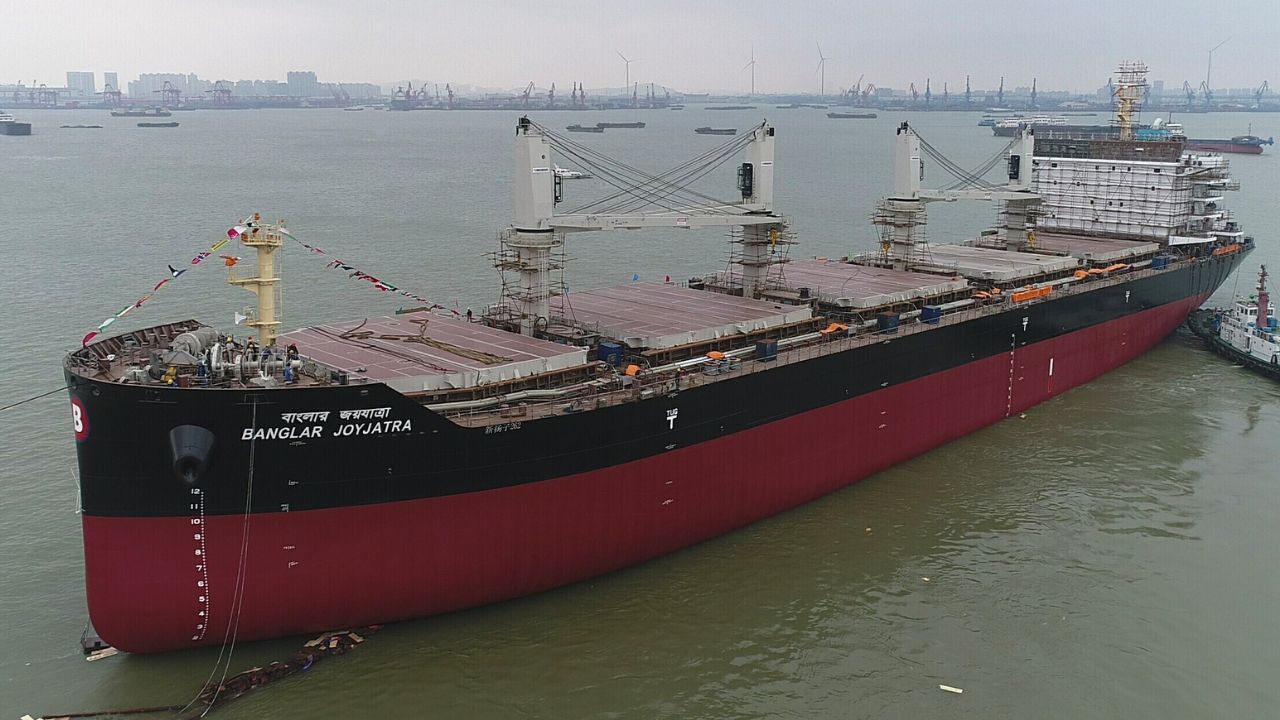
Thirty-seven thousand tonnes of fertilizer, stranded in the Persian Gulf for four and a half months, is finally moving toward Cape Town and every dry bulk operator trading the Persian Gulf to Africa corridor must now decide whether one vessel's transit represents a structural reopening or a single diplomatic exception.
The MV Banglar Joyjatra is a Handymax-class bulk carrier (a mid-sized dry bulk vessel, typically 35,000–55,000 deadweight tonnes, suited to regional port infrastructure) owned by the Bangladesh Shipping Corporation (BSC), the state-owned national carrier. The vessel entered the Persian Gulf through the Strait of Hormuz on 2 February 2026, loaded steel coils at a Qatari port, and delivered them to Jebel Ali the UAE's principal container and bulk port arriving 27 February. The following day, according to BSC and multiple government statements, a conflict erupted involving the United States and Iran, triggering restrictions on commercial transit through the Strait of Hormuz, the 33 kilometre wide chokepoint through which roughly 20% of the world's traded oil and a significant volume of dry bulk cargo flows daily. The vessel subsequently loaded 37,000 tonnes of fertilizer at Ras Al Khair Saudi Arabia's industrial port on the Gulf coast, home to the Ma'aden and SABIC fertilizer export terminals bound for Cape Town.
The timeline of detention is important to reconstruct precisely, because it shapes how operators should read the resolution. On 10 April, the Banglar Joyjatra attempted to transit Hormuz outbound from Ras Al Khair and was intercepted by the Iranian Coast Guard. The vessel was diverted to the outer anchorage of Mina Saqr, Oman's port near the Hormuz approaches, where it sheltered for a further two months. It finally crossed the Strait at approximately 03:00 Bangladesh Standard Time on 23 June 2026, according to BSC, and is now proceeding to Fujairah the UAE's eastern coast bunkering hub, the largest ship refueling port in the world by volume at approximately 7 knots. All 31 Bangladeshi crew members are reported safe and in good health. BSC states the vessel did not go off-hire that is, did not lose its charter earnings for a single day during the standoff, a commercially significant detail that speaks to the structure of the underlying voyage charter.
The off-hire claim deserves analytical attention, because it determines where the financial pain of this disruption actually settled. Under a time charter (an arrangement where the shipowner leases the vessel to a charterer for a defined period at a daily rate, regardless of what the vessel is doing), the charterer pays hire continuously even when the vessel is at anchor and earning nothing commercially. Under a voyage charter (a contract for a specific cargo movement, where the shipowner is paid a lump sum for the voyage), the vessel earns freight only when making progress. BSC's statement that the vessel never went off-hire implies the cargo interest the fertilizer charterer bound for Cape Town continued paying daily hire through 135 days of effective immobility. For a Handymax at current Gulf-Africa time charter equivalent (TCE) rates of approximately $12,000–$14,000 per day, 135 idle days represent between $1.62 million and $1.89 million in hire paid without cargo delivery. That cost did not disappear: it was absorbed somewhere in the supply chain, most likely passed through to the end fertilizer buyer or charged against the voyage account of the cargo principal.
On the buy side, Sub-Saharan African fertilizer importers particularly those in South Africa's agricultural sector have almost certainly absorbed a material seasonal timing loss. South Africa's main summer cropping season (maize, soybeans, sunflowers) runs from October to March, requiring fertilizer application from roughly August through October. A cargo that was expected to arrive in Cape Town in late March or April 2026 and has now been delayed by approximately 135 days arrives into a market window where immediate seasonal demand has passed. The distributor receiving this cargo faces a choice: store the product (at warehousing cost of approximately $3–6/MT per month for granular fertilizer) to sell into the next planting cycle, or liquidate at a discounted spot price to a buyer who can absorb inventory. Neither outcome is the one priced into the original contract. On the sell side, Saudi fertilizer exporters at Ras Al Khair whether Ma'aden or SABIC had freight and credit risk contractually allocated to the cargo buyer, but the reputational cost of a major export detention affects their positioning in future tender negotiations for African supply contracts.
For large integrated traders Trafigura, Ameropa, or an NOC trading arm shipping Saudi urea or DAP (diammonium phosphate, the most widely traded phosphate fertilizer) to Africa the Hormuz closure forced a structural reroute decision in late February. The alternative for a Persian Gulf origin fertilizer cargo bound for Africa is either to wait (as the Banglar Joyjatra did) or to source equivalent product from alternative origins: Egypt's OCI via the Red Sea, Moroccan OCP via the Atlantic, or Black Sea origin via the Cape of Good Hope. That basis shift the price differential between Saudi origin fertilizer delivered to Cape Town versus alternative origin product widened materially during the closure. Traders who locked in alternative origin cargoes at the widened differential are now exposed to compression as Saudi supply re-enters the market. The window to liquidate that alternative origin inventory at favourable margins is likely measured in weeks, not months, and narrows with every confirmed Hormuz transit.
For smaller regional operators a mid-sized Bangladeshi bulk operator, an East African grain importer chartering vessels without derivatives access, or a regional fertilizer distributor in Mozambique the practical lesson is more structural. War risk insurance (coverage for physical damage or detention losses arising from military conflict, piracy, or political interdiction) on the Hormuz corridor was already elevated before this standoff; it will not normalise simply because one vessel has crossed. The Baltic and International Maritime Council (BIMCO) Joint War Committee designated the Persian Gulf as a listed area in 2019, requiring separate additional war risk premium on top of standard hull and P&I cover. A Handymax transiting Hormuz today may attract a war risk additional premium of 0.2–0.5% of hull value per voyage on a vessel valued at $20 million, that is $40,000–$100,000 per transit, not including increased cargo insurance cost. Smaller operators cannot hedge this cost dynamically; their practical instrument is to secure firm underwriter quotations before fixing charters into the Gulf, not after.
The critical intelligence caveat and the one that separates accurate reading from premature optimism is that the Banglar Joyjatra's transit appears to have followed "government guidance and diplomatic resolution," according to BSC's statement, and occurred at 03:00 in low-visibility conditions at a cautious 7 knots. This is not the operational profile of a freely transiting commercial vessel; it resembles a negotiated passage under specific diplomatic conditions that may not apply to the next bulk carrier attempting Hormuz without state-level backing. War risk underwriters, who price the chokepoint daily, have not publicly normalised their premia as of this writing. The Hormuz Strait's last comparable closure was the Iran-Iraq Tanker War of the 1980s, when freight rates on Gulf export routes tripled within weeks of each major attack, and normalisation took years, not weeks, after the ceasefire. One vessel's transit resolves one vessel's problem; it does not reopen a market.
The specific signal to watch over the next 30 days is the Baltic Dry Index's Handymax sub-index (the BSI, or Baltic Supramax Index), specifically the AG-East Africa and AG-Red Sea route assessments, where AG denotes Arabian Gulf. If those route assessments tighten meaning freight rates on Persian Gulf bulk exports recover toward pre-conflict norms it will indicate that commercial operators are booking Gulf cargoes again without exceptional diplomatic facilitation. A secondary signal is war risk premium quotations from Lloyd's of London underwriters for Persian Gulf hull coverage: if these fall below 0.15% per voyage on a standard Handymax within 30 days, that is a credible market signal that Hormuz is functionally reopened. Until both signals confirm, the Banglar Joyjatra's crossing is a milestone for Bangladesh's maritime history and for 31 crew members who endured 135 days at anchor but it is not, yet, a clearance for the wider market.
.jpg)
.jpg)


'%3e%3cg id='Final-Copy-2_2_' transform='translate(1275.000000, 200.000000)'%3e%3cpath class='st0' d='M7.4,12.8h6.8l3.1-11.6H7.4C4.2,1.2,1.6,3.8,1.6,7S4.2,12.8,7.4,12.8z'/%3e%3c/g%3e%3c/g%3e%3c/g%3e%3cg id='final---dec.11-2020'%3e%3cg id='_x30_208-our-toggle' transform='translate(-1275.000000, -200.000000)'%3e%3cg id='Final-Copy-2' transform='translate(1275.000000, 200.000000)'%3e%3cpath class='st1' d='M22.6,0H7.4c-3.9,0-7,3.1-7,7s3.1,7,7,7h15.2c3.9,0,7-3.1,7-7S26.4,0,22.6,0z M1.6,7c0-3.2,2.6-5.8,5.8-5.8 h9.9l-3.1,11.6H7.4C4.2,12.8,1.6,10.2,1.6,7z'/%3e%3cpath id='x' class='st2' d='M24.6,4c0.2,0.2,0.2,0.6,0,0.8l0,0L22.5,7l2.2,2.2c0.2,0.2,0.2,0.6,0,0.8c-0.2,0.2-0.6,0.2-0.8,0 l0,0l-2.2-2.2L19.5,10c-0.2,0.2-0.6,0.2-0.8,0c-0.2-0.2-0.2-0.6,0-0.8l0,0L20.8,7l-2.2-2.2c-0.2-0.2-0.2-0.6,0-0.8 c0.2-0.2,0.6-0.2,0.8,0l0,0l2.2,2.2L23.8,4C24,3.8,24.4,3.8,24.6,4z'/%3e%3cpath id='y' class='st3' d='M12.7,4.1c0.2,0.2,0.3,0.6,0.1,0.8l0,0L8.6,9.8C8.5,9.9,8.4,10,8.3,10c-0.2,0.1-0.5,0.1-0.7-0.1l0,0 L5.4,7.7c-0.2-0.2-0.2-0.6,0-0.8c0.2-0.2,0.6-0.2,0.8,0l0,0L8,8.6l3.8-4.5C12,3.9,12.4,3.9,12.7,4.1z'/%3e%3c/g%3e%3c/g%3e%3c/g%3e%3c/g%3e%3c/svg%3e) Privacy Choices
Privacy Choices