.avif)

The safe barrels are no longer safe, and that is the sentence every European energy buyer needs to absorb this Wednesday afternoon. Brent crude the North Sea benchmark that prices the majority of the world's internationally traded oil is trading near $86 a barrel today, 15 July, having pushed above $86 intraday; West Texas Intermediate, the US benchmark priced at Cushing, Oklahoma, sits near $79.85. Five trading days ago, in the week to 10 July, Brent was $76 and the open question was whether the war premium would hold. That question is now closed. What closed it was not a forecast revision but two cruise missiles: according to the UAE defence ministry, Iran struck two tankers the Al Bahyah and the Mombasa B, both vessels of ADNOC Logistics and Services in the approaches to the Strait of Hormuz, killing one crew member and inflicting significant damage. On the same axis Washington reinstated a naval blockade of Iranian shipping, and President Trump declared the waterway open "with or without Iran," attaching a 20% levy to every non-Iranian cargo that transits it. Brent at $86 is the market pricing all three of those facts at once, and it is repricing them into European gas at the same time, with TTF the Dutch Title Transfer Facility, the continent's wholesale gas benchmark quoted in euros per megawatt-hour up at roughly EUR52.96/MWh from about EUR49.5 last week.
Our 10 July intelligence made a specific, falsifiable call: while the ceasefire stayed collapsed and Hormuz traffic stayed disrupted, Brent would hold above $76 and the path ran toward the $80s, not the $60s. That call was correct, and it resolved in five sessions rather than the thirty to ninety day window we set an important calibration note in itself, because it tells you the market was carrying far less premium than the physical risk warranted, and closed the gap violently once the risk turned kinetic. But the more valuable point is not that the direction was right. It is that the last five days ran a live experiment on the single assumption the entire bearish glut structure and much of the bullish "safe barrels" trade both depended on that the Strait of Hormuz is a binary, either transited or bypassed and the experiment failed. The strait is not binary. It is now a contested zone with a toll booth, and the bypass everyone was pricing as a refuge has become a target and a traffic jam.
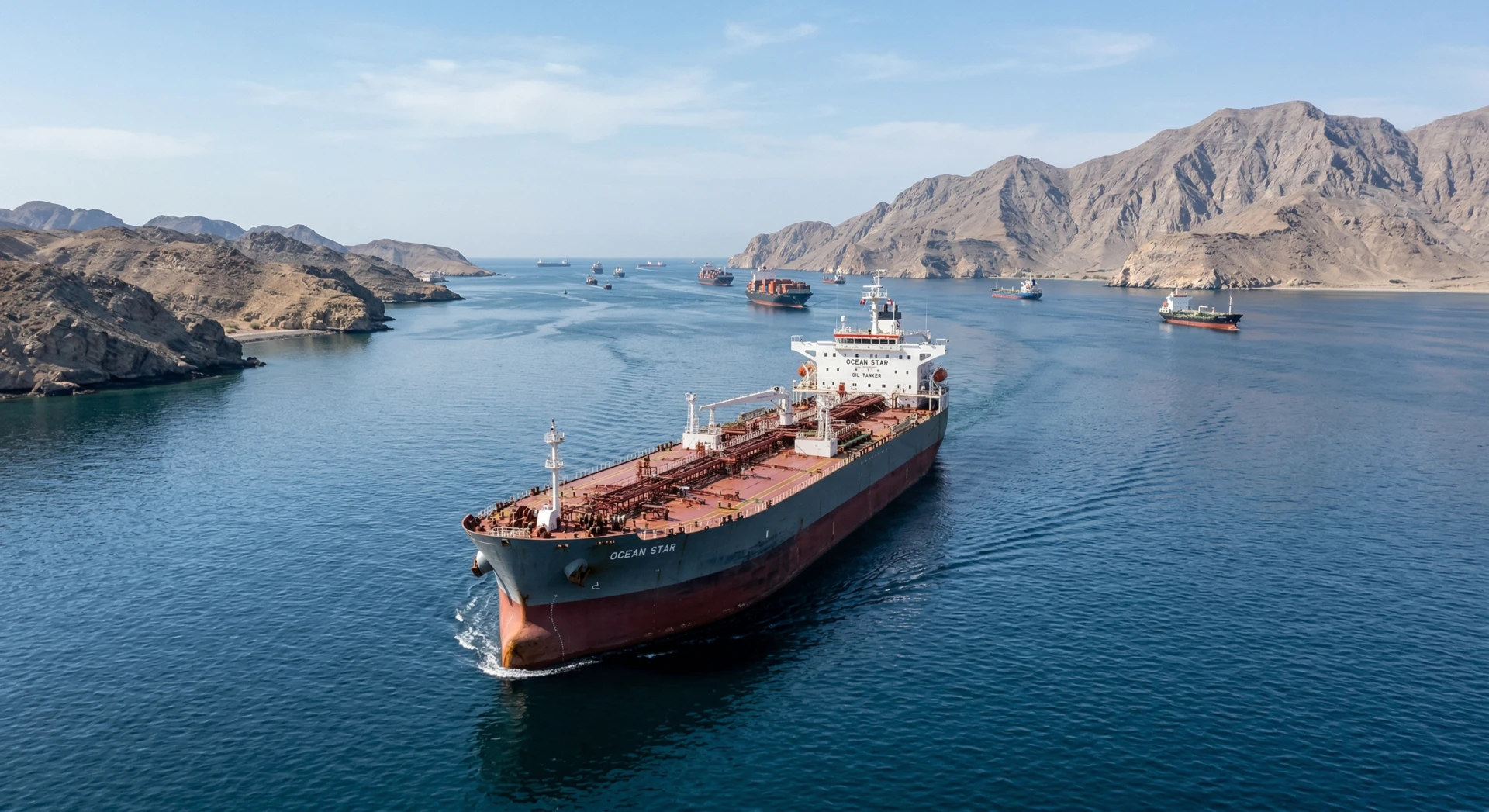
Start with what the attacks actually signal, because the operational detail matters more than the headline. The two vessels were struck while, in the phrase now circulating among shipowners, "sailing dark" running with their Automatic Identification System (AIS) transponders switched off. AIS is the transponder that broadcasts a vessel's identity, position, course and speed to satellites and coastal authorities; switching it off is what sanctioned-trade shadow fleets do to obscure origin, and it is now what mainstream Gulf tonnage is doing to avoid being targeted. When ADNOC controlled tankers go dark in their own home waters, the message to every charterer is unambiguous: the transponder that normally protects you by making you visible and legible to naval forces has become the beacon that gets you hit. That single behavioural shift legitimate cargo hiding like contraband is the clearest evidence that the risk has changed category, from price risk to physical security risk, and physical security risk does not clear on a de-escalation headline the way a price spike does.
Now the first structural point, and it is the one that breaks the trade that worked last week. The consensus refuge including in our own 10 July analysis was that the only Gulf barrels moving freely were the ones that never touch the chokepoint: the UAE's Fujairah terminal on the Gulf of Oman, fed by the Abu Dhabi Crude Oil Pipeline (ADCOP) that bypasses Hormuz entirely. That refuge is now compromised in two directions at once. The attacks landed on the Gulf of Oman side of the equation, near the very anchorage that was supposed to be safe, and the market response has been dozens of tankers stacking up at the Fujairah and Khor Fakkan anchorages not loading and sailing, but sitting, waiting, and forming exactly the kind of dense, stationary, high-value cluster that is itself a target. The refuge has become a car park. Optionality that looked free a week ago the ability to load at Fujairah and skip the strait has been repriced to expensive and uncertain, and the operators who built their July supply plans around it are now discovering that the escape route has its own queue and its own risk.
The second structural fact is a policy instrument that dwarfs everything the insurance market is doing, and most desks have not yet modelled it properly. Trump's 20% levy on every non-Iranian transiting cargo is, at $86 Brent, a de facto tax of roughly $17.20 on every barrel that passes through Hormuz. On a Very Large Crude Carrier (VLCC the supertanker class carrying 2 million barrels), that is approximately $34 million of imposed cost per cargo, appearing at the chokepoint, payable by someone. Decompose where that lands, because a levy is only a number until you trace who actually pays it. If it is collected from the carrier, it is passed to the charterer; if from the charterer, it is passed to the cargo owner; if the cargo is sold on delivered terms, it lands on the buyer. In practice, in a seller's market with backwardation deepening, it lands on the buyer the European or Asian refiner because the seller has the pricing power. But there is a policy versus practice gap the size of the strait here: it is not remotely clear how a 20% levy on cargoes passing through international waters and Omani and Iranian territorial waters is enforced, collected, or adjudicated, and the history of unilateral chokepoint tolls is a history of evasion, reflagging, and disputed jurisdiction. The levy's first-order effect is real it is already in the $86 print as risk. Its second-order effect, if enforcement proves selective, is a two-tier market: cargoes that pay and clear quickly, and cargoes that route around it through legal grey zones, with the spread between them becoming a pure trading opportunity for whoever has the relationships to work the grey.
Set the levy beside the freight and insurance repricing and you can see the full margin anatomy of a Hormuz-transit barrel today, because the flat price is the least of it. Take the acquisition cost of the crude at roughly $86. Add war-risk insurance the specialist premium applied to vessels transiting active conflict zones, charged as a percentage of combined hull and cargo value which has repriced from around 0.1% to an estimated 0.4-0.5% since the strikes; on a VLCC carrying $172 million of cargo plus a $90-100 million hull, that increment is on the order of $1.0-1.3 million per transit, or roughly $0.50-0.65 per barrel. Add the 20% levy at ~$17/barrel. Add financing: a letter of credit (LC) the bank guarantee that underpins most cross-border commodity trade now has to cover a cargo whose delivered value has jumped from ~$152 million at $76 to ~$172 million plus at $86 with the levy loaded, so the same trade consumes more of a buyer's LC line, and confirmation spreads in a war corridor widen as banks price the documentary and jurisdictional risk. The commodity price moved $10. The all-in delivered cost of getting a Hormuz-transit barrel to a European refinery moved far more than $10, and most of the increment is in the freight, insurance, levy and financing stack the components that never appear in the Brent headline. Freight and financing are not the rounding error in this trade. This week they are the trade.
Follow the freight thread specifically, because it tells you where value is migrating. War-risk repricing and the levy do not fall evenly across vessel classes and routes they restructure which tonnage earns and which sits. VLCCs that normally load at Kharg Island or transit Hormuz to Asian refineries are either idle, rerouting, or sailing dark; the tonnage that commands a premium is anything that can lift from a genuinely non-Hormuz load point, and that pool has just shrunk because Fujairah itself is now contested. Watch the Baltic Dirty Tanker Index (BDTI), and specifically the TD3C route from the Middle East Gulf to Japan: if TD3C VLCC rates spike hard, it confirms that scarce willing tonnage is extracting rent from cargo owners; if they stall despite the crisis, it signals that cargoes simply are not moving that the backlog is growing, not clearing. Whoever controls uncommitted, insurable, relationship cleared tonnage right now is capturing the margin that used to sit with the cargo, and that is a very small club.
Here is the elephant that almost no oil-desk coverage has named, and it is the reason a European buyer should be more worried about gas than about crude. Oil has a partial escape from Hormuz; LNG has none. The UAE can move roughly 1.5 million barrels a day of crude around the strait through ADCOP to Fujairah a real, if capacity-capped, bypass. There is no equivalent pipeline for liquefied natural gas. Qatar, which supplies roughly a fifth of the world's LNG, must sail every single cargo out through the Strait of Hormuz; there is no ADCOP for gas, no overland export-scale alternative, no way to reroute a molecule of Qatari LNG that does not begin with a tanker in the strait. The strait carries around a third of all seaborne LNG. This is why TTF at ~EUR52.96 is not a sympathetic move tracking oil it is the gas market beginning to price the fact that its single largest swing supplier to the seaborne market is behind a chokepoint that is now being mined with cruise missiles and toll booths. Crude can partially reroute and will find Atlantic Basin substitutes at a cost. Qatari LNG cannot reroute at all. For Europe, which spent three years rebuilding its gas security around LNG after piped Russian gas collapsed, that is the exposure that matters, and it is structurally worse than the oil exposure because there is no physical bypass to build toward on any relevant timescale.
That structural asymmetry drives the most commercially significant second-order effect now in motion. The attack on the safe route does not merely raise the premium on Hormuz-transit crude; it reprices war-risk insurance across the entire Gulf basin, including for LNG carriers, and LNG carriers are among the most expensive and specialised vessels afloat. As their war-risk premiums climb and some owners simply decline Gulf voyages, Qatari cargoes that would have gone to Asia on flexible terms get rationed, spot LNG tightens globally, and the marginal molecule Europe needs to cover a cold snap or a nuclear outage this coming winter gets more expensive and less certain - months before winter, while storage decisions are being made now. The chain runs: missile strike on a Gulf tanker, to Gulf-wide war-risk repricing, to LNG carriers pricing out of Qatari loadings, to a global spot-LNG squeeze, to European gas-storage economics deteriorating in July for a risk that bites in January. The most actionable intelligence in this whole episode is not in the $86 crude print. It is in that sentence.
Disaggregate the crude by grade, because a $10 benchmark move never hits all barrels equally. The premium is loading most heavily into Hormuz dependent Gulf sour grades the medium and heavy sour crudes that Gulf producers ship east while light sweet Atlantic Basin grades gain relative attractiveness for any refiner configured to run them. Murban, the Abu Dhabi grade that can load from Fujairah, holds a security premium precisely because it has the partial bypass; Nigerian Bonny Light and Angolan Cabinda in the Atlantic Basin become competitive substitutes for European refiners despite the added freight of the longer haul, because the whole point is that they never approach the strait. But substitution has a ceiling and a spec problem: not every refinery calibrated for heavy Gulf sour can simply switch to light sweet West African crude without yield loss and reconfiguration, and the West African barrels that are reroutable are finite. The substitution is real at the margin and illusory in bulk.
On the buy side, the squeeze on European refiners is now three-dimensional, not two. Brent feeds their crude cost, TTF feeds the gas that powers their refining process, and the 20% levy loads onto any Hormuz-transit feedstock they take three rising costs at once, with the added structural threat that the gas leg has no bypass. The 3-2-1 crack spread - the rough refining margin modelled as two barrels of gasoline plus one of distillate minus three of crude compresses as WTI presses toward $80 into inelastic peak-summer gasoline demand in the United States, and demand for the refined product is low-elasticity in the near term because transport fuel has no quick substitute, so the cost passes downstream to households with a lag rather than destroying demand cleanly. US Gulf Coast and East Coast refiners feel the WTI leg; European refiners feel all three legs plus the LNG-shaped tail risk into winter.
On the sell side, precision matters, because "producers benefit" is the lazy version. The specific winners are producers who hold three things simultaneously: a genuine non-Hormuz load option, the bilateral relationships and mandate access to place rationed cargoes with premium buyers, and the balance-sheet and insurance capacity to keep sailing when war-risk premiums spike. That is a narrow set parts of ADNOC's book, Atlantic Basin national oil companies, US Gulf exporters and it explicitly excludes the many nominally well-positioned sellers who lack insurable tonnage or the relationship capital to access scarce vessels. Russia sits in an ambiguous corner of this: Urals, its discounted export grade, rises mechanically with Brent, and at roughly 7.7 million barrels a day of oil and products exports (of which about 3.9 Mb/d is seaborne crude), each additional dollar on Brent adds on the order of $5-8 million a day to Russian oil revenue a genuine tailwind, though from a wide ~$24 a barrel discount (about 28% below Brent) that reflects Russia's own degraded, drone battered refining base. The war premium punishing European buyers is, once again, partially refilling Moscow's treasury; that uncomfortable symmetry from last week is intact and larger.
The two operator scales face this with entirely different toolkits, and the practical advice diverges hard. A large integrated trader or national oil company trading arm a Vitol, a Trafigura, an ADNOC or Shell trading desk has exchange traded ICE Brent options to buy $90 call protection, has standing war-risk insurance facilities and the balance sheet to wear the premium, has the relationship capital to secure scarce insurable tonnage and Fujairah allocation, and can arbitrage the two-tier market the levy is creating. For them this is a positioning event, priced and hedged within the day. A smaller regional operator a mid-sized fuel importer, an independent distributor, a regional utility has none of that. Their realistic moves are physical and contractual, and the window is now: fix Q3 and Q4 supply on delivered terms before sellers reprice term books; negotiate explicit war-risk and levy pass-through clauses so a mid-contract escalation does not vaporise the margin; diversify loading origin toward Atlantic Basin grades even at a freight penalty; and, for anyone with gas exposure, lock winter LNG or hedge TTF now, because the gas risk is the one with no bypass to wait for. In a rationed, relationship driven market, the operator without bilateral access does not merely pay more they may not get allocated a cargo at all, which is a different and more dangerous problem than price.
Two honest unknowns sit underneath all of this, and treating them as settled is how books blow up in both directions. The first: no one actually knows whether the Fujairah and Gulf of Oman anchorages are safe or merely not yet hit, and the difference is the entire value of the bypass. If another cargo is struck at anchor, the refuge closes completely and the premium goes vertical; if the strikes prove to have been a one-off signal, the premium bleeds out over weeks. The second: the durability of the 20% levy and the blockade is a political variable, not a market one, and a single diplomatic reversal a revived Switzerland track, a back-channel de-escalation would collapse the war premium and resurrect the glut case that the IEA built in June, because those barrels still physically exist. This is why $86 should be understood for what it is: a risk price, not a scarcity price. The oil has not disappeared. What has disappeared is the certainty that it can move, and certainty can return faster than supply can.
History offers a sobering frame. The closest analogue is the Iran-Iraq tanker war of the 1980s, when attacks on Gulf shipping sent war-risk premiums and freight rates spiralling and kept them elevated for as long as the threat stayed credible. But today's episode is worse in one specific respect the 1980s did not feature: in that war, the alternative was to route around the combatants; today the designated alternative the non-Hormuz refuge at Fujairah is itself under fire, and the highest-value cargo of all, LNG, has no alternative at any price. Chokepoint premiums do not decay linearly. They stay elevated while the threat is credible and collapse only when it is convincingly removed, which is precisely why building a procurement plan around a rapid return to the $60s is a bet against the structure of how these premiums unwind.
For observers and buyers tracking this in real time, the signals that carry weight are concrete and time-bound. Watch Brent's daily ICE settlement against $86 and $90: a sustained hold above $86 confirms the physical-security premium is embedded, and a close above $90 marks the market pricing a prolonged, not transient, disruption. Watch TTF against EUR53 and EUR60, because the gas leg is the one with no bypass and therefore the truest measure of structural European exposure. Watch the Fujairah and Khor Fakkan anchorage counts and any second attack on anchored tonnage that single data point decides whether the refuge holds. Watch the Baltic Dirty Tanker Index TD3C route for whether cargoes are clearing at premium or simply not clearing. Watch Qatari LNG loadings and Gulf LNG-carrier war-risk quotes as the leading indicator of the winter gas problem. And watch the enforcement pattern of the 20% levy: if it is collected cleanly, it is a straightforward cost; if it is applied selectively, the two-tier spread it creates will be one of the largest trading opportunities of the year for the operators positioned to work it. The barrels still exist. This week, the only thing that has become scarce is the certainty that they can move and in physical commodity trade, certainty is the most valuable cargo of all.
.jpg)
.jpg)

'%3e%3cg id='Final-Copy-2_2_' transform='translate(1275.000000, 200.000000)'%3e%3cpath class='st0' d='M7.4,12.8h6.8l3.1-11.6H7.4C4.2,1.2,1.6,3.8,1.6,7S4.2,12.8,7.4,12.8z'/%3e%3c/g%3e%3c/g%3e%3c/g%3e%3cg id='final---dec.11-2020'%3e%3cg id='_x30_208-our-toggle' transform='translate(-1275.000000, -200.000000)'%3e%3cg id='Final-Copy-2' transform='translate(1275.000000, 200.000000)'%3e%3cpath class='st1' d='M22.6,0H7.4c-3.9,0-7,3.1-7,7s3.1,7,7,7h15.2c3.9,0,7-3.1,7-7S26.4,0,22.6,0z M1.6,7c0-3.2,2.6-5.8,5.8-5.8 h9.9l-3.1,11.6H7.4C4.2,12.8,1.6,10.2,1.6,7z'/%3e%3cpath id='x' class='st2' d='M24.6,4c0.2,0.2,0.2,0.6,0,0.8l0,0L22.5,7l2.2,2.2c0.2,0.2,0.2,0.6,0,0.8c-0.2,0.2-0.6,0.2-0.8,0 l0,0l-2.2-2.2L19.5,10c-0.2,0.2-0.6,0.2-0.8,0c-0.2-0.2-0.2-0.6,0-0.8l0,0L20.8,7l-2.2-2.2c-0.2-0.2-0.2-0.6,0-0.8 c0.2-0.2,0.6-0.2,0.8,0l0,0l2.2,2.2L23.8,4C24,3.8,24.4,3.8,24.6,4z'/%3e%3cpath id='y' class='st3' d='M12.7,4.1c0.2,0.2,0.3,0.6,0.1,0.8l0,0L8.6,9.8C8.5,9.9,8.4,10,8.3,10c-0.2,0.1-0.5,0.1-0.7-0.1l0,0 L5.4,7.7c-0.2-0.2-0.2-0.6,0-0.8c0.2-0.2,0.6-0.2,0.8,0l0,0L8,8.6l3.8-4.5C12,3.9,12.4,3.9,12.7,4.1z'/%3e%3c/g%3e%3c/g%3e%3c/g%3e%3c/g%3e%3c/svg%3e) Privacy Choices
Privacy Choices