.avif)

Between July 9 and 11, 2026, Gwadar Port completed its first international bunkering operation — supplying 2,500 metric tonnes of VLSFO (Very Low Sulphur Fuel Oil, the IMO 2020-compliant marine fuel containing no more than 0.5% sulphur) to the LNG carrier Enugu. The parties involved — NLC, Vitol Asia, Gwadar Port Authority (GPA), and GITL — formally launched commercial bunkering services at the port. For marine fuel suppliers assessing new supply points across the Arabian Sea, this marks the moment Gwadar transitions from a cargo-handling facility to a multi-service maritime hub in theory. Whether it can do so in practice, at competitive cost, is the question that will determine whether this single 2,500 MT operation is a landmark or an anomaly.
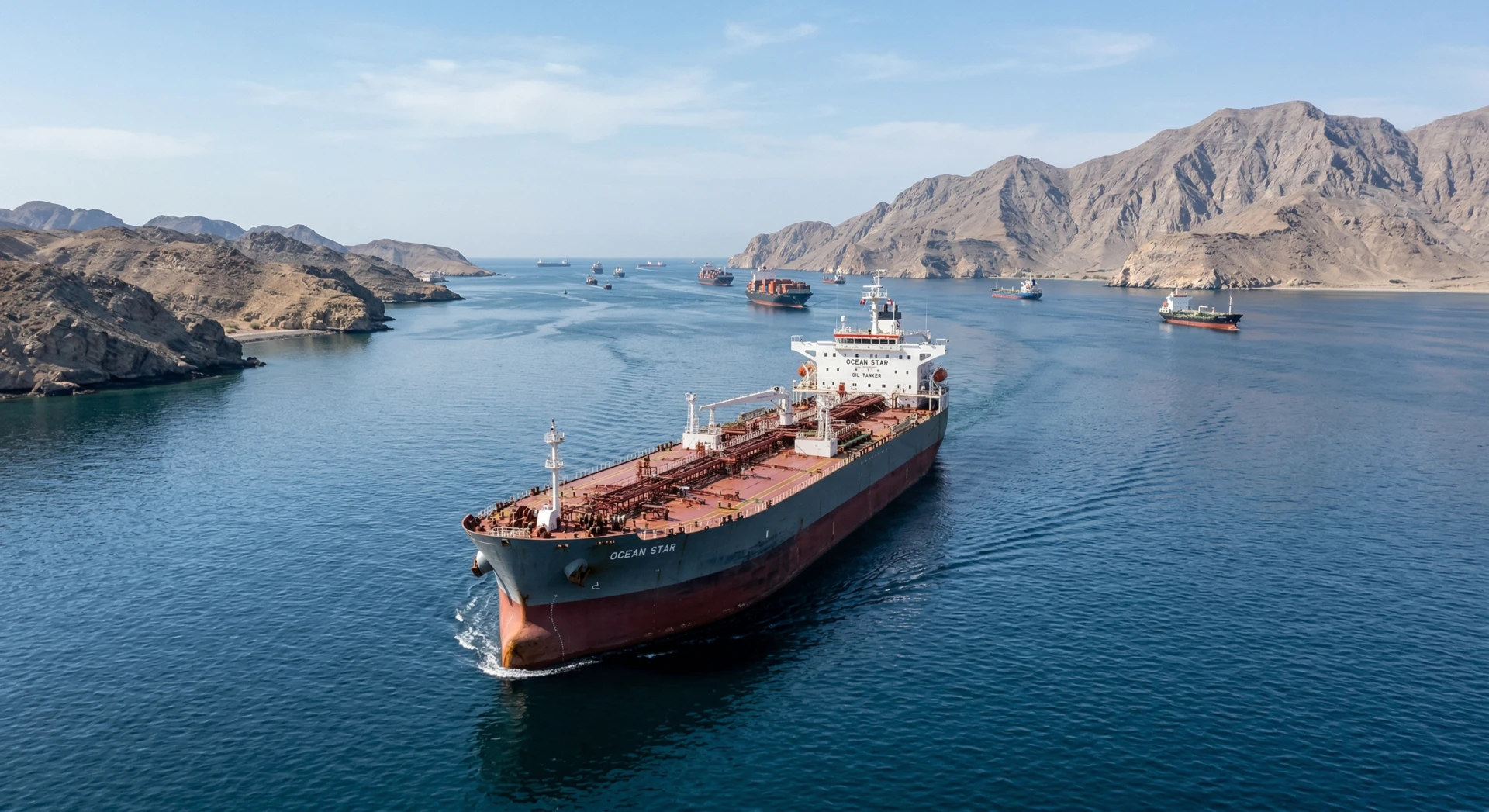
The physical operation merits close attention. The Enugu — a 285.4-metre LNG carrier, a vessel class that typically requires berths capable of handling drafts of 11–12 metres and specialised mooring infrastructure — was refuelled not at a dedicated marine terminal but via the bunker barge Marine Ista. A bunker barge is a dedicated smaller vessel that carries fuel and pumps it across to a waiting ship, avoiding the need for the receiving vessel to berth directly at a fuel terminal. Pakistan Customs and local shipping agent Pak Traders Gwadar oversaw compliance. The fuel itself was produced domestically by Cnergyico PK Limited, Pakistan's largest private refiner, whose Byco complex processes imported crude into, among other products, IMO-compliant marine fuels. This matters because it means the VLSFO did not need to be imported — the supply chain originates inside Pakistan's borders, which structurally lowers the foreign-exchange cost of the input but raises the question of whether Cnergyico's production economics can match regional spot pricing.
That pricing question is where the commercial case either stands or collapses. The established benchmark for Arabian Sea bunkering is Fujairah, UAE — the world's second-largest bunkering hub by volume, handling over 8 million metric tonnes of marine fuels annually, with deep VLSFO storage, multiple competing suppliers, and daily spot price transparency. VLSFO at Fujairah has traded in the $580–620 per metric tonne range in recent periods. Consider a vessel operator scheduling a bunkering call: detouring to Gwadar rather than Fujairah adds roughly 150–200 nautical miles of roundtrip steaming distance for a vessel transiting the Arabian Sea on an India–Europe or Gulf–Asia route. At a typical large LNG carrier speed of 17–19 knots and a daily operating cost of $30,000–$45,000, that detour costs approximately $56,000–$95,000 in additional time and fuel. Gwadar VLSFO would need to be priced at a meaningful discount to Fujairah — roughly $22–38 per metric tonne on a 2,500 MT lift — just to break even on the deviation cost, before any consideration of port fees, pilotage, or service quality.
On the sell side, Cnergyico PK is the entity with the most direct margin exposure. If sustained monthly bunkering volumes reached 10,000–15,000 MT — a target that would require attracting four to six vessel calls of this size per month — revenues would reach $6–9 million per month at Fujairah-equivalent pricing. At current volumes, that number is closer to $1.5 million per operation. The structural arbitrage exists in theory: if Cnergyico's domestic crude processing economics allow VLSFO production at a cost below $560/MT, the delivered margin at port — after barge costs, port fees, and agent charges — could still be positive even with a discount to Fujairah. That cost figure has not been independently verified or benchmarked. Until Cnergyico publishes or a trade house independently confirms delivered VLSFO pricing at Gwadar, the sell-side margin remains an assertion, not a fact.
On the buy side, two distinct operator types face different calculations. For a large integrated energy trader — Vitol, Trafigura, or a national oil company trading arm — Gwadar represents an optionality play rather than an immediate procurement decision. These operators can hedge VLSFO exposure via derivatives on the Singapore or Rotterdam paper markets — the S&P Global Platts VLSFO assessments being the primary settlement benchmarks — and will deploy physical bunkering at Gwadar only if the delivered price, after all costs, beats Fujairah on a risk-adjusted basis. Vitol's involvement in this inaugural operation is notable: it is simultaneously a validator of the facility's readiness and a demonstration of a commercial relationship that could convert into a structured supply agreement if volumes develop. For a smaller regional operator — a Pakistani coastal shipping company, a regional dry-bulk operator working Gulf-to-South-Asia routes — the calculus is different. These operators typically cannot access derivatives markets for price protection and depend on bilateral negotiated terms. If Gwadar can offer VLSFO on fixed, forward-priced contracts with 30–60 day delivery windows, that predictability alone has value regardless of a modest price premium over Fujairah spot.
The structural constraint Gwadar faces is not one problem but several compounding ones. Berth depth at Gwadar's main commercial pier limits direct access for the largest vessel classes — VLCCs (Very Large Crude Carriers, capable of carrying 2 million barrels of crude) and large LNG carriers — making the bunker-barge model structurally necessary rather than optional. That model adds cost and complexity relative to Fujairah's direct-to-vessel pipeline bunkering infrastructure. Storage capacity for VLSFO at Gwadar has not been publicly quantified; without dedicated shore tanks holding at minimum 30,000–50,000 MT of VLSFO, the port cannot guarantee availability to visiting vessels on short notice — the minimum requirement for a credible bunkering hub. Colombo and Fujairah hold competitive advantages not just in geography but in the depth of their maritime services ecosystems: ship chandlers (suppliers of provisions and stores), ship repair facilities, crew change infrastructure, and daily price transparency published by recognised indices. Gwadar currently offers none of these at scale.
For observers tracking whether Gwadar's bunkering ambitions convert into commercial traction, the signal to watch is monthly bunkering volume as reported by the Gwadar Port Authority, against which Platts or Argus Media VLSFO assessments for Fujairah should be compared. If Gwadar volumes reach 5,000 MT per month by the end of Q1 2027 — still a fraction of Fujairah's daily throughput — that would indicate the port has attracted repeat, non-captive callers and that the pricing gap is within tolerable range for at least some operator categories. If volumes remain below 5,000 MT per month six months after the commercial launch, the chicken-and-egg infrastructure problem — no throughput without competitive price, no competitive price without throughput — will be winning. The July 2026 operation is a proof of concept. It is not yet proof of a market.

.jpg)
.jpg)


'%3e%3cg id='Final-Copy-2_2_' transform='translate(1275.000000, 200.000000)'%3e%3cpath class='st0' d='M7.4,12.8h6.8l3.1-11.6H7.4C4.2,1.2,1.6,3.8,1.6,7S4.2,12.8,7.4,12.8z'/%3e%3c/g%3e%3c/g%3e%3c/g%3e%3cg id='final---dec.11-2020'%3e%3cg id='_x30_208-our-toggle' transform='translate(-1275.000000, -200.000000)'%3e%3cg id='Final-Copy-2' transform='translate(1275.000000, 200.000000)'%3e%3cpath class='st1' d='M22.6,0H7.4c-3.9,0-7,3.1-7,7s3.1,7,7,7h15.2c3.9,0,7-3.1,7-7S26.4,0,22.6,0z M1.6,7c0-3.2,2.6-5.8,5.8-5.8 h9.9l-3.1,11.6H7.4C4.2,12.8,1.6,10.2,1.6,7z'/%3e%3cpath id='x' class='st2' d='M24.6,4c0.2,0.2,0.2,0.6,0,0.8l0,0L22.5,7l2.2,2.2c0.2,0.2,0.2,0.6,0,0.8c-0.2,0.2-0.6,0.2-0.8,0 l0,0l-2.2-2.2L19.5,10c-0.2,0.2-0.6,0.2-0.8,0c-0.2-0.2-0.2-0.6,0-0.8l0,0L20.8,7l-2.2-2.2c-0.2-0.2-0.2-0.6,0-0.8 c0.2-0.2,0.6-0.2,0.8,0l0,0l2.2,2.2L23.8,4C24,3.8,24.4,3.8,24.6,4z'/%3e%3cpath id='y' class='st3' d='M12.7,4.1c0.2,0.2,0.3,0.6,0.1,0.8l0,0L8.6,9.8C8.5,9.9,8.4,10,8.3,10c-0.2,0.1-0.5,0.1-0.7-0.1l0,0 L5.4,7.7c-0.2-0.2-0.2-0.6,0-0.8c0.2-0.2,0.6-0.2,0.8,0l0,0L8,8.6l3.8-4.5C12,3.9,12.4,3.9,12.7,4.1z'/%3e%3c/g%3e%3c/g%3e%3c/g%3e%3c/g%3e%3c/svg%3e) Privacy Choices
Privacy Choices