.avif)
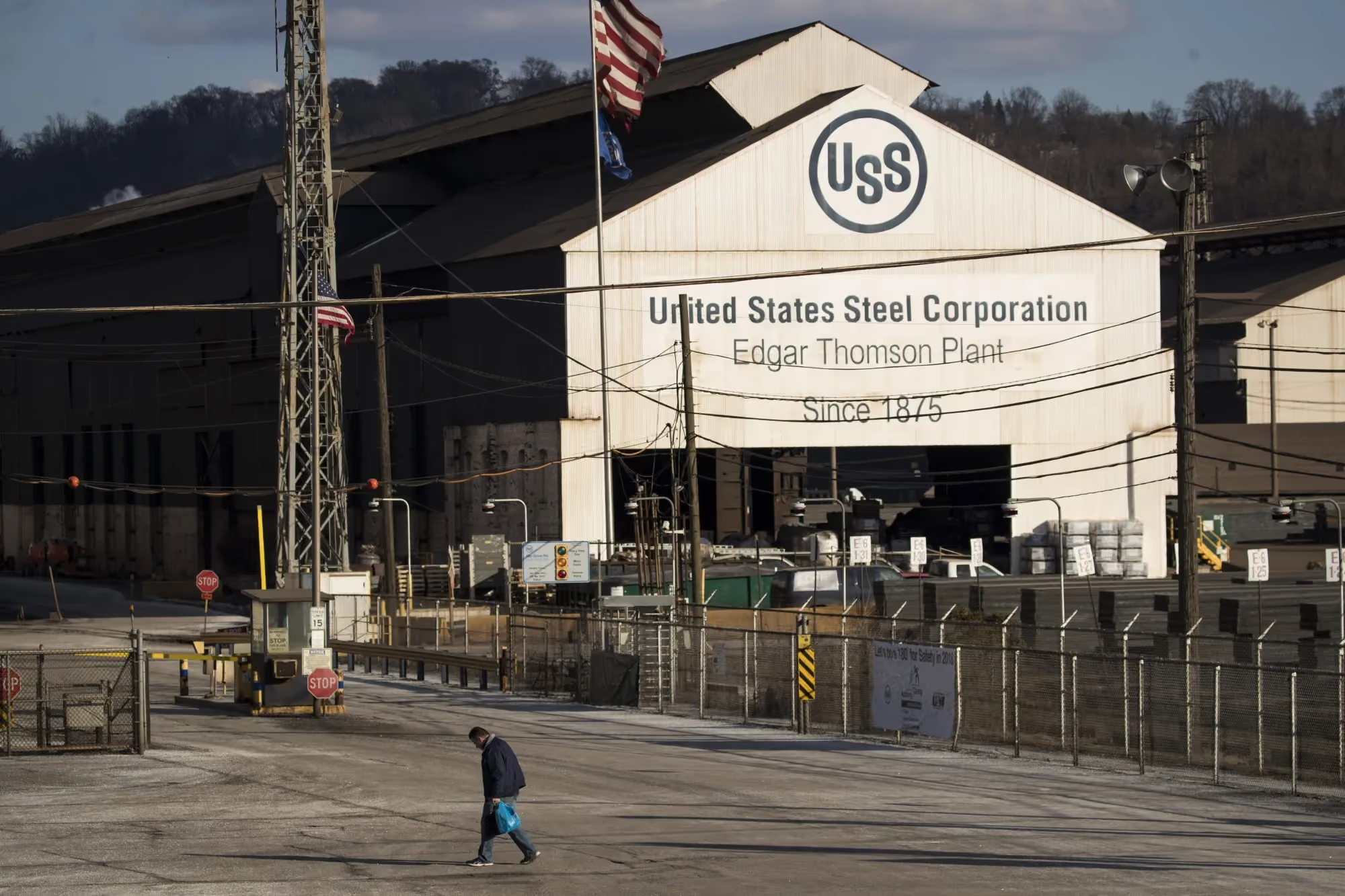
U.S. Steel's $475 million commitment at its Fairfield, Alabama tubular plant will add roughly 750,000 short tons per year of internal quench and tempering capacity for OCTG products by Q2 2029 reshaping domestic supply economics for every operator buying or selling oil country tubular goods into the Permian, Eagle Ford, Haynesville, and Appalachia basins within three years.
OCTG oil country tubular goods is the collective term for the steel pipe used in drilling and completing oil and gas wells: casing (the structural pipe cemented into the wellbore), tubing (through which hydrocarbons flow to surface), and drill pipe. The critical process here is quench-and-tempering, or Q&T: a heat treatment sequence in which steel pipe is rapidly cooled (quenched) in water or oil, then reheated to a lower temperature (tempered) to achieve precise combinations of tensile strength, toughness, and corrosion resistance. Today, U.S. Steel's Fairfield operation sends pipe to third party heat treaters for this process paying a toll of approximately $40–80 per short ton depending on grade and volume. Internalising that step across 750,000 tons per year captures between $30 million and $60 million annually in avoided third party cost, before any premium pricing benefit from tighter quality control. The project also adds full digital traceability from casting through finishing every joint of pipe tracked from the melt shop to the wellsite which increasingly matters to operators running integrity critical deepwater and high pressure/high temperature completions.
The worked example makes the margin logic concrete. Consider a Permian Basin E&P company completing a 15,000 foot horizontal well requiring roughly 400 short tons of Q&T casing. At today's domestic OCTG prices, that string costs approximately $1.2–1.4 million in tubular goods alone. A portion of that price currently reflects the toll heat treatment cost passed through the supply chain. Once Fairfield's integrated line is running, U.S. Steel can either compress that cost into a lower offered price competing harder against imports from Mexico, Argentina, Italy, and Japan or hold price and capture wider margin. For E&P buyers on the buy side, the competitive pressure on domestic pricing is a medium-term positive: more domestic tonnes competing for the same well programmes means narrower spreads between domestic and import parity. On the sell side, the pressure falls most directly on import reliant OCTG distributors who currently profit from the landed-cost arbitrage the gap between the delivered cost of imported pipe and the domestic market price. When a large domestic producer internalises cost and scales capacity, that gap narrows. Distributors holding long import inventory positions as 2029 approaches face inventory repricing risk if domestic prices soften relative to import parity.
Scale matters for how operators respond to this signal. For a large integrated steel producer or a national oil company's supply-chain arm entities with long-term frame agreements and access to futures or swap instruments on hot-rolled coil (the steel input benchmark that partially determines OCTG cost) the response is to engage U.S. Steel now on multi-year offtake structures that lock in domestic supply and pricing before the line is commissioned. The capacity will be competed for before it runs. For a smaller regional OCTG distributor or an independent E&P with no derivatives access and no contracting team dedicated to tubular procurement, the practical equivalent is simpler but no less urgent: begin qualifying Fairfield as a domestic source in your approved supplier list now, so that when the line starts producing in 2029 you are positioned to receive allocation rather than competing on spot. The $75 million premium thread line announced at Fairfield last November threading being the machined connection on pipe ends that determines how joints seal under pressure is already running, which means Fairfield can today deliver finished, threaded OCTG; the Q&T line extends that integration upstream into heat treatment.
Two structural uncertainties temper the headline optimism. First, the timing mismatch is real: Q2 2029 is three years away, and U.S. unconventional drilling activity is acutely sensitive to the WTI crude oil price and Henry Hub natural gas price cycles that will prevail then neither of which is knowable today. If WTI softens materially or Haynesville gas economics deteriorate before commissioning, the 750,000-ton demand thesis shifts substantially. Second, the Nippon Steel acquisition of U.S. Steel under which this investment sits within an announced $11 billion U.S. capital commitment remains subject to unresolved regulatory and political scrutiny, according to reports. If the deal is restructured or unwound, funding continuity for this and other committed capex projects becomes a live question that the headline treats as settled. For observers tracking the forward signal, the specific indicator to watch is the U.S. Census Bureau's monthly OCTG import volume data (HTS code 7304/7306 series), published with a six to eight week lag, over the 2027–2029 window. A sustained drop in import volumes ahead of Fairfield commissioning would confirm that the market is already repricing domestic supply expectations and that the arbitrage distributors currently rely on is closing faster than the line itself.

.jpg)

'%3e%3cg id='Final-Copy-2_2_' transform='translate(1275.000000, 200.000000)'%3e%3cpath class='st0' d='M7.4,12.8h6.8l3.1-11.6H7.4C4.2,1.2,1.6,3.8,1.6,7S4.2,12.8,7.4,12.8z'/%3e%3c/g%3e%3c/g%3e%3c/g%3e%3cg id='final---dec.11-2020'%3e%3cg id='_x30_208-our-toggle' transform='translate(-1275.000000, -200.000000)'%3e%3cg id='Final-Copy-2' transform='translate(1275.000000, 200.000000)'%3e%3cpath class='st1' d='M22.6,0H7.4c-3.9,0-7,3.1-7,7s3.1,7,7,7h15.2c3.9,0,7-3.1,7-7S26.4,0,22.6,0z M1.6,7c0-3.2,2.6-5.8,5.8-5.8 h9.9l-3.1,11.6H7.4C4.2,12.8,1.6,10.2,1.6,7z'/%3e%3cpath id='x' class='st2' d='M24.6,4c0.2,0.2,0.2,0.6,0,0.8l0,0L22.5,7l2.2,2.2c0.2,0.2,0.2,0.6,0,0.8c-0.2,0.2-0.6,0.2-0.8,0 l0,0l-2.2-2.2L19.5,10c-0.2,0.2-0.6,0.2-0.8,0c-0.2-0.2-0.2-0.6,0-0.8l0,0L20.8,7l-2.2-2.2c-0.2-0.2-0.2-0.6,0-0.8 c0.2-0.2,0.6-0.2,0.8,0l0,0l2.2,2.2L23.8,4C24,3.8,24.4,3.8,24.6,4z'/%3e%3cpath id='y' class='st3' d='M12.7,4.1c0.2,0.2,0.3,0.6,0.1,0.8l0,0L8.6,9.8C8.5,9.9,8.4,10,8.3,10c-0.2,0.1-0.5,0.1-0.7-0.1l0,0 L5.4,7.7c-0.2-0.2-0.2-0.6,0-0.8c0.2-0.2,0.6-0.2,0.8,0l0,0L8,8.6l3.8-4.5C12,3.9,12.4,3.9,12.7,4.1z'/%3e%3c/g%3e%3c/g%3e%3c/g%3e%3c/g%3e%3c/svg%3e) Privacy Choices
Privacy Choices