.avif)
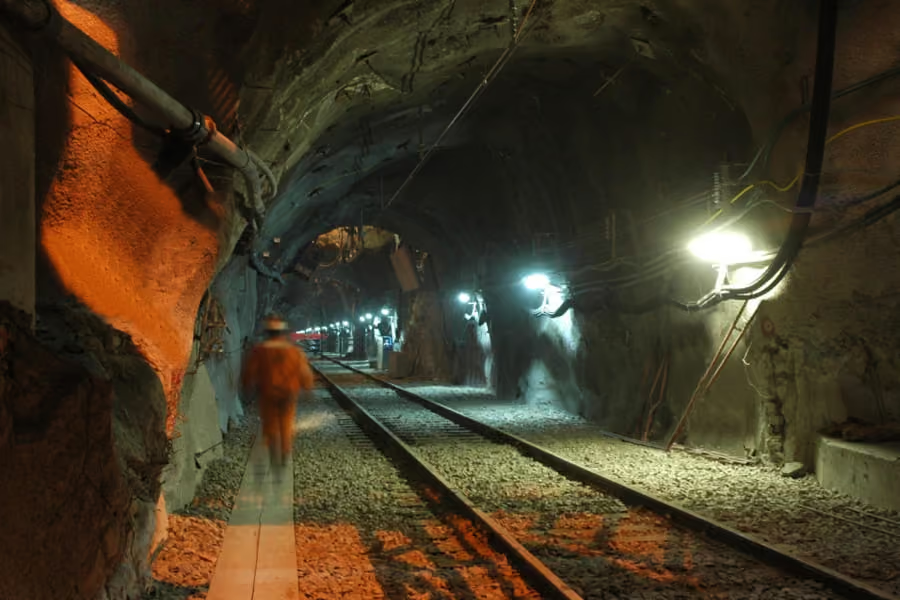
Copper smelters facilities that process raw copper concentrate into refined metal are facing margin erasure as Chile's production crisis pushes treatment charges (TC/RCs) to unprecedented lows. Chile's April copper output fell 13.8% year on year to 399,954 metric tons, marking the loss of more than 64,000 metric tons of supply in a single month. The annual TC/RC benchmark settled at USD 0 per tonne in January 2026, the lowest level ever agreed, and spot TC/RCs have been negative since 2024. For a mid-sized copper smelter processing 200,000 tonnes annually, the collapse from typical TC/RCs of $80-100/tonne to zero represents a $16-20 million annual margin hit before operating costs. The facility bleeds cash every day.
Statistics agency INE attributed the decline to "low ore grades at major companies in the sector" a gradual exhaustion of existing deposits that does not resolve in a quarter. Chile produced an estimated 5.3 million tonnes in 2025 nearly a quarter of global mine output, with state-owned Codelco alone contributing 1.332 million tonnes. The ore grade problem is exponential, not linear. Average ore grades at many flagship deposits have been declining as higher-grade ore at shallower depths becomes depleted, requiring processing more rock to extract the same amount of copper. What mines call "efficiency improvements" are actually desperate attempts to extract diminishing returns from aging geology.
On the buy side: Chinese smelters who process roughly 50% of global concentrate are cutting production by over 10% in 2026 to preserve working capital. China's top smelters have agreed to these cuts, and the government has halted around 2 million tonnes of planned new smelting capacity, but these cuts are not enough to meaningfully balance the market. A 500,000 tonne Chinese smelter operating at 80% utilization to preserve cash flow loses approximately $40 million in potential throughput revenue annually compared to full capacity, but avoids catastrophic concentrate procurement costs that would exceed $200/tonne above historical norms.
On the sell side: Non-Chilean concentrate suppliers are capturing windfall margins. Democratic Republic of the Congo and Peru follow Chile in global copper mining, and their concentrate now commands premiums of $15-25/tonne above benchmark pricing. A Congolese concentrate supplier shipping 30,000 tonnes monthly to Asian smelters captures an additional $450,000-750,000 per cargo in premium pricing margin that flows directly to the mining operation, not the smelter. Peruvian concentrate suppliers are experiencing similar dynamics, with term contracts being renegotiated mid-year to capture tightness premiums.
For large integrated traders (Glencore, Trafigura, major mining houses with downstream assets): The concentrate shortage creates arbitrage opportunities between regions, but also operational nightmares. Treatment charges in China have fallen below those in Europe and North America, inverting traditional flow patterns. A cargo of Chilean concentrate previously destined for a Chinese smelter might now be redirected to a European facility offering marginally better net smelter returns. However, the $2-3/tonne freight differential rarely compensates for the logistical complexity and relationship damage from contract redirection.
For smaller regional smelters mid-sized custom smelters in Europe, India, and Latin America without captive mine supply: The crisis is existential. Custom smelters outside China are particularly exposed to prolonged low-TC/RC environments, though some are partially shielded by integration into broader copper supply chains. A 150,000 tonne European smelter without long-term concentrate contracts faces negative margins of $30-50/tonne of throughput. The facility operates purely to maintain market relationships and workforce, hemorrhaging cash in anticipation of eventual TC/RC recovery.
Current LME copper prices near $6.37/lb ($13,512.50/tonne) provide some buffer for integrated producers, but smelters capture none of this upside. The copper price recovery reflects optimism over demand linked to artificial intelligence expansion and data center infrastructure, plus increasing consumption in global power networks. However, visible global inventories exceeded 1.3 million tonnes in March 2026, adding near-term pressure but not resolving structural tightness, with the concentrate market expected to remain tight for years.
Ore grade deterioration at Chile's major copper producers has been building for years, with April's figures putting a hard number on how fast that pressure is translating into lost output. Supply from Codelco risks further pullback as the company targets roughly $2 billion in cost reductions. This is not temporary operational optimization it represents fundamental capital allocation away from production maintenance toward debt reduction. The country that defined global copper supply for four decades is entering managed decline.
For observers: Monitor the Shanghai Futures Exchange copper warehouse stocks weekly through July. Chinese buyers represent around 60% of global copper demand and have been actively buying the dip to replenish inventories following sustained higher prices. When Chinese inventory accumulation peaks typically visible as SHFE stock stabilization it signals demand saturation and potential price correction. The technical support level sits at $11,100-11,200/tonne on LME, below which the current supply constraint narrative faces serious demand-side challenge. Until then, smelters endure margin compression while hoping for either mine supply recovery or demand destruction to rebalance treatment charges.





'%3e%3cg id='Final-Copy-2_2_' transform='translate(1275.000000, 200.000000)'%3e%3cpath class='st0' d='M7.4,12.8h6.8l3.1-11.6H7.4C4.2,1.2,1.6,3.8,1.6,7S4.2,12.8,7.4,12.8z'/%3e%3c/g%3e%3c/g%3e%3c/g%3e%3cg id='final---dec.11-2020'%3e%3cg id='_x30_208-our-toggle' transform='translate(-1275.000000, -200.000000)'%3e%3cg id='Final-Copy-2' transform='translate(1275.000000, 200.000000)'%3e%3cpath class='st1' d='M22.6,0H7.4c-3.9,0-7,3.1-7,7s3.1,7,7,7h15.2c3.9,0,7-3.1,7-7S26.4,0,22.6,0z M1.6,7c0-3.2,2.6-5.8,5.8-5.8 h9.9l-3.1,11.6H7.4C4.2,12.8,1.6,10.2,1.6,7z'/%3e%3cpath id='x' class='st2' d='M24.6,4c0.2,0.2,0.2,0.6,0,0.8l0,0L22.5,7l2.2,2.2c0.2,0.2,0.2,0.6,0,0.8c-0.2,0.2-0.6,0.2-0.8,0 l0,0l-2.2-2.2L19.5,10c-0.2,0.2-0.6,0.2-0.8,0c-0.2-0.2-0.2-0.6,0-0.8l0,0L20.8,7l-2.2-2.2c-0.2-0.2-0.2-0.6,0-0.8 c0.2-0.2,0.6-0.2,0.8,0l0,0l2.2,2.2L23.8,4C24,3.8,24.4,3.8,24.6,4z'/%3e%3cpath id='y' class='st3' d='M12.7,4.1c0.2,0.2,0.3,0.6,0.1,0.8l0,0L8.6,9.8C8.5,9.9,8.4,10,8.3,10c-0.2,0.1-0.5,0.1-0.7-0.1l0,0 L5.4,7.7c-0.2-0.2-0.2-0.6,0-0.8c0.2-0.2,0.6-0.2,0.8,0l0,0L8,8.6l3.8-4.5C12,3.9,12.4,3.9,12.7,4.1z'/%3e%3c/g%3e%3c/g%3e%3c/g%3e%3c/g%3e%3c/svg%3e) Privacy Choices
Privacy Choices