.avif)
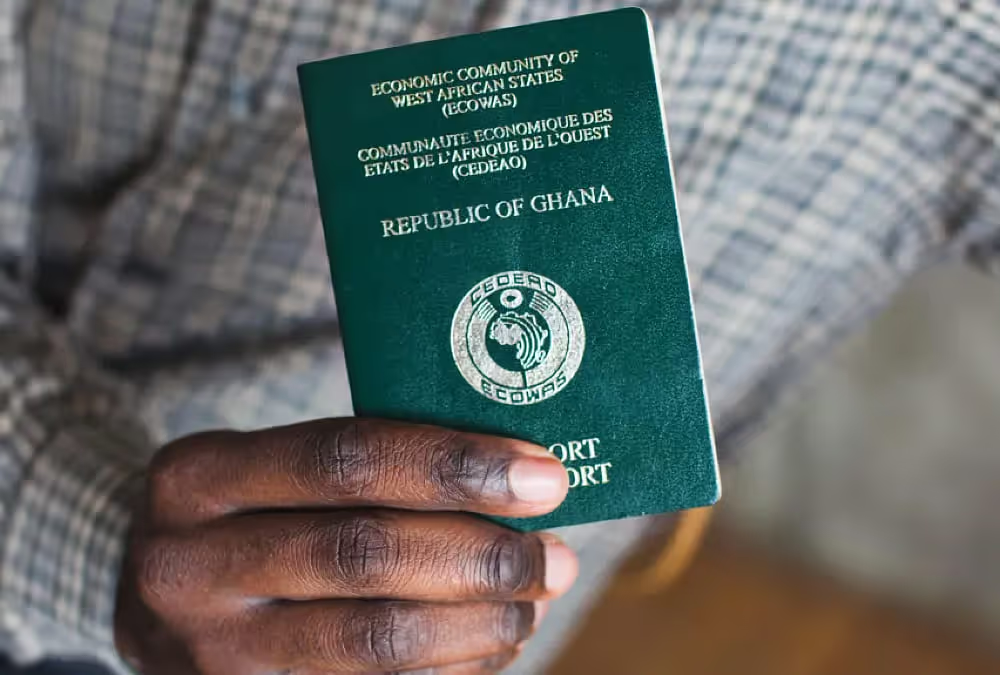
Ghana's visa-free policy for all African passport holders, effective May 25, 2026, positions agricultural commodity buyers for both opportunity and bottleneck risk at Tema port. The policy making Ghana the fifth African nation to eliminate visa barriers for continental travelers directly targets boosting intra-African trade and supporting AfCFTA implementation by reducing movement friction for traders and entrepreneurs. For cocoa and gold buyers with existing Ghana operations, the move signals potential volume increases as regional traders gain easier market access. However, Tema port already operates near capacity during peak cocoa export seasons (October-March), and increased trade flows without corresponding infrastructure investment could create new congestion rather than smoother operations.
Buyers sourcing cocoa, gold, or other Ghanaian commodities face immediate logistics planning decisions as the policy approaches. The visa free regime could attract more regional traders and cargo flows, potentially increasing competition for port slots, storage facilities, and inland transport capacity. Those operating on spot terms for cocoa purchases might find themselves competing with newly enabled African traders who previously faced visa barriers. Meanwhile, established buyers with forward contracts and pre-negotiated port allocations may benefit from increased liquidity and potential arbitrage opportunities as market participation broadens. The key commercial question becomes whether Ghana's port and logistics infrastructure can absorb additional trade volume without creating costly delays.
Sellers of agricultural inputs, equipment, or services to Ghana's commodity sector should monitor whether the policy actually materializes this time, President Akufo Addo announced similar visa free access in January 2025 that never implemented. If successful, the initiative could expand the customer base for agricultural technology, financing, and logistics services as more African entrepreneurs gain easier access to Ghana's markets. Regional grain traders, equipment suppliers, and service providers might consider Ghana as a continental hub under the new regime. However, infrastructure constraints could also create demand for port expansion, storage solutions, and inland transport capacity potential opportunities for logistics providers and infrastructure investors.
The visa policy's success hinges on implementation details that remain unclear, particularly around security screening processes and border control efficiency. Ghana's broader immigration reforms promise to maintain security while streamlining travel, but the practical mechanics, including e-visa processing capacity and border checkpoint throughput will determine whether increased visitor flows translate to actual trade volume growth. For commodity markets, the timing matters: if the policy launches successfully in May 2026, the first test will come during Ghana's 2026-2027 cocoa season. Whether Ghana's infrastructure investment will match its policy ambitions, or whether visa-free access will simply shift bottlenecks from embassies to ports.
.jpg)



'%3e%3cg id='Final-Copy-2_2_' transform='translate(1275.000000, 200.000000)'%3e%3cpath class='st0' d='M7.4,12.8h6.8l3.1-11.6H7.4C4.2,1.2,1.6,3.8,1.6,7S4.2,12.8,7.4,12.8z'/%3e%3c/g%3e%3c/g%3e%3c/g%3e%3cg id='final---dec.11-2020'%3e%3cg id='_x30_208-our-toggle' transform='translate(-1275.000000, -200.000000)'%3e%3cg id='Final-Copy-2' transform='translate(1275.000000, 200.000000)'%3e%3cpath class='st1' d='M22.6,0H7.4c-3.9,0-7,3.1-7,7s3.1,7,7,7h15.2c3.9,0,7-3.1,7-7S26.4,0,22.6,0z M1.6,7c0-3.2,2.6-5.8,5.8-5.8 h9.9l-3.1,11.6H7.4C4.2,12.8,1.6,10.2,1.6,7z'/%3e%3cpath id='x' class='st2' d='M24.6,4c0.2,0.2,0.2,0.6,0,0.8l0,0L22.5,7l2.2,2.2c0.2,0.2,0.2,0.6,0,0.8c-0.2,0.2-0.6,0.2-0.8,0 l0,0l-2.2-2.2L19.5,10c-0.2,0.2-0.6,0.2-0.8,0c-0.2-0.2-0.2-0.6,0-0.8l0,0L20.8,7l-2.2-2.2c-0.2-0.2-0.2-0.6,0-0.8 c0.2-0.2,0.6-0.2,0.8,0l0,0l2.2,2.2L23.8,4C24,3.8,24.4,3.8,24.6,4z'/%3e%3cpath id='y' class='st3' d='M12.7,4.1c0.2,0.2,0.3,0.6,0.1,0.8l0,0L8.6,9.8C8.5,9.9,8.4,10,8.3,10c-0.2,0.1-0.5,0.1-0.7-0.1l0,0 L5.4,7.7c-0.2-0.2-0.2-0.6,0-0.8c0.2-0.2,0.6-0.2,0.8,0l0,0L8,8.6l3.8-4.5C12,3.9,12.4,3.9,12.7,4.1z'/%3e%3c/g%3e%3c/g%3e%3c/g%3e%3c/g%3e%3c/svg%3e) Privacy Choices
Privacy Choices