.avif)
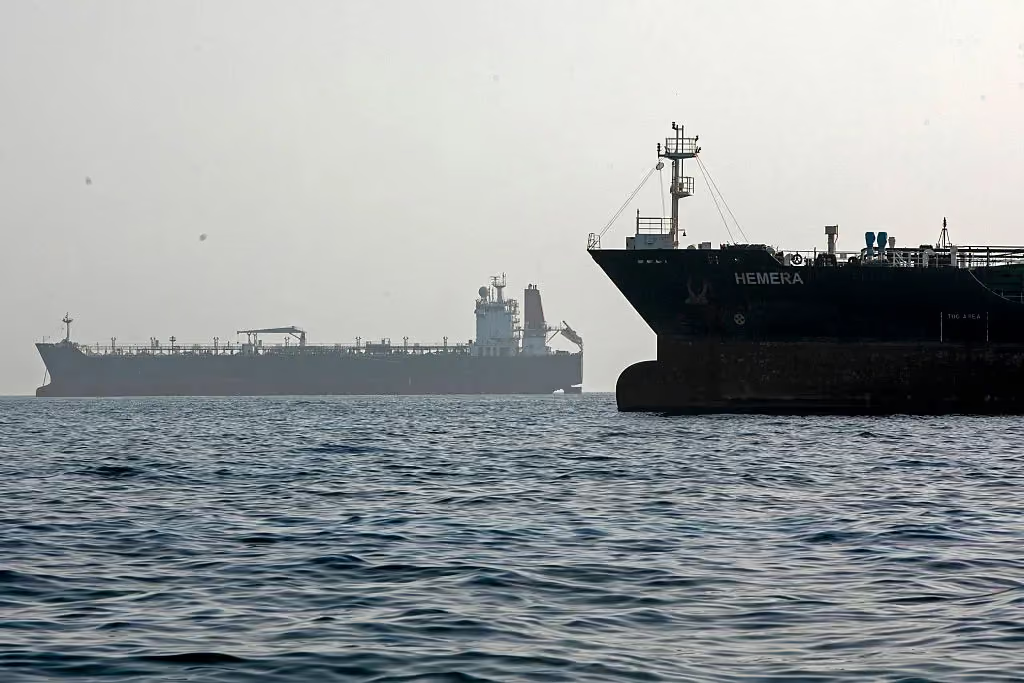
Crude oil traders face an immediate $2 million toll burden per vessel transiting the Strait of Hormuz, erasing margin and forcing route recalculation. With Brent crude falling 17% in May to $91.2/barrel and WTI down 16% to below $88/barrel on ceasefire speculation, the pricing environment compounds the cost impact of Iran's "navigational service fees." Qatar's Deputy Prime Minister Sheikh Saoud bin Abdulrahman Al Thani announced opposition to permanent fees but indicated temporary arrangements for mine-clearing could be considered. The distinction matters commercially: permanent tolls restructure global energy transport costs, temporary fees create a hedge-able expense.
Iran's Foreign Ministry insists these are "service fees rather than tolls," a distinction carrying significant weight under international maritime law. The UNCLOS regime of innocent passage through territorial waters prohibits imposing fees on passing ships unless they receive specific services. The semantic engineering serves Iran's legal position while doing nothing to reduce commercial impact. A VLCC (Very Large Crude Carrier a supertanker carrying 2 million barrels) paying $2 million in transit fees sees its delivered margin reduced by $1 per barrel before considering additional time-charter premiums, insurance surcharges, and routing penalties.
Qatar, Saudi Arabia, and the UAE issued a joint warning through the International Maritime Organization on May 25, 2026, advising vessels against complying with Iranian fee demands. The warning has proven commercially meaningless. Tanker operators cannot afford cargo delays or route cancellations to observe diplomatic positions. A shipowner facing $150,000 daily time-charter costs cannot idle a vessel at anchorage while governments negotiate. The $2 million toll represents 13 days of charter rates expensive but manageable compared to indefinite delays or Cape of Good Hope diversions adding $4-6 million in additional voyage costs.
Oman's Maritime Security Centre confirmed a suspected mine in Omani territorial waters on May 30, precisely within the jurisdictional seam Iran and Oman are negotiating for bilateral waterway co-management. The timing is not coincidental. Mine presence creates the operational justification for "navigational services" Iran bills at $2 million per vessel. Identified mine types include the Maham-3 with magnetic and acoustic sensors, the Maham-7 seabed limpet designed to evade sonar, and the Sadaf-03 engineered for high-current Hormuz conditions. Each mine type requires different clearance methodologies, justifying extended service periods and associated fees.
On the buy side: European refiners importing 500,000 barrel cargoes face an immediate $1 million toll surcharge per shipment, forcing supply chain recalculation. Integrated oil companies with existing long-term crude contracts must absorb the fee or renegotiate terms, with most choosing to pay rather than trigger force majeure clauses. Asian refiners dependent on Middle East crude see their feedstock advantage eroded the $2 million toll adds $4/barrel to smaller Suezmax cargoes, potentially making US shale crude competitive despite longer voyage distances.
On the sell side: Gulf producers find their crude pricing power constrained by transit costs their buyers cannot avoid. Saudi Aramco and other national oil companies effectively subsidize the Iranian toll through reduced FOB prices to maintain market share. Regional crude differentials have compressed as buyers factor transit costs into bidding strategies. Qatar's own North Field condensate shipments face the same $2 million burden, explaining Doha's commercial motivation for negotiating fee structures rather than accepting permanent arrangements that would structurally disadvantage its own exports.
For large integrated traders (Vitol, Trafigura, Gunvor), the $2 million toll becomes a hedging problem requiring derivative protection against route closure risk. These operators can access freight derivatives and oil options to lock in alternative routing costs, effectively converting the toll into an insurance premium. They also maintain global storage networks allowing inventory repositioning when Hormuz routes become uneconomical. The toll represents operational friction rather than existential threat to their business models.
For smaller regional operators independent fuel importers, domestic oil companies without derivatives access, cooperative purchasing groups the $2 million toll often exceeds their working capital for individual voyages. These operators cannot hedge route risk through derivatives and lack storage infrastructure for inventory management. They face binary choices: pay the toll and accept compressed margins, or source alternative crude from non-Hormuz origins at potentially higher prices. The regional fuel distributor importing 80,000 tonnes of diesel sees the toll add $25/tonne to costs often eliminating profit entirely.
During past regional conflicts, temporary toll arrangements have peaked at around $2 million per vessel, suggesting current Iranian pricing reflects historical precedent rather than arbitrary extraction. The 1987-88 Tanker War provides the closest comparison, when Iran conducted the most extensive naval mine campaign since World War II. That conflict's convoy escort system required 7-8 destroyers to protect 3-4 commercial ships daily costs ultimately reflected in shipping rates rather than direct tolls. The current Iranian approach monetizes security provision directly rather than forcing military intervention costs onto consuming nations.
The difference between a temporary toll expiring in six months and a permanent fee regime represents the difference between a speed bump and structural realignment for markets, with Qatar betting it can deliver the former. The financing structure under negotiation creates precedent for future chokepoint management. If Iran and Oman successfully establish temporary fee collection for mine clearance, other chokepoint nations may adopt similar models for Suez Canal security, Malacca Strait patrol, or Bab-el-Mandeb escort services. The Hormuz negotiations establish whether transit fees become normalized infrastructure costs or remain conflict-specific exceptions.
The immediate watch point is the Qatar-mediated talks schedule in Doha, where temporary fee duration and renewal mechanisms are under discussion. Whether Iran accepts temporary arrangements depends largely on progress with unlocking frozen assets. For operators, monitor PGSA transit fee announcements from Iran's Revolutionary Guard, which typically provides 48-72 hours advance notice of rate changes. Any reduction below $2 million per vessel signals successful Qatar mediation; increases above $2.5 million indicate negotiation breakdown and potential permanent regime implementation.


.jpg)
.jpg)

'%3e%3cg id='Final-Copy-2_2_' transform='translate(1275.000000, 200.000000)'%3e%3cpath class='st0' d='M7.4,12.8h6.8l3.1-11.6H7.4C4.2,1.2,1.6,3.8,1.6,7S4.2,12.8,7.4,12.8z'/%3e%3c/g%3e%3c/g%3e%3c/g%3e%3cg id='final---dec.11-2020'%3e%3cg id='_x30_208-our-toggle' transform='translate(-1275.000000, -200.000000)'%3e%3cg id='Final-Copy-2' transform='translate(1275.000000, 200.000000)'%3e%3cpath class='st1' d='M22.6,0H7.4c-3.9,0-7,3.1-7,7s3.1,7,7,7h15.2c3.9,0,7-3.1,7-7S26.4,0,22.6,0z M1.6,7c0-3.2,2.6-5.8,5.8-5.8 h9.9l-3.1,11.6H7.4C4.2,12.8,1.6,10.2,1.6,7z'/%3e%3cpath id='x' class='st2' d='M24.6,4c0.2,0.2,0.2,0.6,0,0.8l0,0L22.5,7l2.2,2.2c0.2,0.2,0.2,0.6,0,0.8c-0.2,0.2-0.6,0.2-0.8,0 l0,0l-2.2-2.2L19.5,10c-0.2,0.2-0.6,0.2-0.8,0c-0.2-0.2-0.2-0.6,0-0.8l0,0L20.8,7l-2.2-2.2c-0.2-0.2-0.2-0.6,0-0.8 c0.2-0.2,0.6-0.2,0.8,0l0,0l2.2,2.2L23.8,4C24,3.8,24.4,3.8,24.6,4z'/%3e%3cpath id='y' class='st3' d='M12.7,4.1c0.2,0.2,0.3,0.6,0.1,0.8l0,0L8.6,9.8C8.5,9.9,8.4,10,8.3,10c-0.2,0.1-0.5,0.1-0.7-0.1l0,0 L5.4,7.7c-0.2-0.2-0.2-0.6,0-0.8c0.2-0.2,0.6-0.2,0.8,0l0,0L8,8.6l3.8-4.5C12,3.9,12.4,3.9,12.7,4.1z'/%3e%3c/g%3e%3c/g%3e%3c/g%3e%3c/g%3e%3c/svg%3e) Privacy Choices
Privacy Choices