.avif)
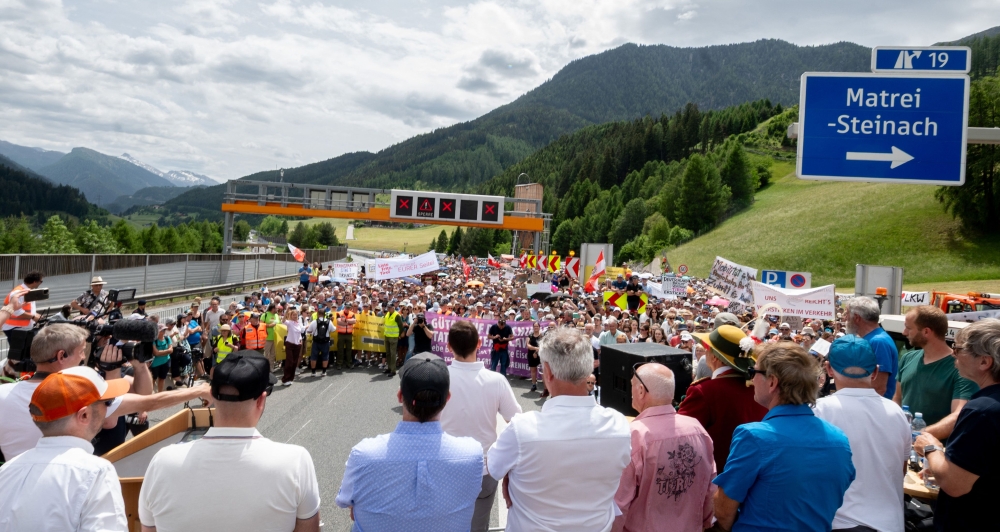
Road freight carriers absorbing rerouting delays and blocked Alpine corridors lost 20-25% operational efficiency on 30 May 2026, when around 3,000 protesters led by Karl Muehlsteiger shut down the Brenner motorway the primary Germany-Italy freight corridor handling 2.4 million vehicle crossings annually, compared to 900,000 lorries in 1991. The eight-hour closure of Europe's most vital Alpine pass a route with no meaningful alternatives exposed the structural vulnerability of continental road freight networks, where 219 commercial trucks were turned back from restricted zones during the demonstrations. Current European road freight contract rates stand at 140.1 index points, up substantially year over year, but carriers cannot pass through disruption costs on fixed contracts, making route blockages a direct margin hit.
The Brenner Pass operates as a chokepoint not a preference. The highway links northern and southern Europe, with the Austrian stretch providing trans-Alpine access into Italy. Swiss routes carry strict tonnage limits and impose transit fees 40-60% higher than Austrian equivalents. When Brenner closes, cargo doesn't flow smoothly to alternatives; it compresses through a handful of mountain passes with limited overflow capacity. The 2025 freight traffic alone contributed to 14,000 tons of nitrogen oxide emissions, reflecting the intensity of truck volumes that locals say have made daily life "no longer manageable for the population, no longer bearable". The protest targeted this specific constraint: organizers wanted to "send a message to Brussels, to the federal government in Vienna, that things absolutely cannot and must not continue like this with the constantly increasing traffic".
Consider a mid-sized German logistics operator moving 40 tonne loads from Munich to Milan via Brenner a 450 kilometre journey typically completed in 6-7 hours at approximately €1.20-1.40 per kilometre. The closure forced rerouting through Switzerland's San Bernardino or Gotthard passes, adding 200-300 kilometres and 4-6 additional hours. Swiss transit charges of CHF 325 ($350) per journey plus fuel for the extra distance increased total costs by roughly €200-250 per truck. For high-frequency operators running 50+ weekly Brenner crossings, the single-day disruption cost €10,000-12,500 in unrecoverable expenses. European road freight contract rates reached 140.1 index points, a solid 3.2-point increase quarter on quarter, while spot rates edged down slightly to 132.3 index points, meaning carriers absorbed the disruption without rate relief.
On the buy side, German automotive suppliers and Italian food distributors sectors heavily dependent on just-in-time Alpine crossings faced immediate inventory disruption. Major buyers like BMW's Munich logistics hub or Barilla's Parma distribution centre rely on 24-48 hour delivery windows that Brenner delays completely shatter. These operators maintain safety stock for routine delays but cannot absorb multi-day Alpine diversions without affecting production schedules. On the sell side, European road freight carriers particularly smaller Austrian and German haulers without flexible routing arrangements absorbed the full cost impact. The number of EU transport businesses ceasing operations has risen to a ten year high, with businesses ceasing to trade trending upwards as underlying costs have risen, making for toxic operating conditions. Large integrated logistics providers (DB Schenker, DHL, Kuehne+Nagel) can absorb single-day disruptions through network optimization, but regional operators lacking scale face direct margin compression from unplanned rerouting.
For large integrated logistics networks with EU-wide coverage: negotiate force majeure clauses in Alpine route contracts specifying disruption cost-sharing when major passes close for more than four hours. For regional road freight operators: establish bilateral agreements with Swiss transit partners to secure priority routing during Austrian blockages, accepting higher baseline costs for operational certainty. For observers: monitor the Austrian Transport Ministry's consultation on proposed "Brenner north access route" rail line scheduled for completion by Q3 2026 approval signals medium-term Alpine freight shift from road to rail, affecting carrier capacity allocation across Germany-Italy corridors.
.jpg)


'%3e%3cg id='Final-Copy-2_2_' transform='translate(1275.000000, 200.000000)'%3e%3cpath class='st0' d='M7.4,12.8h6.8l3.1-11.6H7.4C4.2,1.2,1.6,3.8,1.6,7S4.2,12.8,7.4,12.8z'/%3e%3c/g%3e%3c/g%3e%3c/g%3e%3cg id='final---dec.11-2020'%3e%3cg id='_x30_208-our-toggle' transform='translate(-1275.000000, -200.000000)'%3e%3cg id='Final-Copy-2' transform='translate(1275.000000, 200.000000)'%3e%3cpath class='st1' d='M22.6,0H7.4c-3.9,0-7,3.1-7,7s3.1,7,7,7h15.2c3.9,0,7-3.1,7-7S26.4,0,22.6,0z M1.6,7c0-3.2,2.6-5.8,5.8-5.8 h9.9l-3.1,11.6H7.4C4.2,12.8,1.6,10.2,1.6,7z'/%3e%3cpath id='x' class='st2' d='M24.6,4c0.2,0.2,0.2,0.6,0,0.8l0,0L22.5,7l2.2,2.2c0.2,0.2,0.2,0.6,0,0.8c-0.2,0.2-0.6,0.2-0.8,0 l0,0l-2.2-2.2L19.5,10c-0.2,0.2-0.6,0.2-0.8,0c-0.2-0.2-0.2-0.6,0-0.8l0,0L20.8,7l-2.2-2.2c-0.2-0.2-0.2-0.6,0-0.8 c0.2-0.2,0.6-0.2,0.8,0l0,0l2.2,2.2L23.8,4C24,3.8,24.4,3.8,24.6,4z'/%3e%3cpath id='y' class='st3' d='M12.7,4.1c0.2,0.2,0.3,0.6,0.1,0.8l0,0L8.6,9.8C8.5,9.9,8.4,10,8.3,10c-0.2,0.1-0.5,0.1-0.7-0.1l0,0 L5.4,7.7c-0.2-0.2-0.2-0.6,0-0.8c0.2-0.2,0.6-0.2,0.8,0l0,0L8,8.6l3.8-4.5C12,3.9,12.4,3.9,12.7,4.1z'/%3e%3c/g%3e%3c/g%3e%3c/g%3e%3c/g%3e%3c/svg%3e) Privacy Choices
Privacy Choices