.avif)
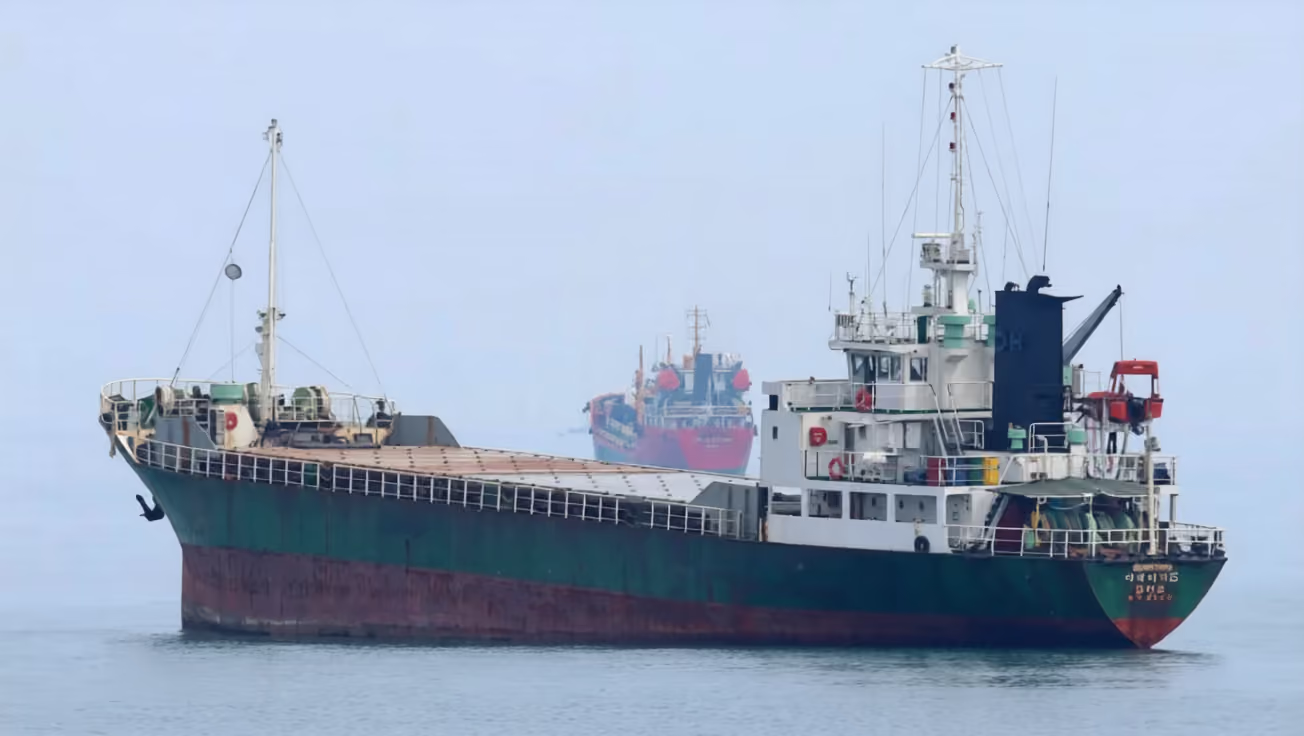
Middle East crude exporters face margin destruction and inventory strain as US naval forces escalate kinetic enforcement of the Iranian blockade. US aircraft fired a Hellfire missile into the Gambia-flagged M/V Lian Star's engine room on May 29 after issuing more than 20 warnings while the vessel attempted to breach the blockade toward an Iranian port. According to CENTCOM, five commercial ships have been disabled and 116 vessels redirected since the start of the blockade. The escalation transforms commercial risk calculations permanently even vessels not bound for Iran now operate under war-risk exposure that breaks traditional maritime insurance frameworks.
Commercial transit through the Strait of Hormuz reached just 4 vessels on May 24 against a typical 95 per day representing 4% of pre-crisis volume. This "chokepoint compression" where a critical shipping lane operates far below capacity due to military interdiction creates immediate margin pressure across the entire Gulf crude export system. Brent crude trades at $94.45 per barrel while WTI sits at $92.71, but price discovery has broken down. Physical crude from Gulf producers now requires alternative routing that adds 15-20 days and $3-5/barrel in freight costs, erasing thin trading margins entirely.
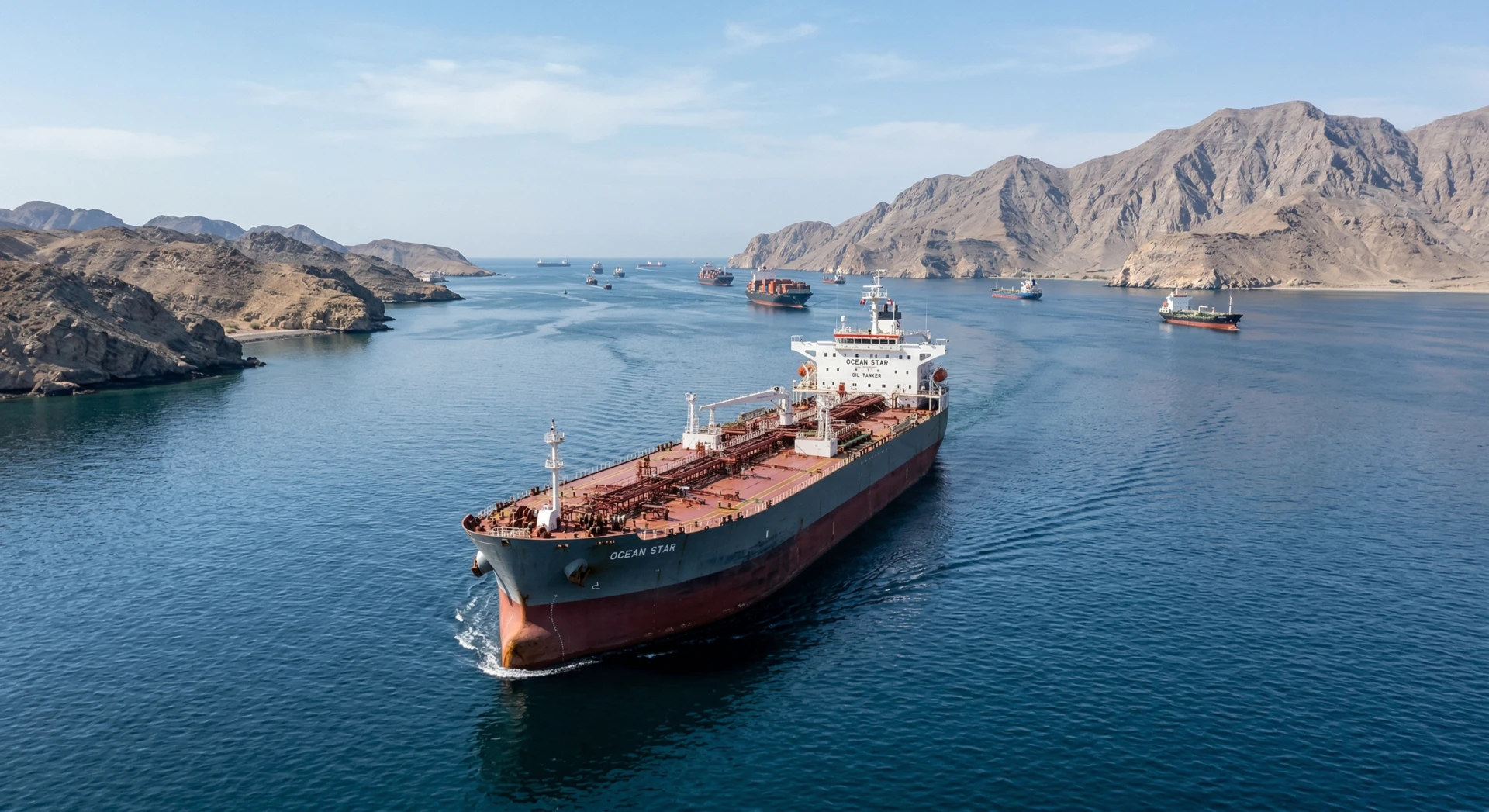
A Very Large Crude Carrier (VLCC) a supertanker capable of carrying 2 million barrels normally earns $14,000-18,000/day on the 18 day Jebel Ali to Singapore route. War-risk insurance for tankers now prices at 8.0× pre-crisis levels, with 6 P&I clubs withdrawing cover. At current war-risk premiums of 2.5-3.5% of vessel value per transit, a $80 million VLCC faces $2-2.8 million in additional insurance costs per voyage more than doubling operational expenses. The math is unforgiving: where margin existed at $1-2/barrel, it vanishes at current insurance loads.
The Strait of Hormuz a 33 kilometre wide chokepoint between Oman and Iran normally handles 25% of global seaborne oil trade and 20% of LNG shipments. Shipping traffic through the strait has been largely blocked by Iran since February 28, 2026, when the US and Israel launched air strikes against Iran, with the strait previously carrying about 25% of the world's seaborne oil trade. Following failed talks, the US Navy began blockading Iranian ports from April 13, creating what The Guardian described as a "dual blockade" with the US Navy blockading Iran and Iran blockading the Gulf. Ships must now route via the Cape of Good Hope, adding 6,000 nautical miles and 20+ days to Asia bound cargoes.
On the buy side: Asian refineries face acute supply disruption as Middle East crude typically 60-70% of their feedstock becomes uneconomical or unavailable. Japan sends 70% of its Middle Eastern crude through the strait and has already asked its government to release strategic petroleum reserves. Refiners are paying $8-12/barrel premiums for Atlantic Basin alternatives, with Dated Brent-Dubai spreads widening to abnormal levels as buyers compete for non-Gulf supply. Medium-scale refineries without long-term supply agreements face inventory shortfalls within 30-45 days.
On the sell side: Gulf producers confront a dual squeeze. Storage constraints force production cuts as export capacity evaporates Iraq, Saudi Arabia, Kuwait, UAE, Qatar, and Bahrain collectively shut in an estimated 9.1 million barrels per day in April due to storage constraints and infrastructure damage. National oil companies cannot monetise production stuck behind the blockade, creating immediate cash flow pressure for government budgets dependent on oil revenues. The Kingdom's East-West pipeline to Yanbu offers limited relief at 5 million barrels/day capacity versus 15+ million/day Hormuz requirements.
For large integrated traders Vitol, Trafigura, Mercuria the crisis creates both opportunity and risk. Alternative route arbitrage generates substantial profits: a Cape-routed VLCC from Saudi Arabia to China earns $45,000-60,000/day versus $18,000/day pre-crisis. However, these operators face massive working capital requirements as voyage times double and inventory turns collapse. A $500 million crude position now requires 40+ days to monetise versus 20 days pre-crisis, doubling financing costs and credit exposure.
For smaller regional operators independent fuel distributors, mid-sized trading houses, regional cooperatives the disruption proves existential. Without derivatives access or credit lines sufficient for extended voyage financing, these operators cannot compete for scarce supply. A Dubai based trader previously importing 100,000 barrels/month from Iran must now source from distant suppliers at double the cost while tying up capital for twice as long. Many simply exit the market.
The question is whether the sea interdictions are meant to sharpen leverage at the negotiating table or risk blowing up talks altogether, with the blockade doing both things at once: forcing ships to turn back, and putting a negotiation track under heavier strain. Each kinetic interdiction raises the stakes. The Lian Star incident represents the fifth disabled vessel, but precedent now exists for missile strikes on commercial traffic in international waters fundamentally altering risk calculations for vessel operators and cargo insurers globally.
Timing compounds the crisis. DHL's Middle East and Africa CEO told customers shipping through the Strait of Hormuz will take at least four to six months to normalise. This timeline assumes conflict resolution without political settlement, the dual blockade could persist indefinitely. Pentagon officials informed the US House Armed Services Committee that it could take six months to fully clear the Strait of Hormuz of mines deployed by Iranian forces. Even post-conflict normalisation requires extensive mine clearance operations before commercial transit resumes.
Financing structures that enable physical commodity trade assume predictable voyage times and manageable risks. Since the war began, traffic has been reduced to a trickle, with just 191 vessels recorded crossing in the entire month of April. Letters of credit bank guarantees that payment occurs upon document presentation typically allow 21-30 days for crude oil delivery. Current routing requires 45+ days, forcing expensive amendments or alternative financing arrangements that smaller operators cannot access.
War-risk exclusions in standard marine insurance policies mean most commercial vessels lack coverage for military action damage. War-risk insurance for tankers now prices at 8.0× pre-crisis levels, with 6 P&I clubs withdrawing cover. Even vessels avoiding Iranian ports face elevated premiums due to regional exposure. This insurance crisis creates a financing bottleneck banks won't provide trade finance without adequate vessel coverage, but coverage costs exceed voyage economics for many trades.
The enforcement precedent established by the Lian Star missile strike extends far beyond Gulf waters. Commercial vessel operators globally now recognise that naval forces may use lethal force against merchant shipping in contested waters. The disablement of a commercial vessel in international waters raises questions under the United Nations Convention on the Law of the Sea (UNCLOS). This precedent fundamentally alters global maritime risk assessment future blockades may adopt similar kinetic enforcement models.
Freight rates for alternative routes reflect structural capacity constraints rather than temporary premiums. Cape routing requires 40+ extra days versus Suez Canal passage, but Cape capable tonnage remains limited. Traffic through Hormuz in the last two months has run at about 5% of the pre-war average, leading to shortages of refined products, especially in Asia. Available vessel capacity cannot absorb diverted flows, creating sustained rate elevation that persists even if conflicts resolve the global tanker fleet lacks sufficient Cape capable tonnage to replicate Hormuz throughput via alternative routes.
For observers monitoring commercial developments, track the Baltic Exchange's weekly Time Charter Equivalent (TCE) rates for VLCCs on the Middle East-Far East route. The 30 day Escalation Probability forecast stands at 62% (high) with prediction market data showing forward-looking pricing of conflict outcomes. When TCE rates for alternative routing drop below $35,000/day from current $55,000+ levels, it signals either conflict de-escalation or sufficient vessel capacity diversion to normalise freight markets. Until then, margin compression persists for anyone dependent on Middle East crude flows.
.jpg)
.jpg)

'%3e%3cg id='Final-Copy-2_2_' transform='translate(1275.000000, 200.000000)'%3e%3cpath class='st0' d='M7.4,12.8h6.8l3.1-11.6H7.4C4.2,1.2,1.6,3.8,1.6,7S4.2,12.8,7.4,12.8z'/%3e%3c/g%3e%3c/g%3e%3c/g%3e%3cg id='final---dec.11-2020'%3e%3cg id='_x30_208-our-toggle' transform='translate(-1275.000000, -200.000000)'%3e%3cg id='Final-Copy-2' transform='translate(1275.000000, 200.000000)'%3e%3cpath class='st1' d='M22.6,0H7.4c-3.9,0-7,3.1-7,7s3.1,7,7,7h15.2c3.9,0,7-3.1,7-7S26.4,0,22.6,0z M1.6,7c0-3.2,2.6-5.8,5.8-5.8 h9.9l-3.1,11.6H7.4C4.2,12.8,1.6,10.2,1.6,7z'/%3e%3cpath id='x' class='st2' d='M24.6,4c0.2,0.2,0.2,0.6,0,0.8l0,0L22.5,7l2.2,2.2c0.2,0.2,0.2,0.6,0,0.8c-0.2,0.2-0.6,0.2-0.8,0 l0,0l-2.2-2.2L19.5,10c-0.2,0.2-0.6,0.2-0.8,0c-0.2-0.2-0.2-0.6,0-0.8l0,0L20.8,7l-2.2-2.2c-0.2-0.2-0.2-0.6,0-0.8 c0.2-0.2,0.6-0.2,0.8,0l0,0l2.2,2.2L23.8,4C24,3.8,24.4,3.8,24.6,4z'/%3e%3cpath id='y' class='st3' d='M12.7,4.1c0.2,0.2,0.3,0.6,0.1,0.8l0,0L8.6,9.8C8.5,9.9,8.4,10,8.3,10c-0.2,0.1-0.5,0.1-0.7-0.1l0,0 L5.4,7.7c-0.2-0.2-0.2-0.6,0-0.8c0.2-0.2,0.6-0.2,0.8,0l0,0L8,8.6l3.8-4.5C12,3.9,12.4,3.9,12.7,4.1z'/%3e%3c/g%3e%3c/g%3e%3c/g%3e%3c/g%3e%3c/svg%3e) Privacy Choices
Privacy Choices