.avif)
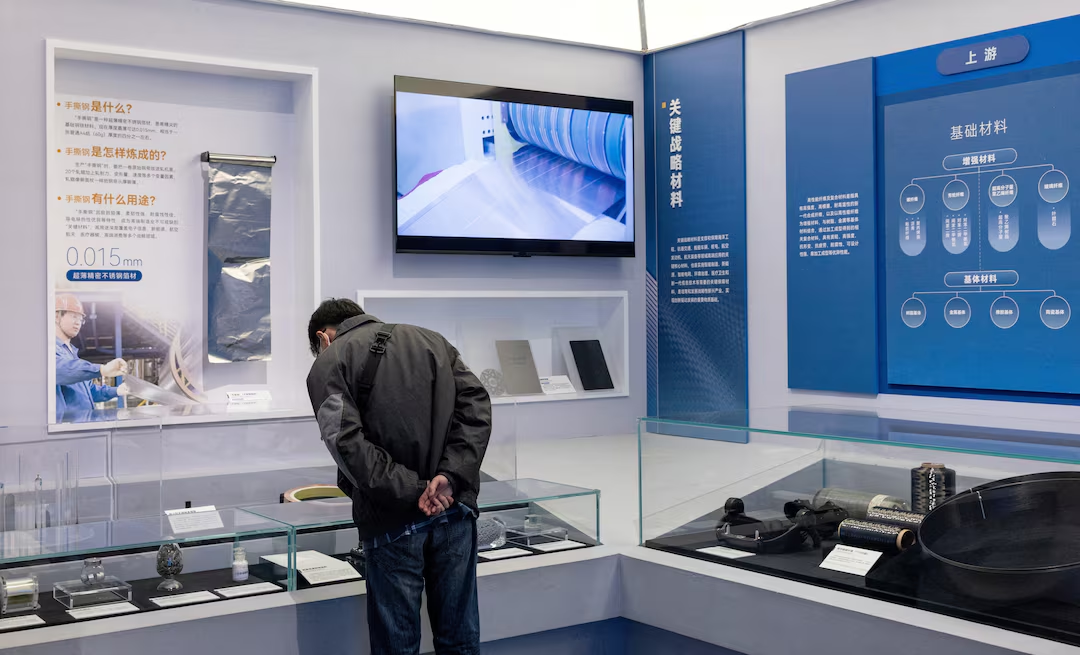
MP Materials and USA Rare Earth face immediate suspension of Chinese rare earth and dual-use material shipments as of 22 June 2026, with operational continuity not merely future supply now at risk across both companies' processing circuits.
China's Ministry of Commerce has added 10 US firms to its dual-use export control list a regulatory mechanism restricting exports of goods with both civilian and military applications effective immediately upon the announcement's release. MP Materials, which operates the Mountain Pass mine in California, and USA Rare Earth, developing the Round Top heavy rare earth deposit in West Texas, are the two entries with direct rare earth relevance. The listing does not just bar future sales. It requires Chinese exporters to suspend all ongoing shipments to the named entities without delay, and prohibits any third party worldwide from transferring Chinese made dual-use goods to those firms without Ministry of Commerce approval. That third-party prohibition is the clause procurement teams need to read carefully: it reaches into Malaysian, Estonian, and other intermediate processing nodes that handle Chinese origin feedstock before it arrives in Western supply chains.
The headline risk is supply interruption. The structural risk runs deeper. Mountain Pass is the only operating rare earth mine in the United States at meaningful scale, producing a mixed rare earth carbonate a partially processed intermediate that requires further separation into individual oxides such as neodymium and praseodymium, the elements used in permanent magnets for electric vehicle motors and defence guidance systems. MP Materials ships that carbonate to a separation facility, and its separation chemistry has historically relied on Chinese developed reagents, ion-exchange membranes, and solvent extraction equipment. If those processing inputs reagents, membranes, centrifuges are classified as dual-use items under Chinese regulations, which is entirely plausible given their military adjacent applications in nuclear and defence material processing, then the export controls extend beyond ore and oxide supply into the operational heart of Mountain Pass's separation circuit. USA Rare Earth's Round Top project faces an analogous constraint: the facility has not yet reached commercial scale separation, and its process development drew on Chinese separation know-how at the design stage.
Consider the margin arithmetic for a mid-sized US magnet manufacturer currently sourcing neodymium-praseodymium (NdPr) oxide the combined form of two magnetic rare earth elements from a Chinese supplier at approximately $65 per kilogram, the approximate benchmark price in mid-2026. That buyer now has three realistic options. First, source from Lynas Rare Earths, the Australian operator with a separation facility in Malaysia, at a security of supply premium that experienced negotiators currently estimate at 15–30% above Chinese benchmark pricing call it $75–$85/kg on a new contract. Second, accept spot availability from non-Chinese third country processors in Estonia at comparable or higher premiums with limited volume. Third, wait for MP Materials' domestic separation output to scale, which the export controls may now delay by 12–24 months. For a manufacturer consuming 200 tonnes of NdPr oxide annually, the move from $65/kg to $80/kg adds $3 million per year to input costs a meaningful compression in a business where magnet material is typically 40–60% of finished product cost.
On the sell side, Lynas Rare Earths and comparable non-Chinese operators are the clearest immediate beneficiaries. Lynas operates the Mount Weld mine in Western Australia one of the highest-grade rare earth deposits outside China and its LAMP separation facility in Kuantan, Malaysia, which processes mixed rare earth concentrate into separated oxides including NdPr. In the weeks following China's escalation, Lynas's contract negotiating position strengthens materially. Buyers who previously used Chinese pricing as a ceiling are now negotiating against supply scarcity and geopolitical risk premium, not just chemistry. African origin material principally from Malawi and Tanzania adds optionality at the exploration and concentrate stage but cannot provide separated oxides at commercial scale within any operationally relevant timeframe. The sell-side margin expansion is real, but it is concentrated in operators who already have separation infrastructure in service, not those still developing it.
The freight and logistics dimension of this disruption is less discussed but structurally important. Rare earth oxides and separated metals move in relatively small, high-value consignments typically 20–40-foot container shipments, not bulk carriers. The route from China's Jiangxi and Inner Mongolia processing provinces to US ports involves rail to Chinese coastal ports, ocean transit of 15–22 days, and onward trucking. That route is now severed for the named entities. The alternative routing Mount Weld concentrate to Kuantan by sea, separation in Malaysia, ocean transit to US East or Gulf Coast ports adds approximately 5–8 days of transit time and increases freight cost by an estimated $800–1,200 per tonne on a full container load, against an oxide value of $65,000–85,000 per tonne. Freight is a rounding error at these commodity values. The operational constraint is not shipping cost it is separation capacity, which cannot be built in months.
The licence application pathway that China's Ministry of Commerce offers for 'special, genuine necessity' cases involving the listed entities should not be read as a practical relief valve. It is fully discretionary and, based on the reported pattern of China's 2025 escalations batches of listings on 2 January (28 entities), 4 March (15 entities), April (12 entities), and several smaller additions since the licensing mechanism has functioned primarily as a delay and intelligence gathering tool rather than a genuine approval pathway, according to trade compliance analysts tracking the sequence. For large integrated rare earth processors or trading houses with legal resources, filing a licence application may preserve the appearance of an ongoing commercial relationship while alternative supply is arranged. For smaller regional magnet manufacturers or component buyers without dedicated trade compliance teams, the application process creates legal exposure and timeline uncertainty that practically forces them to seek alternative sources regardless of outcome.
For procurement operators at two scales: a large integrated defence contractor with an in-house supply chain team should immediately audit which of its tier-2 and tier-3 suppliers source Chinese-origin rare earth oxides or processed metals, and whether any of those intermediaries are now subject to the third-party transfer prohibition. The instrument here is a full dual-use classification review of every Chinese origin input in the magnet supply chain, cross-referenced against the updated Ministry of Commerce list. For a smaller regional buyer a mid-sized EV component manufacturer or an independent motor winding shop without that legal infrastructure, the practical equivalent is: contact Lynas's commercial team and Less Common Metals in Estonia directly this week, establish indicative pricing, and begin a qualification process for alternative material even if current inventory provides 60–90 days of runway. Qualification of a new rare earth oxide source for magnet-grade applications typically takes 3–6 months.
Observers should track two specific signals over the next 30 days. First, the Metal Pages NdPr oxide price assessment published daily, on a cost-insurance freight China basis and any divergence between that benchmark and ex-works Lynas or third country pricing: a spread widening beyond $15/kg signals that the supply premium is crystallising into a structural price tier, not a temporary disruption spike. Second, watch for any Ministry of Commerce licence approval announcement for MP Materials or USA Rare Earth: approval would signal that China is managing the escalation tactically rather than seeking a full commercial severance; continued silence or denial through mid-July 2026 would confirm that the controls are intended to be operationally effective. The Mountain Pass separation circuit's next scheduled production run is the tangible operational clock against which both signals should be read.
'%3e%3cg id='Final-Copy-2_2_' transform='translate(1275.000000, 200.000000)'%3e%3cpath class='st0' d='M7.4,12.8h6.8l3.1-11.6H7.4C4.2,1.2,1.6,3.8,1.6,7S4.2,12.8,7.4,12.8z'/%3e%3c/g%3e%3c/g%3e%3c/g%3e%3cg id='final---dec.11-2020'%3e%3cg id='_x30_208-our-toggle' transform='translate(-1275.000000, -200.000000)'%3e%3cg id='Final-Copy-2' transform='translate(1275.000000, 200.000000)'%3e%3cpath class='st1' d='M22.6,0H7.4c-3.9,0-7,3.1-7,7s3.1,7,7,7h15.2c3.9,0,7-3.1,7-7S26.4,0,22.6,0z M1.6,7c0-3.2,2.6-5.8,5.8-5.8 h9.9l-3.1,11.6H7.4C4.2,12.8,1.6,10.2,1.6,7z'/%3e%3cpath id='x' class='st2' d='M24.6,4c0.2,0.2,0.2,0.6,0,0.8l0,0L22.5,7l2.2,2.2c0.2,0.2,0.2,0.6,0,0.8c-0.2,0.2-0.6,0.2-0.8,0 l0,0l-2.2-2.2L19.5,10c-0.2,0.2-0.6,0.2-0.8,0c-0.2-0.2-0.2-0.6,0-0.8l0,0L20.8,7l-2.2-2.2c-0.2-0.2-0.2-0.6,0-0.8 c0.2-0.2,0.6-0.2,0.8,0l0,0l2.2,2.2L23.8,4C24,3.8,24.4,3.8,24.6,4z'/%3e%3cpath id='y' class='st3' d='M12.7,4.1c0.2,0.2,0.3,0.6,0.1,0.8l0,0L8.6,9.8C8.5,9.9,8.4,10,8.3,10c-0.2,0.1-0.5,0.1-0.7-0.1l0,0 L5.4,7.7c-0.2-0.2-0.2-0.6,0-0.8c0.2-0.2,0.6-0.2,0.8,0l0,0L8,8.6l3.8-4.5C12,3.9,12.4,3.9,12.7,4.1z'/%3e%3c/g%3e%3c/g%3e%3c/g%3e%3c/g%3e%3c/svg%3e) Privacy Choices
Privacy Choices