.avif)
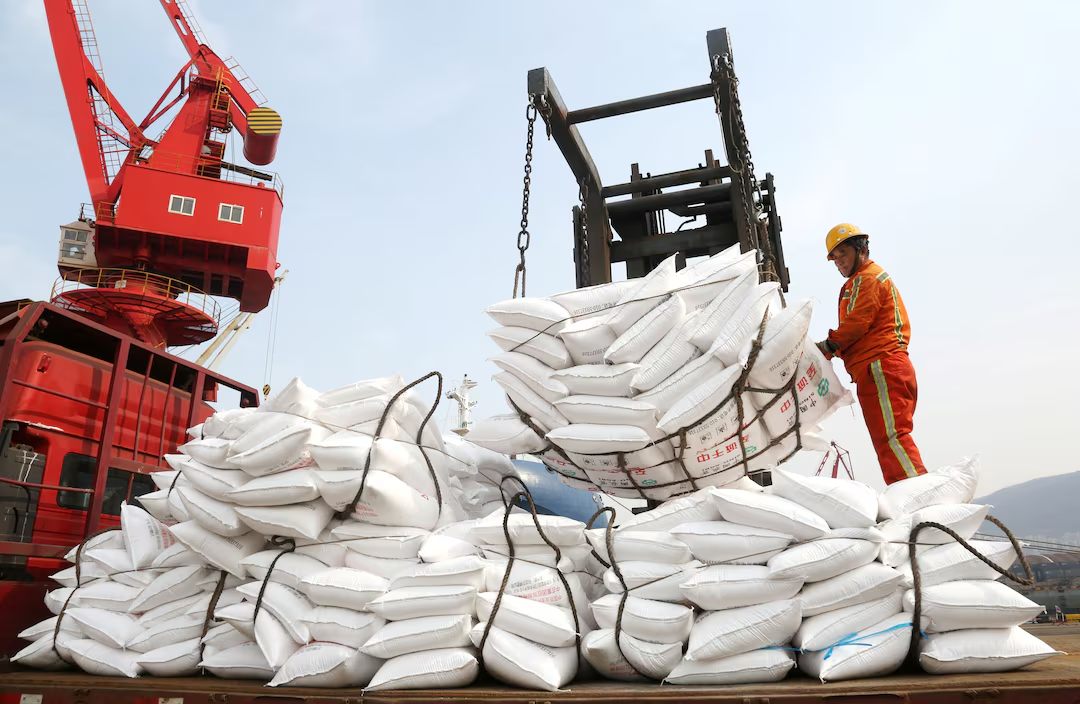
Urea importers without state to state access or diversified origin agreements are paying approximately 40 percent more for granular urea than pre-war levels and in many cases, they simply cannot source Chinese tonnes at any price, starting from the moment China's 14 March 2026 directive locked export volumes behind a quota wall. For procurement teams running June–August 2026 import programmes, the combination of restricted Chinese supply and constrained Middle East output has compressed the addressable market to a handful of origins. Landed cost and political access are now the two variables that determine whether a programme is viable or impossible.
China has historically accounted for roughly 12–15 million tonnes of annual urea exports the single largest origin in a global seaborne trade of approximately 45–50 million tonnes per year. The 14 March directive formalised a domestic-supply-priority policy that has been tightening since late 2024, establishing export quotas of approximately 1.5–1.6 million tonnes for the June–August 2026 window. That is not a reduction it is near-total closure. The critical structural detail is that a portion of even that limited allocation is ring-fenced for state to state transactions: government to government deals negotiated at the sovereign level, not available to private traders regardless of price or relationship. For commercial buyers, Chinese urea has not become expensive. It has become inaccessible.
The directive's state to state carve-out creates a two-tier market that has no commercial solution. A large state fertiliser buyer Pakistan's APCL, Bangladesh's BCIC, or an Indian state trading entity may be able to negotiate a bilateral allocation through diplomatic channels. A private regional importer in Southeast Asia, West Africa or Latin America has no equivalent pathway. This is not information asymmetry that better market intelligence resolves; it is access asymmetry that only political relationships bridge. The gap between what a connected government buyer pays for Chinese tonnes and what an open-market buyer pays for Gulf or Nigerian supply is not a spread to be arbitraged it is a structural divide between two different procurement realities.
The physical supply chain has re-routed accordingly. Demand that formerly pulled Chinese granular urea loaded at Nanjing, Tianjin or Yuzhny-bound vessels diverted toward Asia is now competing for capacity from three alternative origins: the Arabian Gulf (primarily Saudi Arabia's SAFCO and Ma'aden, and Qatar's QAFCO), Nigeria's Indorama facility, and Algeria's Fertial and Sorfert plants. Each has constraints. Gulf producers already running near-capacity are managing domestic subsidy obligations and long-term offtake contracts that limit spot availability. Nigerian output is intermittent, with feed gas reliability a persistent issue. Algerian volumes are real but modest relative to the gap China has left. None of these origins, individually or combined, replaces Chinese export capacity at scale.
The margin anatomy is unambiguous. Before the March directive, granular urea from a Chinese inland producer moved to port, loaded onto a Handymax or Supramax vessel (typically 25,000–55,000 tonnes capacity), and arrived at a Southeast Asian destination with an all-in delivered cost of approximately USD 230–250 per tonne, CIF (cost, insurance and freight meaning the seller arranges and pays for shipping to the destination port). Current Q3/Q4 2026 forward indications sit at USD 330–380 per tonne from alternative origins. That is a USD 80–130 per tonne deterioration in landed cost, against a crop nutrient where application economics for smallholder rice farmers in Vietnam or Bangladesh typically assume urea at USD 260–300 per tonne for the programme to be profitable at farmgate. The margin has not compressed it has been transferred. It now sits with non-Chinese producers and with vessel operators running tighter triangles across longer routes.
Consider a mid-sized import-dependent buyer a regional distributor in the Philippines managing a 30,000 tonne Q3 programme. Previously, they would fix a cargo from a Chinese trading house, CFR (cost and freight similar to CIF but excluding insurance, with buyer arranging insurance separately) Manila, at approximately USD 245/t, with payment via a 90 day usance letter of credit (LC) a bank instrument guaranteeing payment to the seller upon presentation of shipping documents, with the buyer repaying the bank after 90 days. The financing cost on that structure, at current Philippine banking rates, added roughly USD 4–5/t. Total landed: approximately USD 250/t. The same programme sourced from Saudi Arabia today costs approximately USD 355–375/t CFR, with Saudi producers increasingly requiring shorter LC tenors or, for smaller counterparties, cash against documents. Financing cost rises because the commodity value is higher. Add USD 6–8/t in financing, and landed cost approaches USD 365–383/t a USD 115–133/t increase on a 30,000 tonne programme, representing USD 3.45–4.0 million in additional outlay. That is not a rounding error. That is the programme's entire contingency budget, twice over.
On the sell side, non-Chinese producers are in a position not seen since the 2021–2022 supply crisis, when European gas curtailments shuttered urea capacity and prices briefly reached USD 900/t. SAFCO, Ma'aden and QAFCO can now price Q4 allocations at USD 360–380/t and face genuine competition for those tonnes from buyers who have no alternative. The discipline to hold price is real there is no surplus to discount. For Nigerian and Algerian producers, the opportunity is partially constrained by logistics: port congestion at Onne (Nigeria's primary fertiliser export terminal) and vessel scheduling constraints at Arzew (Algeria) mean that even willing sellers cannot always convert margin opportunity into executed volume. For intermediary traders who have pre-purchased allocation from these origins or who hold long positions in non-Chinese supply the current spread between forward contract prices and spot demand is where margin concentrates. A trader who fixed Gulf tonnes at USD 295/t in Q1, before the directive's full market impact was priced, and is now reselling at USD 365/t spot, captures a USD 70/t gross margin on every tonne in inventory. That position is not replicable today.
For large integrated fertiliser traders Yara's trading arm, Helm AG, or a national oil company's agri-commodity desk with derivatives access the instrument of relevance is the CME urea futures contract (Gulf Coast delivery), which has seen a sharp increase in open interest since April 2026. Buying call options (the right but not the obligation to purchase at a fixed price) on Q4 delivery provides upside exposure if prices extend beyond USD 380/t while capping downside if diplomatic resolution or additional Gulf capacity brings relief. For smaller regional operators without derivatives access the Philippine distributor, a West African state importer, a Latin American cooperative the practical equivalent is bilateral term agreements with two or more non-Chinese origins, accepting a modest premium over current spot in exchange for delivery certainty through Q4. Split the programme: one third from Gulf via term, one third from Nigeria or Algeria on a spot basis as logistics allow, and carry a working inventory buffer equivalent to six weeks of domestic demand rather than the typical four. Financing that buffer is a real cost but it is cheaper than a supply gap.
The specific signal to watch is the weekly FOB (free on board seller delivers to the vessel, buyer assumes cost and risk from that point) price assessment published by Fertilizer Week and the ICIS Urea Index for Arab Gulf origins, updated every Thursday. If Arab Gulf FOB urea crosses USD 390/t sustained across two consecutive weekly assessments, it will signal that non-Chinese supply has absorbed all available demand and that a further price leg is likely at which point even well-structured programmes face renegotiation pressure. The second signal is any Chinese customs data release showing June or July export volumes materially above the 1.5–1.6 Mt quota window which would indicate either quota expansion or under-reporting, and would bring Chinese tonnes back into the commercial conversation within four to six weeks of the data publication. Both signals are public, both are weekly, and both are actionable without derivatives infrastructure.
.jpg)


'%3e%3cg id='Final-Copy-2_2_' transform='translate(1275.000000, 200.000000)'%3e%3cpath class='st0' d='M7.4,12.8h6.8l3.1-11.6H7.4C4.2,1.2,1.6,3.8,1.6,7S4.2,12.8,7.4,12.8z'/%3e%3c/g%3e%3c/g%3e%3c/g%3e%3cg id='final---dec.11-2020'%3e%3cg id='_x30_208-our-toggle' transform='translate(-1275.000000, -200.000000)'%3e%3cg id='Final-Copy-2' transform='translate(1275.000000, 200.000000)'%3e%3cpath class='st1' d='M22.6,0H7.4c-3.9,0-7,3.1-7,7s3.1,7,7,7h15.2c3.9,0,7-3.1,7-7S26.4,0,22.6,0z M1.6,7c0-3.2,2.6-5.8,5.8-5.8 h9.9l-3.1,11.6H7.4C4.2,12.8,1.6,10.2,1.6,7z'/%3e%3cpath id='x' class='st2' d='M24.6,4c0.2,0.2,0.2,0.6,0,0.8l0,0L22.5,7l2.2,2.2c0.2,0.2,0.2,0.6,0,0.8c-0.2,0.2-0.6,0.2-0.8,0 l0,0l-2.2-2.2L19.5,10c-0.2,0.2-0.6,0.2-0.8,0c-0.2-0.2-0.2-0.6,0-0.8l0,0L20.8,7l-2.2-2.2c-0.2-0.2-0.2-0.6,0-0.8 c0.2-0.2,0.6-0.2,0.8,0l0,0l2.2,2.2L23.8,4C24,3.8,24.4,3.8,24.6,4z'/%3e%3cpath id='y' class='st3' d='M12.7,4.1c0.2,0.2,0.3,0.6,0.1,0.8l0,0L8.6,9.8C8.5,9.9,8.4,10,8.3,10c-0.2,0.1-0.5,0.1-0.7-0.1l0,0 L5.4,7.7c-0.2-0.2-0.2-0.6,0-0.8c0.2-0.2,0.6-0.2,0.8,0l0,0L8,8.6l3.8-4.5C12,3.9,12.4,3.9,12.7,4.1z'/%3e%3c/g%3e%3c/g%3e%3c/g%3e%3c/g%3e%3c/svg%3e) Privacy Choices
Privacy Choices