.avif)
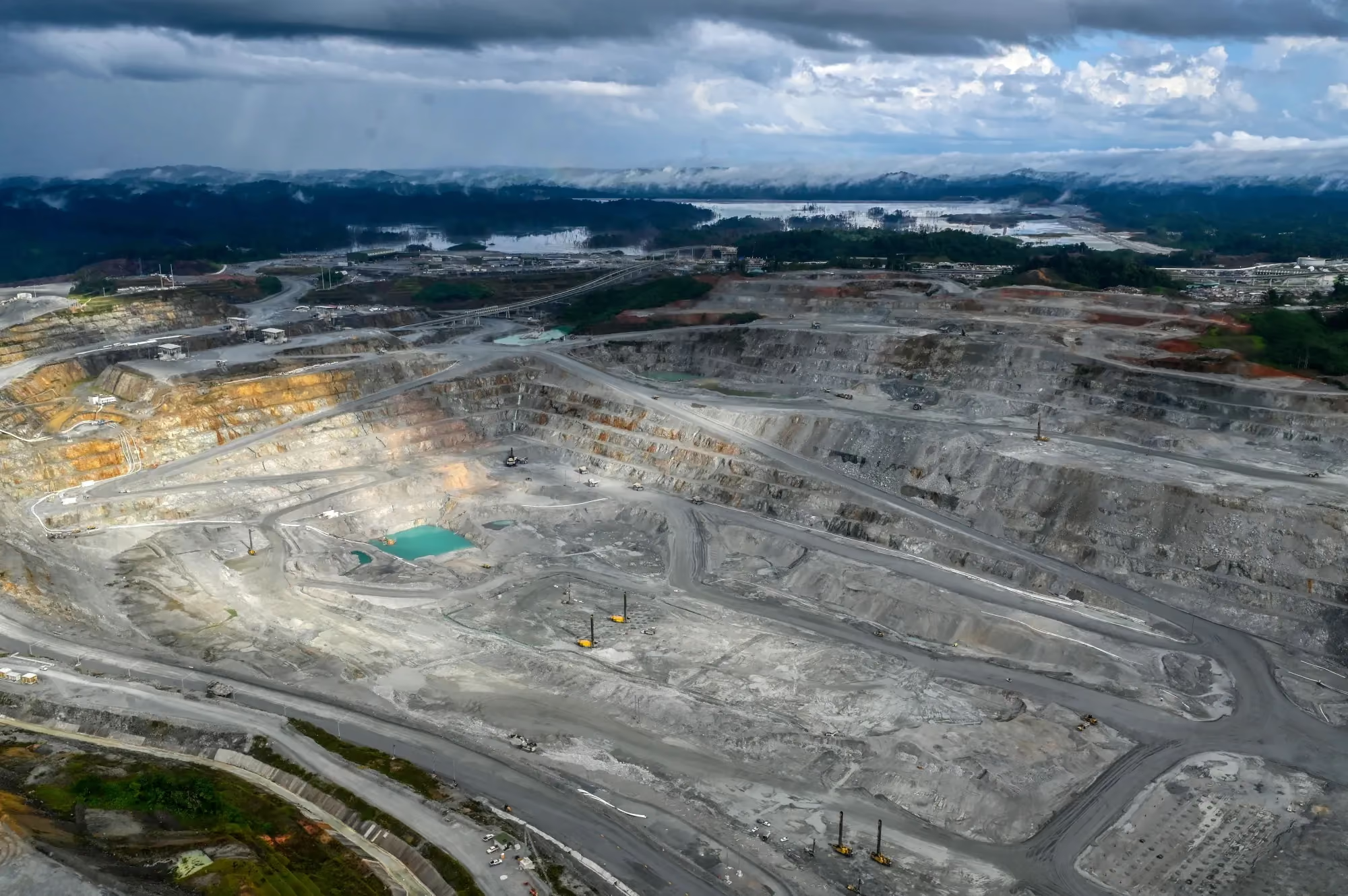
Copper concentrate traders pricing Cobre Panamá restart probability into their forward books face a recalibration moment: Panama's SGS audit, delivered June 19, 2026, awarded the shuttered mine an 88% compliance score across 370 audited commitments but the political and legal obstacles to any actual restart remain entirely intact, and First Quantum Minerals is bleeding $16 million per month in care and maintenance costs with no production to show for it.
The audit, conducted by SGS Panama Control Services an internationally recognised inspection and verification firm evaluated Cobre Panamá against 370 specific obligations spanning environmental, legal, fiscal, and operational categories. An overall score of 88% places the project firmly in a 'broadly compliant' band but deliberately below the top 'optimized' rating, because auditors flagged concrete weaknesses in four areas: reforestation and habitat/biodiversity restoration, water management protocols, environmental monitoring systems, and potential future liabilities tied to tailings storage (the engineered facilities where mineral processing waste is deposited), acid rock drainage (a chemical reaction in which sulphide bearing waste rock exposed to air and water generates sulphuric acid), and erosion control. These are not cosmetic deficiencies. Remediation of tailings and acid drainage infrastructure at a mine of Cobre Panamá's scale which was producing roughly 350,000 to 400,000 tonnes of copper in concentrate per year before its November 2023 closure typically requires 12 to 36 months and capital measured in tens of millions of dollars. The audit has converted a political standoff into a technical checklist, which is a different kind of obstacle rather than a lower one.
Copper concentrate the intermediate product shipped from mine to smelter, typically grading 25–30% copper content moves in bulk carriers along well established Atlantic and Pacific Basin trade lanes. Before Cobre Panamá's closure, the mine was loading concentrate at Puerto Manzanillo on Panama's Caribbean coast, with shipments bound primarily for smelters in Asia (China, Japan, South Korea) and Europe. That volume at peak, roughly 1.5 to 1.7 million dry metric tonnes of concentrate per year has not disappeared from the market; it has been replaced primarily by incremental Chilean and Peruvian production, with spot tightness absorbed through higher treatment and refining charges (TC/RCs the fees smelters charge miners to process concentrate, quoted in dollars per dry metric tonne and cents per pound) during the transition period. Global copper concentrate supply has remained tight enough that the TC/RC benchmark for 2025 settled near historically low levels, indicating smelters have more feed options than initially feared but not abundant ones. If Cobre Panamá restarts at full capacity, the market absorbs a material 8–10% increment of seaborne concentrate supply, which would put upward pressure on TC/RCs good for smelters, bad for miners and traders holding long concentrate positions on tight market assumptions.
On the sell side, First Quantum faces a margin anatomy that is deteriorating with each passing month. Consider the arithmetic directly: $16 million per month in care and maintenance overhead, zero revenue from Cobre Panamá operations, and a company whose equity market capitalisation has been substantially pressured since closure. Over 30 months from shutdown to the audit date, the cumulative unproductive overhead approaches $480 million capital that earns no return and cannot be recovered. The audit's 88% score provides reputational and negotiating credibility, but it does not constitute a restart mandate. Panama's Constitutional Court ruled the original 2023 concession contract unconstitutional, and an audit score of any magnitude does not resolve that legal status. Any restart requires either new legislation passed by Panama's National Assembly or a new concession agreement both of which demand political consensus in a country where mass street protests forced the original closure. Trade Minister Julio Molto's statement that decisions 'will be based on data, evidence and technical rigor' is politically useful framing, but the actual constraint is legislative, not technical.
On the buy side, copper concentrate traders and offtake holders must distinguish between two different market signals the audit produces. The first is a restart probability repricing: if trading desks had assigned, say, a 15–20% probability of restart within 24 months before the audit, an 88% compliance score logically pushes that figure higher perhaps toward 30–40%, conditional on legal resolution. That shift, even probabilistic, affects how traders value forward concentrate supply contracts and how streaming companies (entities that provide upfront capital to miners in exchange for the right to buy future metal production at a fixed, below market price) value suspended stream rights. Franco Nevada holds a gold and silver stream on Cobre Panamá; if the market reprices restart probability upward meaningfully, the implied value of that stream rises, potentially creating a secondary market transaction opportunity or a valuation arbitrage against First Quantum's equity implied restart probability. The second signal is more cautious: the Constitutional Court issue means restart could be another two to four years away even under an optimistic scenario, and traders building physical supply plans around an imminent restart face meaningful execution risk.
For a large integrated trading house a Trafigura, Glencore, or IXM with structured offtake agreements and derivatives access the practical instrument is optionality preservation. A house with existing Chilean or Peruvian concentrate supply secured under long-term offtake can afford to monitor Cobre Panamá's legal progress without repositioning aggressively; the downside of a surprise restart (TC/RC softening, some displaced volume) is manageable through derivatives overlay on LME copper contracts. For a smaller regional smelter facing trader or concentrate merchant without derivatives access a mid-sized operator sourcing spot cargoes for secondary smelters in Southeast Asia or India the practical equivalent is bilateral supply diversification: locking in six to twelve month rolling agreements with Chilean producers now, before any Cobre Panamá restart announcement creates a scramble for replacement tonnage or, conversely, before a failed restart causes further spot tightness. The asymmetry here matters: the cost of supply security is lower than the cost of being caught short in a tightening spot market.
The specific, time-bound signal for observers is Panama's National Assembly legislative calendar through Q4 2026. Any Cobre Panamá restart requires either a new concession law or a constitutional amendment pathway both would need to appear on the legislative agenda before year-end to enable a 2027 operational restart, which is the earliest technically feasible timeline given remediation requirements. Watch the Panamanian government's official gazette (Gaceta Oficial) for concession related draft legislation and track LME copper spreads specifically the cash to three month spread, known as the contango or backwardation indicator for any structural tightening in Q3 2026 that would signal the market is beginning to price out near-term Panamanian supply recovery. If TC/RC benchmarks for the 2027 annual contracts, typically negotiated in Q4 at the Cesco Asia Copper Week equivalent discussions, come in below $20 per dry metric tonne, that is the market confirming it does not expect Cobre Panamá volume in the near to medium term. The audit has provided a foundation, not a floor and the ceiling remains political.






'%3e%3cg id='Final-Copy-2_2_' transform='translate(1275.000000, 200.000000)'%3e%3cpath class='st0' d='M7.4,12.8h6.8l3.1-11.6H7.4C4.2,1.2,1.6,3.8,1.6,7S4.2,12.8,7.4,12.8z'/%3e%3c/g%3e%3c/g%3e%3c/g%3e%3cg id='final---dec.11-2020'%3e%3cg id='_x30_208-our-toggle' transform='translate(-1275.000000, -200.000000)'%3e%3cg id='Final-Copy-2' transform='translate(1275.000000, 200.000000)'%3e%3cpath class='st1' d='M22.6,0H7.4c-3.9,0-7,3.1-7,7s3.1,7,7,7h15.2c3.9,0,7-3.1,7-7S26.4,0,22.6,0z M1.6,7c0-3.2,2.6-5.8,5.8-5.8 h9.9l-3.1,11.6H7.4C4.2,12.8,1.6,10.2,1.6,7z'/%3e%3cpath id='x' class='st2' d='M24.6,4c0.2,0.2,0.2,0.6,0,0.8l0,0L22.5,7l2.2,2.2c0.2,0.2,0.2,0.6,0,0.8c-0.2,0.2-0.6,0.2-0.8,0 l0,0l-2.2-2.2L19.5,10c-0.2,0.2-0.6,0.2-0.8,0c-0.2-0.2-0.2-0.6,0-0.8l0,0L20.8,7l-2.2-2.2c-0.2-0.2-0.2-0.6,0-0.8 c0.2-0.2,0.6-0.2,0.8,0l0,0l2.2,2.2L23.8,4C24,3.8,24.4,3.8,24.6,4z'/%3e%3cpath id='y' class='st3' d='M12.7,4.1c0.2,0.2,0.3,0.6,0.1,0.8l0,0L8.6,9.8C8.5,9.9,8.4,10,8.3,10c-0.2,0.1-0.5,0.1-0.7-0.1l0,0 L5.4,7.7c-0.2-0.2-0.2-0.6,0-0.8c0.2-0.2,0.6-0.2,0.8,0l0,0L8,8.6l3.8-4.5C12,3.9,12.4,3.9,12.7,4.1z'/%3e%3c/g%3e%3c/g%3e%3c/g%3e%3c/g%3e%3c/svg%3e) Privacy Choices
Privacy Choices