.avif)
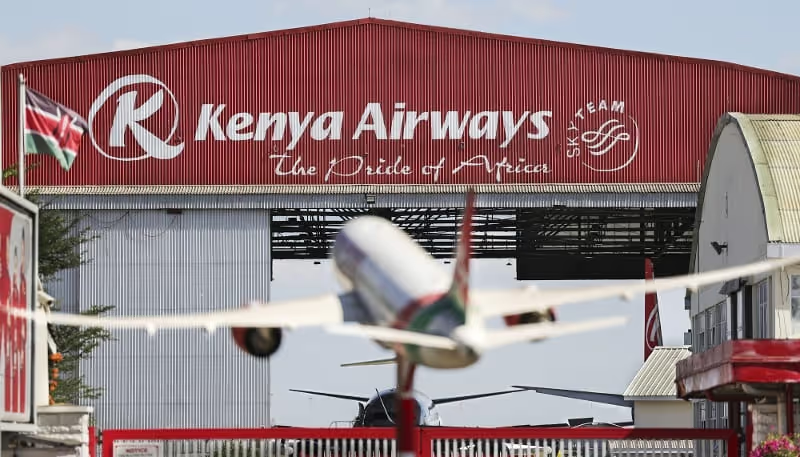
The contract for 32,000 tonnes of annual sustainable aviation fuel (SAF) production will cut into Kenya Airways' current 1.1 million tonnes of annual jet fuel imports, but only if waste feedstock collection can scale to commercial levels. Conventional jet fuel trades at $162.89/barrel globally, while SAF commands $2,500/MT in Europe roughly 3.4 times the premium. The memorandum of understanding signed May 10, 2026, between Kenya Airways and Rubis Energy commits €60–70 million ($70.5–82.2 million) for a modular refinery using Dragonfly technology near Jomo Kenyatta International Airport. Sustainable aviation fuel (SAF) jet fuel produced from waste feedstocks like used cooking oil, animal fats, and vegetable oils rather than petroleum promises to reduce aviation emissions by up to 80% compared to conventional fuel. Dragonfly claims the facility can be operational within 24 months after planning approvals, but the timeline assumes a feedstock supply chain that doesn't yet exist at commercial scale.
Commercial scale waste oil collection faces immediate structural constraints, as most used cooking oil in Africa competes with food vendors, soap makers, and other traditional uses, with Ghana generating only 3,765 tonnes annually despite its 80,000 tonne potential. The Kenyan project requires reliable flows of used cooking oil from restaurants, waste animal fats, and discarded vegetable oils feedstocks currently without established aggregation networks. Dragonfly's modular approach allows refineries to locate close to both feedstock sources and fuel customers, but proximity doesn't solve collection infrastructure gaps. Previous ICAO feasibility studies identified Kenyan used cooking oil (UCO) collection systems as a critical bottleneck for any commercial SAF operation. The 32,000 tonne annual target requires roughly 35,000 tonnes of waste feedstock input approximately 96 tonnes daily across Nairobi's uncoordinated restaurant and food service sectors.
On the buy side: Kenya Airways, which "currently depend[s] entirely on imports," sees the refinery as enabling "a sustainable, local version" of jet fuel to meet ICAO's net-zero emissions target by 2050. JKIA consumes 2.9 million litres (roughly 2,320 tonnes) of jet fuel daily equivalent to filling 52,727 family cars making it East Africa's largest aviation fuel consumption point. Kenya Airways has set a target for SAF to account for 10% of its total fuel consumption by 2030, requiring approximately 110,000 tonnes annually. The proposed 32,000 tonne refinery covers less than 30% of this commitment, leaving Kenya Airways dependent on imports for the remainder. On the sell side: Rubis Energy positions the project within its "roadmap to deliver low-carbon energy solutions," with priority on "technology transfer and ensuring that training is provided for local skills development so that the facility will be operated and managed by Kenyans".
For large integrated traders with SAF exposure: Current European SAF prices at $2,286/MT versus $741/MT for conventional jet create a $1,545/MT premium but with standard deviation of $444/MT for SAF compared to $95/MT for fossil fuel, volatility is 365% higher. Major oil companies like Shell are securing SAF offtake through long-term contracts, acting as both primary feedstock provider and product purchaser on a take or pay basis. For regional operators: HEFA based SAF production from used cooking oil and tallow constitutes virtually all current market SAF, making feedstock access the primary constraint rather than technology. Smaller operators face dual challenges: "SAF production economics remain constrained by limited feedstock availability" while "SAF still remains more expensive than conventional jet fuel globally". Kenya Airways' selection as the sole African airline leading IATA's SAF Registry initiative allows it to buy SAF credits through book and claim models even when fuel is produced elsewhere.
For observers tracking Africa's SAF development: South Africa's existing waste based SAF research positions it as the potential "first SAF producer in Africa," making Kenya's 24 month timeline ambitious rather than assured. Monitor Kenya Airways' SAF deployment timeline the carrier became Africa's first to operate SAF long-haul flights in 2023 and began blended SAF on select routes in October 2025. Watch the African Union's SAF/LCAF Continental Strategy implementation through 2030, targeting 5% emission reductions from cleaner energy. Key checkpoint: whether the partners can secure "local planning approvals, investment execution, feedstock agreements, and regulatory clearance" within the stated 24 month operational timeline. The competing Egyptian SAF project in Sokhna a $212 million facility targeting 200,000 tonnes annually provides a benchmark for African SAF economics at 6x larger scale.





'%3e%3cg id='Final-Copy-2_2_' transform='translate(1275.000000, 200.000000)'%3e%3cpath class='st0' d='M7.4,12.8h6.8l3.1-11.6H7.4C4.2,1.2,1.6,3.8,1.6,7S4.2,12.8,7.4,12.8z'/%3e%3c/g%3e%3c/g%3e%3c/g%3e%3cg id='final---dec.11-2020'%3e%3cg id='_x30_208-our-toggle' transform='translate(-1275.000000, -200.000000)'%3e%3cg id='Final-Copy-2' transform='translate(1275.000000, 200.000000)'%3e%3cpath class='st1' d='M22.6,0H7.4c-3.9,0-7,3.1-7,7s3.1,7,7,7h15.2c3.9,0,7-3.1,7-7S26.4,0,22.6,0z M1.6,7c0-3.2,2.6-5.8,5.8-5.8 h9.9l-3.1,11.6H7.4C4.2,12.8,1.6,10.2,1.6,7z'/%3e%3cpath id='x' class='st2' d='M24.6,4c0.2,0.2,0.2,0.6,0,0.8l0,0L22.5,7l2.2,2.2c0.2,0.2,0.2,0.6,0,0.8c-0.2,0.2-0.6,0.2-0.8,0 l0,0l-2.2-2.2L19.5,10c-0.2,0.2-0.6,0.2-0.8,0c-0.2-0.2-0.2-0.6,0-0.8l0,0L20.8,7l-2.2-2.2c-0.2-0.2-0.2-0.6,0-0.8 c0.2-0.2,0.6-0.2,0.8,0l0,0l2.2,2.2L23.8,4C24,3.8,24.4,3.8,24.6,4z'/%3e%3cpath id='y' class='st3' d='M12.7,4.1c0.2,0.2,0.3,0.6,0.1,0.8l0,0L8.6,9.8C8.5,9.9,8.4,10,8.3,10c-0.2,0.1-0.5,0.1-0.7-0.1l0,0 L5.4,7.7c-0.2-0.2-0.2-0.6,0-0.8c0.2-0.2,0.6-0.2,0.8,0l0,0L8,8.6l3.8-4.5C12,3.9,12.4,3.9,12.7,4.1z'/%3e%3c/g%3e%3c/g%3e%3c/g%3e%3c/g%3e%3c/svg%3e) Privacy Choices
Privacy Choices