.avif)
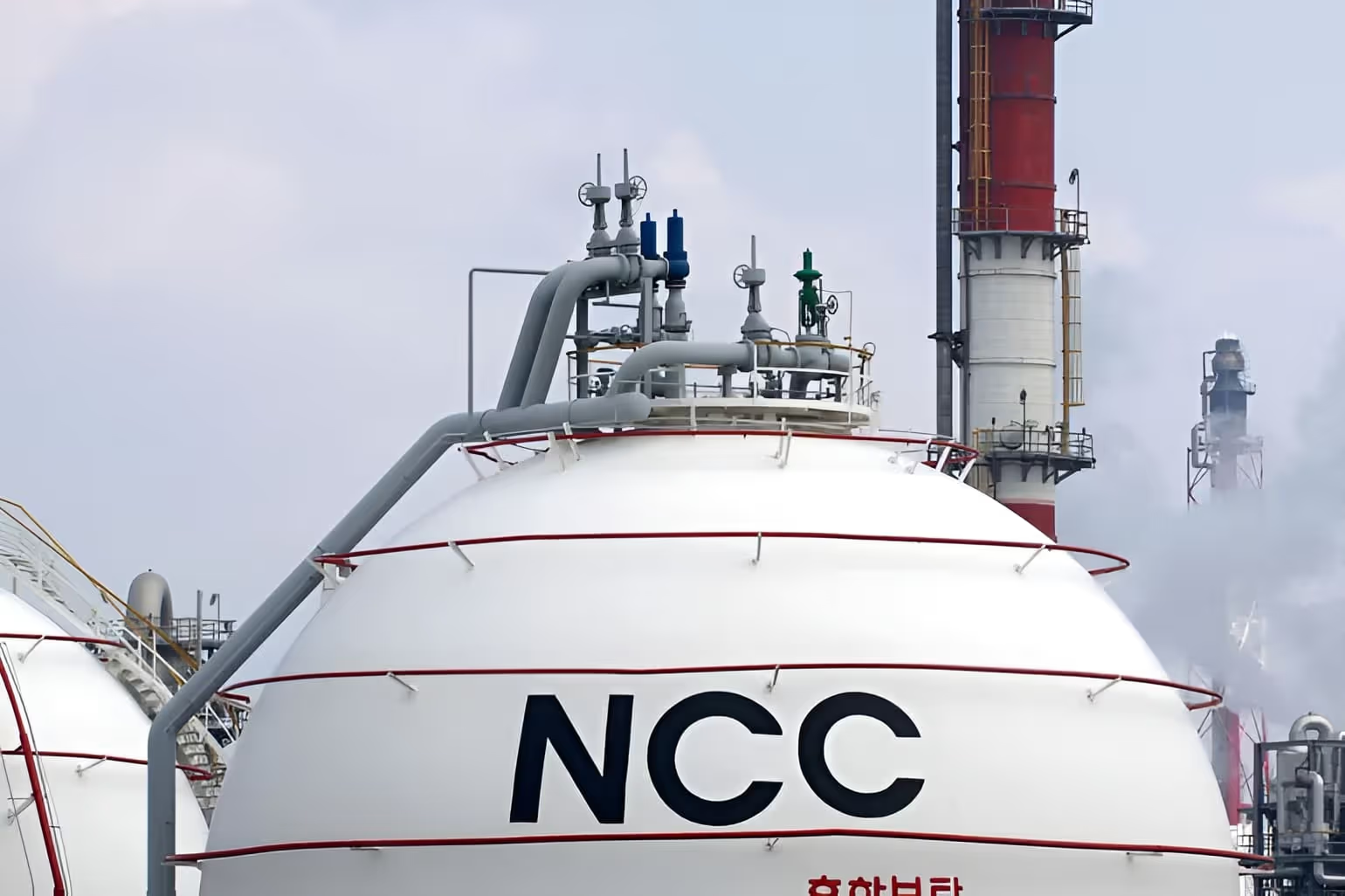
Korean petrochemical importers face input cost inflation of 15–25% starting in Q3 2026 as artificially depleted inventory buffers reverse South Korea's strongest business sentiment reading in 21 months. The Bank of Korea's Composite Business Sentiment Index (CBSI) rose 0.8 points to 94.9 in April the highest since July 2024 but Bank officials attribute the improvement primarily to inventory depletion from supply chain disruptions, noting that excluding inventory effects, business sentiment actually fell by 0.1 points for all industries and by 0.4 points for manufacturing. Consider a mid-sized Korean chemical manufacturer: before the inventory drawdown, input costs averaged $850–900/MT for naphtha feedstock. With Strait of Hormuz loadings down from 20+ million barrels daily to 3.8 million barrels daily, the company has exhausted 60% of its three-month buffer. When forced back into spot markets, that same naphtha will cost $1,050–1,150/MT a margin compression of $200/MT that hits smaller operators hardest.
The CBSI a business sentiment indicator anchored to a long-term average baseline of 100 where values above 100 indicate optimism versus historical norms and values below 100 indicate pessimism is calculated using key components of the Business Survey Index to provide a comprehensive assessment of business perceptions regarding the overall economy. Manufacturing CBSI advanced 2.0 points to 99.1 while non-manufacturing added only 0.1 points to 92.1, reflecting the concentrated impact of inventory effects in industrial sectors. The rebound was attributed to expanded sales and new orders as well as reduction in product inventories in manufacturing that offset higher raw material prices and production disruptions caused by Middle East tensions. For context, this inventory-driven improvement is finite: Korean manufacturers typically maintain 90–120 days of critical petrochemical inputs, but the ongoing largest supply disruption in oil market history has forced accelerated depletion rates. Large integrated operators like LG Chem or SK Innovation maintain deeper strategic reserves estimated at 150–180 days of key inputs providing 3–5% production cost advantage over smaller chemical manufacturers.
On the buy side: Korean petrochemical importers without long-term contracts face immediate procurement crisis as inventory buffers expire. A regional polypropylene producer sourcing 15,000 MT monthly of propylene previously secured at $940/MT through existing inventory will pay $1,180–1,220/MT on the spot market. That $3.6 million monthly cost increase eliminates operational margins entirely for producers selling into competitive domestic markets where price-pass-through lags input costs by 60–90 days. Mid-sized operators cannot hedge effectively: Korean won derivatives markets offer limited petrochemical exposure, forcing reliance on bilateral agreements with suppliers who themselves face margin pressure.
On the sell side: Large Korean chemical exporters with deeper inventories and integrated supply chains gain temporary competitive advantage. Samsung Petrochemicals and LG Chem, maintaining strategic reserves through long-term Qatar and Saudi contracts, can maintain production while competitors cut runs. Export-focused firms recorded CBSI of 103.4 for a fourth consecutive month versus 96.4 for domestically focused companies, highlighting this bifurcation.
For large integrated Korean manufacturers with derivatives access: Secure six-month forward contracts on naphtha and propylene before existing inventory depletes estimated at $50–80/MT premium over spot prices but providing cost certainty through potential supply normalization. Those with Qatar LNG exposure can hedge through Henry Hub-JKM spread positions, though basis risk remains substantial. For smaller regional operators without derivatives access: Negotiate inventory-sharing agreements with larger domestic producers, accepting 3–5% markup over their secured pricing in exchange for supply guarantee. Consider switching to bio-based feedstocks where technically feasible Korean bio-naphtha trades at consistent $150–200/MT premium to conventional naphtha but offers supply security. Regional cooperatives are forming purchasing consortiums to aggregate volume and secure block contracts with Malaysian and Singaporean suppliers at fixed prices through Q4 2026.
For observers: Monitor the Bank of Korea's May CBSI release on 28 May 2026 expect manufacturing sentiment to fall 2–4 points as inventory effects reverse and input cost pressures materialize. Track Ulsan petrochemical complex utilization rates weekly: current 78% capacity utilization will drop below 70% by August if Strait of Hormuz flows remain below 30% of normal levels. Watch Korean won volatility against the Japanese yen: strengthening yen benefits Korean importers sourcing from Japanese trading houses, while won weakness accelerates margin compression. The inventory drawdown creating today's artificial sentiment boost expires within 90–120 days, after which Korean chemical manufacturers face structural cost inflation until Gulf supply routes normalize estimated by industry surveys as unlikely before August 2026. Federal Reserve Bank of Dallas survey of nearly 100 oil and gas executives found nearly 80% believe the strait will not reopen until August or later, with more than 80% seeing future disruptions as somewhat or very likely.

.jpg)
.jpg)
'%3e%3cg id='Final-Copy-2_2_' transform='translate(1275.000000, 200.000000)'%3e%3cpath class='st0' d='M7.4,12.8h6.8l3.1-11.6H7.4C4.2,1.2,1.6,3.8,1.6,7S4.2,12.8,7.4,12.8z'/%3e%3c/g%3e%3c/g%3e%3c/g%3e%3cg id='final---dec.11-2020'%3e%3cg id='_x30_208-our-toggle' transform='translate(-1275.000000, -200.000000)'%3e%3cg id='Final-Copy-2' transform='translate(1275.000000, 200.000000)'%3e%3cpath class='st1' d='M22.6,0H7.4c-3.9,0-7,3.1-7,7s3.1,7,7,7h15.2c3.9,0,7-3.1,7-7S26.4,0,22.6,0z M1.6,7c0-3.2,2.6-5.8,5.8-5.8 h9.9l-3.1,11.6H7.4C4.2,12.8,1.6,10.2,1.6,7z'/%3e%3cpath id='x' class='st2' d='M24.6,4c0.2,0.2,0.2,0.6,0,0.8l0,0L22.5,7l2.2,2.2c0.2,0.2,0.2,0.6,0,0.8c-0.2,0.2-0.6,0.2-0.8,0 l0,0l-2.2-2.2L19.5,10c-0.2,0.2-0.6,0.2-0.8,0c-0.2-0.2-0.2-0.6,0-0.8l0,0L20.8,7l-2.2-2.2c-0.2-0.2-0.2-0.6,0-0.8 c0.2-0.2,0.6-0.2,0.8,0l0,0l2.2,2.2L23.8,4C24,3.8,24.4,3.8,24.6,4z'/%3e%3cpath id='y' class='st3' d='M12.7,4.1c0.2,0.2,0.3,0.6,0.1,0.8l0,0L8.6,9.8C8.5,9.9,8.4,10,8.3,10c-0.2,0.1-0.5,0.1-0.7-0.1l0,0 L5.4,7.7c-0.2-0.2-0.2-0.6,0-0.8c0.2-0.2,0.6-0.2,0.8,0l0,0L8,8.6l3.8-4.5C12,3.9,12.4,3.9,12.7,4.1z'/%3e%3c/g%3e%3c/g%3e%3c/g%3e%3c/g%3e%3c/svg%3e) Privacy Choices
Privacy Choices