.avif)
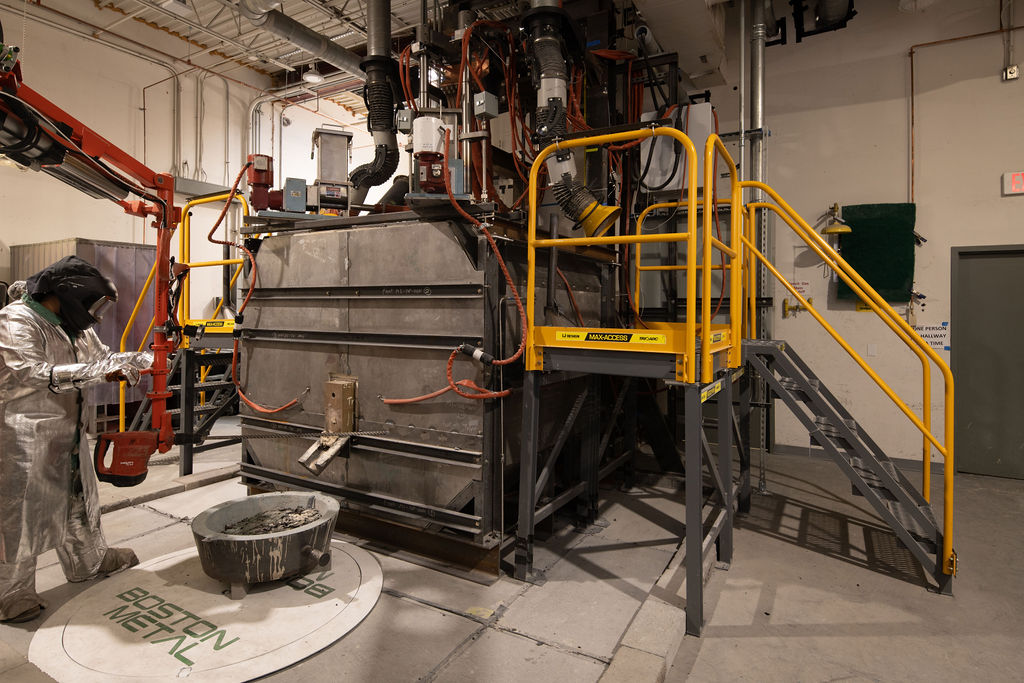
Integrated Steel Producers face a $28/metric ton margin squeeze as hot-rolled coil steel prices hover above $1,000/ton in 2026 while Boston Metal's $75 million funding round led by Tata Steel signals the first major pivot toward electrified metals production that could reshape steel economics within three years. The company's Molten Oxide Electrolysis (MOE) technology an electrified platform that runs electric current through a reactor filled with ore dissolved in molten electrolyte at 1,600°C to separate metals without direct carbon emissions represents the most significant technical breakthrough in primary metals production since the blast furnace. While MOE's immediate focus targets critical metals recovery, its steel application could eliminate the fundamental cost structure that has defined the industry for over a century.
Boston Metal completed its largest industrial pilot run in March 2025, producing approximately one ton of steel, but the company's current commercial focus lies in higher value critical metals including niobium, tantalum, vanadium, nickel, and chromium. Through its Brazilian subsidiary Boston Metal do Brasil, the company operates an industrial scale plant in Minas Gerais processing low-grade materials into critical metal mixtures, with planned commercial startup in September 2026 following repair of industrial accident damage. The Brazil facility demonstrates MOE's core economic proposition: selective recovery from materials that conventional pyrometallurgical and hydrometallurgical processes cannot economically handle, including mining waste and industrial slags. Consider the margin mathematics traditional niobium production from primary ore requires complex multi-stage processing with yields often below 2%. MOE's direct reduction pathway eliminates intermediate steps, potentially doubling realized margins even from waste feedstocks.
On the buy side, integrated steel producers with captive power generation or long-term renewable contracts gain the most immediate advantage from MOE technology deployment. Current hot rolled coil prices above $1,000/ton create a margin environment where electricity intensive processes become economically viable if power costs remain below $45/MWh. Electric arc furnaces already demonstrate that scrap based steelmaking using electricity rather than coke reduces raw material dependencies and operational costs, but MOE extends this principle to primary ore reduction. Melting scrap steel in EAFs requires 75% less energy than refining iron ore in blast furnaces, and this energy differential maintains scrap steel values even during market downturns. MOE's energy requirements are higher than EAF scrap melting but substantially lower than integrated blast furnace basic oxygen furnace routes when calculated per ton of finished steel.
On the sell side, traditional iron ore miners and coking coal producers face the first credible technological threat to their market positions since the 1960s. Conventional blast furnace basic oxygen furnace steelmaking produces around 2.2 tonnes of CO2 per tonne of steel, while EAFs using recycled scrap emit approximately 0.3 tonnes CO2 per tonne. MOE's emissions profile depends entirely on electricity source when powered by renewable energy, the technology produces pure oxygen as its only byproduct. The fundamental constraint is that conventional blast furnaces and smelters perform well only with consistent, high-grade feedstocks, but easily accessible rich ore bodies are largely depleted. Scrap-based EAFs already offer 56-60% energy savings compared to blast furnaces and reduce carbon emissions by nearly 60%. MOE technology threatens to extend these advantages to primary metal production, potentially stranding billions in mining infrastructure optimized for high-grade ore processing.
For large integrated operators with existing steel assets and renewable power portfolios Tata Steel's strategic investment exemplifies this positioning MOE offers a pathway to retrofit existing sites without complete infrastructure replacement. Tata Steel's participation reflects dual strategic exposure: decarbonizing its steelmaking operations while securing supply chain access for critical metals across its manufacturing operations. The $75 million will fund additional commercial scale deployments for niobium, tantalum, vanadium, and nickel, with MOE's modular design enabling scalable capacity additions. For smaller regional operators without derivatives access, the practical equivalent involves securing long-term electricity contracts and diversifying feedstock sources toward industrial waste streams. For observers: watch Shanghai steel futures basis the spread between near-month and three month contracts through Q4 2026. A sustained backwardation above $15/ton indicates physical scrap shortages that accelerate MOE adoption timelines.



'%3e%3cg id='Final-Copy-2_2_' transform='translate(1275.000000, 200.000000)'%3e%3cpath class='st0' d='M7.4,12.8h6.8l3.1-11.6H7.4C4.2,1.2,1.6,3.8,1.6,7S4.2,12.8,7.4,12.8z'/%3e%3c/g%3e%3c/g%3e%3c/g%3e%3cg id='final---dec.11-2020'%3e%3cg id='_x30_208-our-toggle' transform='translate(-1275.000000, -200.000000)'%3e%3cg id='Final-Copy-2' transform='translate(1275.000000, 200.000000)'%3e%3cpath class='st1' d='M22.6,0H7.4c-3.9,0-7,3.1-7,7s3.1,7,7,7h15.2c3.9,0,7-3.1,7-7S26.4,0,22.6,0z M1.6,7c0-3.2,2.6-5.8,5.8-5.8 h9.9l-3.1,11.6H7.4C4.2,12.8,1.6,10.2,1.6,7z'/%3e%3cpath id='x' class='st2' d='M24.6,4c0.2,0.2,0.2,0.6,0,0.8l0,0L22.5,7l2.2,2.2c0.2,0.2,0.2,0.6,0,0.8c-0.2,0.2-0.6,0.2-0.8,0 l0,0l-2.2-2.2L19.5,10c-0.2,0.2-0.6,0.2-0.8,0c-0.2-0.2-0.2-0.6,0-0.8l0,0L20.8,7l-2.2-2.2c-0.2-0.2-0.2-0.6,0-0.8 c0.2-0.2,0.6-0.2,0.8,0l0,0l2.2,2.2L23.8,4C24,3.8,24.4,3.8,24.6,4z'/%3e%3cpath id='y' class='st3' d='M12.7,4.1c0.2,0.2,0.3,0.6,0.1,0.8l0,0L8.6,9.8C8.5,9.9,8.4,10,8.3,10c-0.2,0.1-0.5,0.1-0.7-0.1l0,0 L5.4,7.7c-0.2-0.2-0.2-0.6,0-0.8c0.2-0.2,0.6-0.2,0.8,0l0,0L8,8.6l3.8-4.5C12,3.9,12.4,3.9,12.7,4.1z'/%3e%3c/g%3e%3c/g%3e%3c/g%3e%3c/g%3e%3c/svg%3e) Privacy Choices
Privacy Choices