.avif)
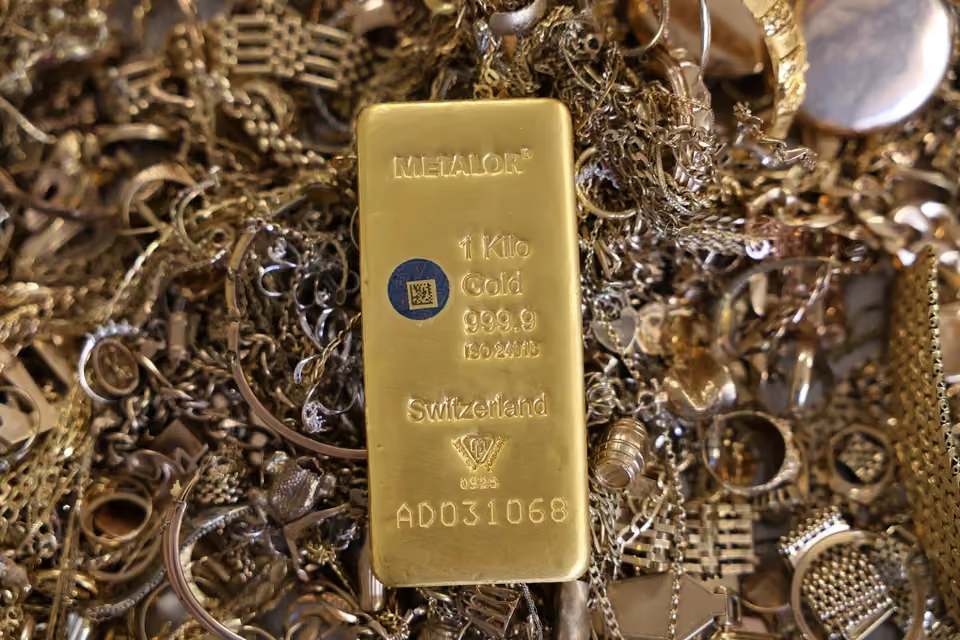
Chinese retail gold investors face immediate forced deleveraging as of 25 June 2026, with margin requirements at Bank of China and China CITIC Bank raised to as high as 140% a level that functionally eliminates leveraged participation for most individual accounts. Simultaneously, state-licensed brokerages led by China International Capital Corp (CICC) have blocked new offshore exposure through cross-border derivatives, locking roughly 825 billion yuan ($114.7 billion) in notional positions into maintenance only mode. This is not a temporary volatility measure. The architecture of Beijing's capital controls has been tightening since at least February 2024, when regulators first capped total cross-border swap capacity. What happened in late June 2026 is enforcement consolidation the regime change was already decided; the latest moves are its operational expression.
To understand the mechanism, it is necessary to understand the instrument being constrained. A total return swap (TRS) a contract in which one party receives the total economic return of an asset (price appreciation plus income) while the other receives a floating rate, without either party taking direct ownership became the preferred tool for Chinese onshore funds wanting foreign exposure. Because funds do not physically transfer money offshore to buy foreign assets, TRS contracts allowed onshore investors to hold effective positions in overseas equities, commodities, and structured products while technically remaining within domestic capital rules. CICC is among a small group of brokerages licensed to offer cross-border TRS in China. Restricting new positions on a $114.7 billion notional book does not unwind existing exposure overnight but it prevents any rollover or expansion, creating a slow-motion deleveraging as contracts mature and cannot be replaced.
The gold-specific dimension sits on top of this structural shift. Gold prices slipping below $4,000 per troy ounce triggered the retail margin hikes but the mechanism matters as much as the trigger. Consider a Chinese retail investor holding a leveraged gold position structured at, say, 20% initial margin on a 100 troy ounce contract. At $3,950/oz, the notional value is $395,000; original margin commitment was approximately $79,000. A hike to 140% margin does not mean 140% of the position's value it means margin required is 140% of what was previously required. If the baseline was 20%, the new effective requirement is 28% of notional: approximately $110,600 on the same position. That is an immediate capital call of roughly $31,600 per contract. For investors already holding losses as prices moved below $4,000, the combined effect of mark to market losses and the margin hike is a forced exit. Not a choice a forced exit.
On the buy side, Chinese retail gold buyers lose the ability to express leveraged long views through domestic bank platforms at economically viable terms. A 140% margin requirement is not a constraint to be managed it is a soft prohibition. Institutional buyers onshore funds that previously used TRS to gain offshore gold exposure through structured vehicles face a harder constraint: they cannot open new positions at all. The demand signal this sends to physical markets is a reduction in synthetic Chinese buying pressure. Reduced leveraged buying does not necessarily mean reduced physical buying, but it removes a marginal demand layer that had been supporting price. The Shanghai Gold Exchange (SGE) China's central platform for physical gold trading, where all imported gold must be sold remains open and unaffected by the TRS restrictions. Institutional demand may migrate toward SGE spot contracts, but the transition is not instantaneous.
On the sell side, physical gold holders and producers outside China face a nuanced picture. Reduced Chinese leveraged buying marginally reduces support for spot prices in the near term. However, the forced exit of retail leveraged longs also removes a source of leveraged selling pressure investors being margin called do not hold positions, they liquidate them, which has already contributed to downward price movement as the restrictions took effect. Once those forced liquidations clear, the remaining holder base is less leveraged and structurally more stable. For gold miners and refiners selling into the LBMA (London Bullion Market Association the benchmark international OTC market for gold) or Singapore spot markets, the clearest short-term pressure is continued price softness; the medium-term picture is modestly more constructive once the deleveraging wave passes.
For traders and intermediaries, the margin opportunity concentrates at the SGE-LBMA spread the price difference between gold traded on the Shanghai Gold Exchange in yuan and gold traded on the international OTC market in dollars. This spread is normally arbitraged tight by cross-border traders with access to both venues. The TRS channel previously enabled some of this arbitrage synthetically. With that channel restricted, the spread may widen beyond its equilibrium range. Physical traders with direct SGE membership, offshore clearing capability, and import quota a restricted licence issued by the People's Bank of China may find cross-venue arbitrage viable if the SGE-LBMA spread exceeds approximately $15–20 per troy ounce. At that spread, a 1,000 oz lot yields $15,000–$20,000 gross arbitrage before logistics, financing, and regulatory compliance costs. The window is narrow but real, and it favours operators already inside the Chinese market infrastructure.
For a large integrated precious metals trader think a global bullion bank or a trading house with both LBMA clearing membership and SGE access the tactical response is to monitor the SGE-LBMA spread daily and position for physical import arbitrage if the gap opens. Hedging instruments remain accessible: COMEX gold futures (the benchmark US exchange-traded gold contract), LBMA forward contracts, and options on gold can all be used to lock in the spread or protect inventory while the arbitrage is executed. The cost of a basic COMEX at the money put to protect a 1,000 oz import position over 30 days is currently in the range of $8–12/oz meaningful but manageable against a $15–20/oz spread opportunity. For a smaller regional operator an independent gold importer, a jewellery manufacturer buying refined gold, or a regional distributor without derivatives access the practical response is to fix purchase prices bilaterally with suppliers now, before the deleveraging wave fully clears and prices potentially stabilise or recover. Locking in spot or near-spot prices with a 30–60 day delivery window captures the current softness without requiring exchange access.
The structural constraint that most participants are underweighting is the scale of the locked TRS book relative to China's offshore investment appetite. At approximately $114.7 billion notional, the onshore OTC TRS book represents a meaningful slice of the mechanism by which Chinese institutional capital expressed offshore views. The February 2024 capacity cap was the inflection point; the June 2026 tightening is phase two. If Beijing continues down this path and the concurrent crackdown on retail leveraged gold trading suggests it will the cross-border derivatives market serving Chinese institutions will structurally shrink. This is not a short-term liquidity event. It is a regime change in how Chinese capital accesses offshore assets, with consequences for every asset class that had been receiving synthetic Chinese demand, from offshore equities to commodities structured through swap vehicles.
The specific signal to watch is the SGE-LBMA gold spread, published daily by the SGE and cross-referenced against LBMA AM Fix prices. For the next 30 days through late July 2026 a spread persistently above $15/oz signals that the TRS-arbitrage channel has not been replaced and that physical import arbitrage is being suppressed by quota constraints or financing friction. A spread below $8/oz suggests new arbitrage flows are clearing the gap, and that the market is adapting faster than the structural narrative suggests. A secondary signal is CICC's next quarterly disclosure on TRS notional outstanding: if the book contracts below 700 billion yuan by September 2026, the deleveraging dynamic is accelerating and offshore asset classes with synthetic Chinese exposure should be repriced accordingly. Watch both. The spread tells you what the market is doing today; the notional book tells you where the constraint ceiling sits.


.jpg)




'%3e%3cg id='Final-Copy-2_2_' transform='translate(1275.000000, 200.000000)'%3e%3cpath class='st0' d='M7.4,12.8h6.8l3.1-11.6H7.4C4.2,1.2,1.6,3.8,1.6,7S4.2,12.8,7.4,12.8z'/%3e%3c/g%3e%3c/g%3e%3c/g%3e%3cg id='final---dec.11-2020'%3e%3cg id='_x30_208-our-toggle' transform='translate(-1275.000000, -200.000000)'%3e%3cg id='Final-Copy-2' transform='translate(1275.000000, 200.000000)'%3e%3cpath class='st1' d='M22.6,0H7.4c-3.9,0-7,3.1-7,7s3.1,7,7,7h15.2c3.9,0,7-3.1,7-7S26.4,0,22.6,0z M1.6,7c0-3.2,2.6-5.8,5.8-5.8 h9.9l-3.1,11.6H7.4C4.2,12.8,1.6,10.2,1.6,7z'/%3e%3cpath id='x' class='st2' d='M24.6,4c0.2,0.2,0.2,0.6,0,0.8l0,0L22.5,7l2.2,2.2c0.2,0.2,0.2,0.6,0,0.8c-0.2,0.2-0.6,0.2-0.8,0 l0,0l-2.2-2.2L19.5,10c-0.2,0.2-0.6,0.2-0.8,0c-0.2-0.2-0.2-0.6,0-0.8l0,0L20.8,7l-2.2-2.2c-0.2-0.2-0.2-0.6,0-0.8 c0.2-0.2,0.6-0.2,0.8,0l0,0l2.2,2.2L23.8,4C24,3.8,24.4,3.8,24.6,4z'/%3e%3cpath id='y' class='st3' d='M12.7,4.1c0.2,0.2,0.3,0.6,0.1,0.8l0,0L8.6,9.8C8.5,9.9,8.4,10,8.3,10c-0.2,0.1-0.5,0.1-0.7-0.1l0,0 L5.4,7.7c-0.2-0.2-0.2-0.6,0-0.8c0.2-0.2,0.6-0.2,0.8,0l0,0L8,8.6l3.8-4.5C12,3.9,12.4,3.9,12.7,4.1z'/%3e%3c/g%3e%3c/g%3e%3c/g%3e%3c/g%3e%3c/svg%3e) Privacy Choices
Privacy Choices