.avif)
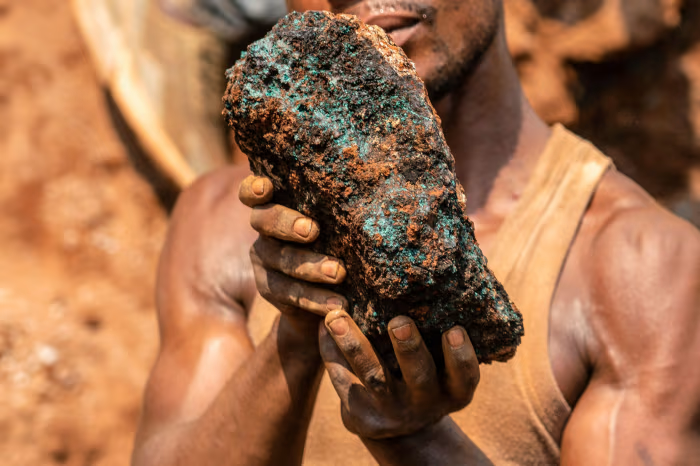
Mining companies operating in Democratic Republic of Congo's emerging lithium sector face an immediate 6.5 percentage point increase in government royalties following the Council of Ministers' decree classifying lithium as a strategic mineral. The new 10% royalty rate on gross revenue replaces the previous 3.5% rate for non-ferrous metals, creating what amounts to a top-line tax that mining operations must absorb regardless of profitability or operational efficiency. The timing coincides precisely with DRC's entry into commercial lithium production, as Chinese miner Zijin Mining Group commissions the Manono project in June 2026, marking the country's first large-scale hard-rock lithium operation.
The 10% strategic mineral royalty is calculated on gross revenue not net profit making the fiscal impact more severe than if it were levied on profitability. Consider a mid-sized lithium operation producing 50,000 tonnes of lithium carbonate equivalent (LCE) annually at current spot prices of approximately CNY 180,000 per tonne ($25,400/MT). The operation generates $1.27 billion in gross revenue, triggering a $127 million annual royalty payment under the new framework compared to $44.5 million under the previous rate. This $82.5 million annual increase flows directly to the Congolese state before any production costs, freight charges, or operational expenses are deducted. The royalty functions more like a production tax than a profit-sharing mechanism, fundamentally altering project economics for marginal deposits.
A royalty (mining tax) the percentage of gross revenue that mining companies pay to the host government on extracted minerals serves as the primary fiscal instrument through which resource rich nations capture value from their mineral endowments. The DRC Council of Ministers approved adding lithium alongside tantalum, niobium, tungsten, uranium and rare earth elements to the strategic classification, joining cobalt, germanium and coltan (colombo-tantalite) which already carried the strategic mineral designation. Strategic minerals those deemed critical to national security, advanced technology, or energy transition supply chains attract higher fiscal treatment reflecting their geopolitical importance beyond commodity market pricing.
On the buy side, lithium processors and battery manufacturers securing DRC supply face an immediate cost increase of approximately $28/MT LCE at current pricing levels. For a major battery cathode producer requiring 20,000 tonnes of LCE annually from Congolese sources, the royalty increase translates to $560,000 in additional delivered costs that must be absorbed through higher selling prices or reduced margins. Firm demand from electric vehicle battery cathode material production and full-rate Gigafactory offtake has tightened spot availability, providing some pricing power to pass through cost increases to downstream buyers.
On the sell side, DRC lithium miners lose 6.5% of gross revenue immediately, regardless of ore grade quality, operational efficiency, or market conditions. For operators working marginal deposits where cash costs already approach $20,000/MT LCE, the additional royalty burden of $1,650/MT can eliminate operating margins entirely if lithium prices decline below $25,000/MT. Chinese controlled operations including Zijin Mining's Manono project and KoBold Metals' exploration programme possess sufficient scale and ore quality to absorb the increase, but smaller concession holders face potential cash flow stress that could strand committed investment.
For large integrated lithium producers with global operations (Albemarle, SQM, Pilbara Minerals, or Chinese SOEs with DRC exposure), the royalty increase creates a $15-20/MT pricing advantage for alternative suppliers outside DRC jurisdiction. Australian spodumene producers, Chilean brine operators, and Argentine lithium developers gain competitive positioning as delivered costs from DRC sources rise relative to their own operations. This cost differential supports investment redirection toward non-DRC lithium projects, potentially constraining long-term DRC market share despite the country's substantial resource endowment. Hedging instruments remain limited for royalty exposure unlike commodity price risk, government fiscal policy changes cannot be directly hedged through derivatives markets.
For smaller regional operators and junior miners without extensive capital market access, the gross revenue royalty structure creates immediate cash flow pressure during lithium price downturns. A junior miner producing 10,000 tonnes LCE annually faces $2.54 million in additional annual royalty payments at current pricing equivalent to several quarters of typical junior mining company cash reserves. These operators lack the economies of scale to absorb fiscal increases through operational improvements and cannot access credit facilities secured against future production to bridge temporary cash flow gaps. The practical solution involves negotiating revenue-sharing partnerships with larger strategic investors willing to provide working capital in exchange for offtake commitments or equity participation.
The Congolese government has empirical evidence from cobalt operations that the battery metals sector will absorb higher fiscal costs when the underlying resource is sufficiently irreplaceable. DRC controls approximately 70% of global cobalt supply and significant lithium reserves, providing negotiating leverage with international buyers who require access to these critical materials. Supply chain anxiety in Western capitals has accelerated programmes designed to reduce reliance on Chinese-controlled critical mineral processing, elevating DRC's negotiating leverage as European and American buyers seek non-Chinese lithium sources despite higher costs.
The decree's timing reflects calculated resource diplomacy rather than opportunistic revenue extraction. The DRC's stated rationale is ensuring the country benefits from the critical and geo-strategic character of mineral endowments within its territory, consistent with a global pattern of resource rich nations reassessing whether legacy fiscal terms adequately reflect the geopolitical value of their mineral wealth. Similar strategic mineral classification approaches are emerging across Africa Zimbabwe imposed export quotas for lithium concentrates with a full export ban starting next year suggesting coordinated resource sovereignty policies among battery material suppliers.
For observers, monitor Fastmarkets' lithium carbonate CIF China,Japan,Korea benchmark and CME Group lithium carbonate futures through July 2026. A sustained price decline below $22,000/MT LCE would pressure marginal DRC operations toward negative cash flow territory, potentially triggering production suspensions that tighten global lithium supply. Conversely, lithium prices maintaining above $28,000/MT demonstrate the market's capacity to absorb DRC's royalty increase without material supply disruption, validating the government's fiscal strategy and encouraging similar moves by other African producers.




'%3e%3cg id='Final-Copy-2_2_' transform='translate(1275.000000, 200.000000)'%3e%3cpath class='st0' d='M7.4,12.8h6.8l3.1-11.6H7.4C4.2,1.2,1.6,3.8,1.6,7S4.2,12.8,7.4,12.8z'/%3e%3c/g%3e%3c/g%3e%3c/g%3e%3cg id='final---dec.11-2020'%3e%3cg id='_x30_208-our-toggle' transform='translate(-1275.000000, -200.000000)'%3e%3cg id='Final-Copy-2' transform='translate(1275.000000, 200.000000)'%3e%3cpath class='st1' d='M22.6,0H7.4c-3.9,0-7,3.1-7,7s3.1,7,7,7h15.2c3.9,0,7-3.1,7-7S26.4,0,22.6,0z M1.6,7c0-3.2,2.6-5.8,5.8-5.8 h9.9l-3.1,11.6H7.4C4.2,12.8,1.6,10.2,1.6,7z'/%3e%3cpath id='x' class='st2' d='M24.6,4c0.2,0.2,0.2,0.6,0,0.8l0,0L22.5,7l2.2,2.2c0.2,0.2,0.2,0.6,0,0.8c-0.2,0.2-0.6,0.2-0.8,0 l0,0l-2.2-2.2L19.5,10c-0.2,0.2-0.6,0.2-0.8,0c-0.2-0.2-0.2-0.6,0-0.8l0,0L20.8,7l-2.2-2.2c-0.2-0.2-0.2-0.6,0-0.8 c0.2-0.2,0.6-0.2,0.8,0l0,0l2.2,2.2L23.8,4C24,3.8,24.4,3.8,24.6,4z'/%3e%3cpath id='y' class='st3' d='M12.7,4.1c0.2,0.2,0.3,0.6,0.1,0.8l0,0L8.6,9.8C8.5,9.9,8.4,10,8.3,10c-0.2,0.1-0.5,0.1-0.7-0.1l0,0 L5.4,7.7c-0.2-0.2-0.2-0.6,0-0.8c0.2-0.2,0.6-0.2,0.8,0l0,0L8,8.6l3.8-4.5C12,3.9,12.4,3.9,12.7,4.1z'/%3e%3c/g%3e%3c/g%3e%3c/g%3e%3c/g%3e%3c/svg%3e) Privacy Choices
Privacy Choices