.avif)
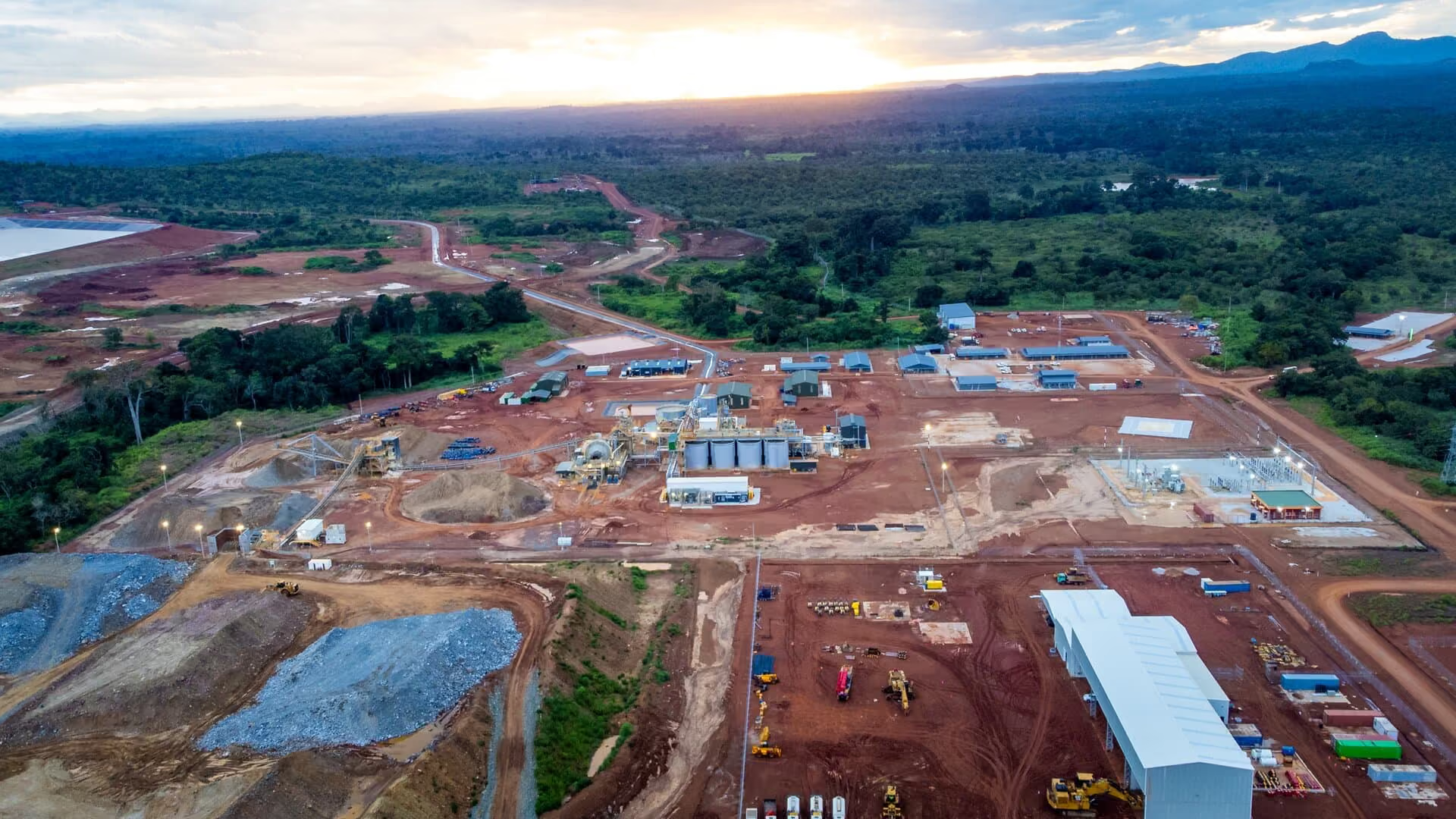
Fortuna Mining's Q2 2026 production result of 72,217 gold equivalent ounces (GEO a common unit that converts silver, lead, and zinc output into a gold equivalent volume using prevailing prices, letting operators track total mine value on a single metric) keeps the company on pace for its 281,000–305,000 GEO full-year guidance, but the quarter's underlying economics were materially softer than headline numbers suggest. A planned mill reline the periodic replacement of the steel or rubber lining inside a grinding mill, required for maintenance but which halts throughput for days to weeks at Séguéla compressed Q2 gold output to 41,683 ounces at 3.46 g/t Au against 433,231 tonnes milled. Strip ratio the tonnes of waste rock removed per tonne of ore extracted hit 13.6:1, meaning Fortuna moved roughly 5.9 million tonnes of waste to recover less than half a million tonnes of ore. At industry average mining costs of $3–5 per tonne moved, that strip burden alone adds $17–24 per ounce of cost to every Séguéla ounce produced this quarter. With no all-in sustaining cost (AISC) per ounce disclosed in this release, realised cash margins for the quarter remain unquantified but the operational pressures are visible in the data.
The Séguéla expansion decision sits at the centre of Fortuna's near-term investment thesis, and the numbers are significant. Lycopodium an Australian engineering firm acting as EPCM lead, meaning it manages Engineering, Procurement, and Construction Management on behalf of the owner has completed studies proposing to lift the process plant from its current throughput to approximately 2.3 million tonnes per year (Mtpa). The scope includes a ball mill (a rotating cylinder that grinds ore to fine particles ahead of chemical leaching), expanded thickener and leach capacity, and backup power generation. The capital cost is approximately $100 million, with a construction decision flagged as imminent. Here is the worked constraint: the Séguéla mill processed 433,231 tonnes in Q2 an annualised rate of roughly 1.7 Mtpa. A $100 million expansion to 2.3 Mtpa represents a 35% throughput increase on a plant that, in this quarter, was already operating below capacity due to a planned reline. The expansion economics are compelling at current gold prices above $3,000/oz, but the margin of safety narrows quickly if throughput targets slip or capital costs escalate.
A fatal accident involving a contractor at the Séguéla mine introduces a risk that the expansion timeline does not yet price. Mining companies operating in Côte d'Ivoire Séguéla's host country are subject to oversight by the Ministry of Mines and the national environmental and safety regulator. Following a fatality, construction permits can be delayed, conditioned, or held pending an independent investigation. Fortuna has disclosed a comprehensive safety review and enhanced protocols, which is the appropriate first step, but the regulatory response from Ivorian authorities is a separate variable. The 'construction decision in coming weeks' timeline assumes no permit complication an assumption that may prove optimistic. Mid-tier gold mining companies evaluating Fortuna as a partner or peer benchmark should weight this risk explicitly: the gap between a sanction decision and a construction start permit is where project timelines most commonly extend.
Sunbird Underground and Diamba Sud represent Fortuna's medium-term production pipeline, and both carry distinct execution risk profiles. Sunbird Underground a new underground operation beneath the existing Sunbird pit at Séguéla recorded Mineral Reserve growth of 34% and Inferred Mineral Resources (material with geological evidence of mineralisation but not yet at reserve confidence) growth of 55%, supported by a $48 million budget covering equipment, infrastructure, and an owner-operator team. Long-lead items equipment with extended manufacturing and delivery lead times, such as underground loaders and ventilation systems are already ordered, meaning capital is committed. For the Diamba Sud project in Senegal, an Environmental and Social Impact Assessment (ESIA the regulatory document evaluating a project's environmental and community effects) has been approved, and a robust feasibility study is complete. However, ESIA approval is one gate among several: community consent agreements, grid access negotiations, and Senegalese construction permits are separate processes that feasibility stage timelines routinely underestimate by six to eighteen months.
On the buy side, royalty and streaming companies evaluating Séguéla streaming deals will need to model the strip ratio trajectory and mill availability assumptions carefully the Q2 data suggests near-term throughput is more variable than annual guidance implies. On the sell side, Fortuna's $80.2 million share buyback of 8.6 million shares signals management confidence in the share price at current levels; combined with 16 insider buying transactions totalling 3.3 million shares over three months, the ownership signal is unambiguous, though it does not resolve operational uncertainties. For large integrated gold producers or royalty funds with project finance capacity, the forward signal to monitor is Côte d'Ivoire's Ministry of Mines for any communication regarding the Séguéla safety investigation a formal suspension or additional permit condition would shift the expansion timeline by a quarter or more. For smaller regional operators benchmarking against Fortuna's cost structure: watch the Q3 2026 AISC disclosure, expected in October, which will be the first clean quarter post-reline and will reveal the true operating cost baseline at the 13.6:1 strip environment. That number is the ground truth for Séguéla's expansion economics.





'%3e%3cg id='Final-Copy-2_2_' transform='translate(1275.000000, 200.000000)'%3e%3cpath class='st0' d='M7.4,12.8h6.8l3.1-11.6H7.4C4.2,1.2,1.6,3.8,1.6,7S4.2,12.8,7.4,12.8z'/%3e%3c/g%3e%3c/g%3e%3c/g%3e%3cg id='final---dec.11-2020'%3e%3cg id='_x30_208-our-toggle' transform='translate(-1275.000000, -200.000000)'%3e%3cg id='Final-Copy-2' transform='translate(1275.000000, 200.000000)'%3e%3cpath class='st1' d='M22.6,0H7.4c-3.9,0-7,3.1-7,7s3.1,7,7,7h15.2c3.9,0,7-3.1,7-7S26.4,0,22.6,0z M1.6,7c0-3.2,2.6-5.8,5.8-5.8 h9.9l-3.1,11.6H7.4C4.2,12.8,1.6,10.2,1.6,7z'/%3e%3cpath id='x' class='st2' d='M24.6,4c0.2,0.2,0.2,0.6,0,0.8l0,0L22.5,7l2.2,2.2c0.2,0.2,0.2,0.6,0,0.8c-0.2,0.2-0.6,0.2-0.8,0 l0,0l-2.2-2.2L19.5,10c-0.2,0.2-0.6,0.2-0.8,0c-0.2-0.2-0.2-0.6,0-0.8l0,0L20.8,7l-2.2-2.2c-0.2-0.2-0.2-0.6,0-0.8 c0.2-0.2,0.6-0.2,0.8,0l0,0l2.2,2.2L23.8,4C24,3.8,24.4,3.8,24.6,4z'/%3e%3cpath id='y' class='st3' d='M12.7,4.1c0.2,0.2,0.3,0.6,0.1,0.8l0,0L8.6,9.8C8.5,9.9,8.4,10,8.3,10c-0.2,0.1-0.5,0.1-0.7-0.1l0,0 L5.4,7.7c-0.2-0.2-0.2-0.6,0-0.8c0.2-0.2,0.6-0.2,0.8,0l0,0L8,8.6l3.8-4.5C12,3.9,12.4,3.9,12.7,4.1z'/%3e%3c/g%3e%3c/g%3e%3c/g%3e%3c/g%3e%3c/svg%3e) Privacy Choices
Privacy Choices