.avif)
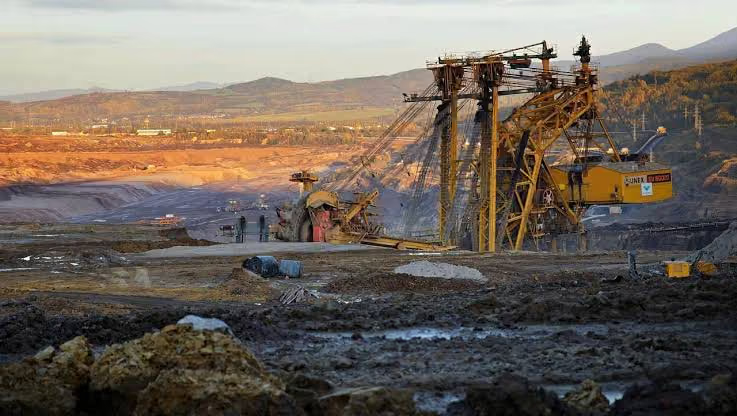
Indian downstream clean-tech manufacturers battery cell assemblers, EV component makers, and wind turbine producers dependent on lithium, vanadium, and graphite face an indefinite extension of full import exposure after India's Ministry of Mines cancelled nine critical mineral block auctions on 5 July 2026, with two blocks drawing zero bids and seven others annulled for failing to attract the minimum three technically qualified bidders required under the Mineral (Auction) Rules, 2015. The cancelled blocks span titanium, vanadium, tungsten, lithium, graphite, and glauconite glauconite being a potassium-bearing silicate mineral used in soil amendment and certain industrial filtration processes across Madhya Pradesh, Rajasthan, Bihar, Chhattisgarh, and Odisha. This is not a one round anomaly. Across the seven auction rounds conducted under the Mines and Minerals (Development and Regulation) Act, 1957 India's governing statute for mineral block sales the cumulative cancellation count stands at 57 blocks: 13 in the first tranche, 14 in the second, 3 in the third, 11 in the fourth, 5 in the fifth, 11 in the sixth, and 9 now in the seventh. The pattern is structural, not cyclical.
The mechanism of failure is precise, and it matters for anyone trying to understand why capital does not simply flow in when prices rise. India's auction rules require at least three technically qualified bidders before a block can proceed to competitive tender. Technical qualification meaning demonstrated exploration stage capacity, geological expertise, and financial capacity to execute a work programme on a pre-resource block filters out most potential participants immediately. A pre-resource block is one where a commercially viable mineral deposit has not yet been confirmed; the winning bidder takes on full exploration risk with no certainty of ore grade, tonnage, or extractability. In jurisdictions such as Australia and Canada, junior mining companies small, specialist exploration firms that take on exactly this early stage risk are supported by government geological data packages: processed airborne surveys, geophysical datasets, and historical drilling records released to the market at low cost. India does not yet offer a comparable data infrastructure. Without it, even a willing bidder cannot efficiently assess whether the exploration risk is commercially viable. The three-bidder threshold is therefore not merely a procedural rule it is a ceiling that the current qualification architecture structurally prevents from being reached.
Consider a mid-sized Indian exploration company evaluating the Naringpanga (South) Graphite Block in Odisha a state with meaningful but underexplored graphite geology. To qualify technically under current rules, the company must commit exploration stage capital likely ₹15–25 crore ($1.8–3.0 million) in initial programme costs before a single tonne of commercially defined resource exists. With no government geological package to reduce subsurface uncertainty, the internal rate of return calculation carries a risk premium that most junior companies cannot absorb. A comparable graphite block in Western Australia would come with processed aeromagnetic surveys, historical assay data, and a standardised data room cutting pre-bid technical assessment costs by an estimated 40–60% and meaningfully compressing the risk premium. The Odisha block attracted fewer than three qualified bidders. The auction was annulled. The graphite stays in the ground.
On the buy side, Indian EV battery assemblers and clean-tech component manufacturers bear the immediate cost. India currently imports roughly 75–80% of its lithium requirements predominantly from Australia and Chile on CIF (cost, insurance, and freight meaning the seller delivers to the buyer's port with insurance included) terms that embed a $15–25/tonne logistics and insurance premium over FOB (free on board where the buyer arranges and pays for shipping from the point of origin) pricing. Every cancelled domestic auction extends the timeline before any domestically sourced material can displace that import premium. For a large integrated manufacturer consuming 5,000 tonnes of lithium carbonate equivalent annually, the difference between a domestic CIF equivalent cost and current import CIF represents $75,000–$125,000 in annual input cost exposure exposure that does not compress until domestic supply exists. On the sell side, Chinese and Australian critical mineral exporters gain directly. Indian buyers remain captive to import channels, sustaining the CIF premiums that would erode if domestic supply came online. For smaller regional clean-tech assemblers a mid-sized battery pack manufacturer sourcing spot volumes there is no hedging instrument available; the practical position is full exposure to spot import prices and rupee-dollar exchange rate movement.
The forward signal to watch is the Ministry of Mines' response architecture for Round 8, expected to be announced in the next 90–120 days. The specific indicator is whether the next tranche includes a government geological data package released through the Geological Survey of India's (GSI) National Geoscience Data Repository attached to each block as a condition of auction. Australia's JORC Code the Joint Ore Reserves Committee standard that governs how mineral resources are publicly reported and Canada's NI 43-101 standard have both demonstrated that standardised data release at the pre-bid stage is the single most effective tool for expanding the qualified bidder pool. If Round 8 launches without that reform, the 57 block cancellation count will extend further, and Indian clean-tech manufacturers should treat structural import dependence on lithium, vanadium, and graphite as a five year minimum planning assumption not a transitional condition on the path to domestic supply.



'%3e%3cg id='Final-Copy-2_2_' transform='translate(1275.000000, 200.000000)'%3e%3cpath class='st0' d='M7.4,12.8h6.8l3.1-11.6H7.4C4.2,1.2,1.6,3.8,1.6,7S4.2,12.8,7.4,12.8z'/%3e%3c/g%3e%3c/g%3e%3c/g%3e%3cg id='final---dec.11-2020'%3e%3cg id='_x30_208-our-toggle' transform='translate(-1275.000000, -200.000000)'%3e%3cg id='Final-Copy-2' transform='translate(1275.000000, 200.000000)'%3e%3cpath class='st1' d='M22.6,0H7.4c-3.9,0-7,3.1-7,7s3.1,7,7,7h15.2c3.9,0,7-3.1,7-7S26.4,0,22.6,0z M1.6,7c0-3.2,2.6-5.8,5.8-5.8 h9.9l-3.1,11.6H7.4C4.2,12.8,1.6,10.2,1.6,7z'/%3e%3cpath id='x' class='st2' d='M24.6,4c0.2,0.2,0.2,0.6,0,0.8l0,0L22.5,7l2.2,2.2c0.2,0.2,0.2,0.6,0,0.8c-0.2,0.2-0.6,0.2-0.8,0 l0,0l-2.2-2.2L19.5,10c-0.2,0.2-0.6,0.2-0.8,0c-0.2-0.2-0.2-0.6,0-0.8l0,0L20.8,7l-2.2-2.2c-0.2-0.2-0.2-0.6,0-0.8 c0.2-0.2,0.6-0.2,0.8,0l0,0l2.2,2.2L23.8,4C24,3.8,24.4,3.8,24.6,4z'/%3e%3cpath id='y' class='st3' d='M12.7,4.1c0.2,0.2,0.3,0.6,0.1,0.8l0,0L8.6,9.8C8.5,9.9,8.4,10,8.3,10c-0.2,0.1-0.5,0.1-0.7-0.1l0,0 L5.4,7.7c-0.2-0.2-0.2-0.6,0-0.8c0.2-0.2,0.6-0.2,0.8,0l0,0L8,8.6l3.8-4.5C12,3.9,12.4,3.9,12.7,4.1z'/%3e%3c/g%3e%3c/g%3e%3c/g%3e%3c/g%3e%3c/svg%3e) Privacy Choices
Privacy Choices