.avif)
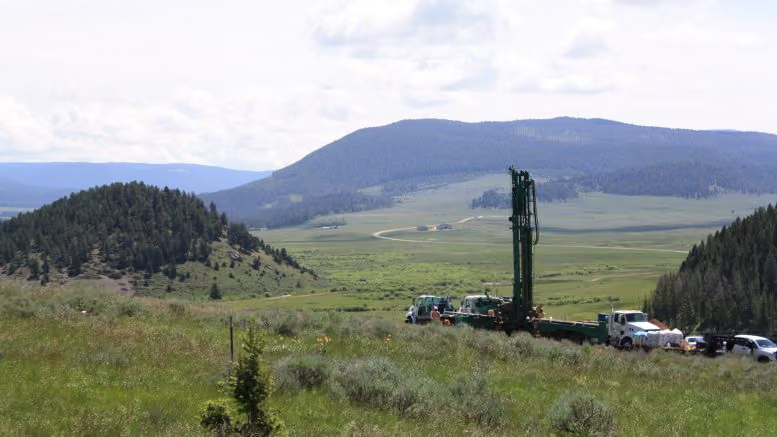
Copper concentrate traders with North American or Pacific Rim offtake exposure now face a 12 year supply window from Montana but only if Sandfire Resources America clears a multi-year permitting hurdle that the headline economics quietly depend on. Sandfire's updated Preliminary Feasibility Study (PFS an engineering and financial assessment conducted before a full feasibility study, establishing project viability with roughly ±25% cost accuracy) for the Black Butte Copper Project integrates the adjacent Lowry deposit with the existing Johnny Lee deposit, lifting total ore reserves to 14.3 million tonnes at 2.6% copper grade. At a base copper price of $4.70 per pound, the project is forecast to generate approximately $3.3 billion in gross revenue over its mine life, with life of mine post-tax cash flow of around $476 million an increase of $122 million versus the prior study. Capital costs remain at $474 million. The combined project would produce approximately 31,000 tonnes of contained copper per year across 12 years, with the initial four years averaging closer to 35,000 tonnes annually as the higher-grade Johnny Lee ore dominates early production.
The Lowry deposit is where the incremental value lives and where the risk concentrates. Lowry's maiden Mineral Reserves (the portion of a mineral deposit that has been assessed as economically mineable under defined assumptions) are estimated at 4.7 million tonnes grading 2.1% copper, containing approximately 100,000 tonnes of copper metal. The Johnny Lee deposit's Probable Mineral Reserves total 13.7 million tonnes at 1.1% copper, contributing roughly 151,000 tonnes of copper but at a lower grade that would make the mine shorter and costlier to operate without Lowry. Mechanized long-hole stoping an underground mining method where vertical or angled slots of ore are drilled and blasted in sequence, allowing highly productive extraction with minimal labour per tonne is the technique enabling the cost reduction. The study projects unit operating costs to fall by $2.28 per tonne of ore processed as a direct result of the Lowry integration and the shift to this more efficient method. That $2.28/tonne saving, applied across a multi-million tonne ore body, is not cosmetic: it is the difference between a project that can attract project finance on competitive terms and one that cannot.
To show what that permitting dependency means in commercial terms: consider the Lowry scenario stripped out entirely. Without Lowry's 4.7 million tonnes, the mine life contracts from 12 years to roughly eight, annual production averages fall below 31,000 tonnes, and the $2.28/tonne operating cost improvement largely disappears because long-hole stoping efficiency gains are partly contingent on the extended ore body geometry. At a base copper price of $4.70/lb, the post-tax NPV8% (net present value discounted at 8% per year the standard measure of a project's worth in today's dollars after tax) of the full integrated project is approximately $126 million against $474 million in capital. That is a thin return. At $6.00/lb copper, the post-tax NPV jumps to $516 million exceeding the capital cost which is where the acquisition arbitrage opens. A strategic buyer, particularly a Chinese, Japanese, or Korean smelter group seeking secured concentrate feed, could theoretically acquire Sandfire's US assets at or near replacement cost and capture the upside in a high copper price environment. That optionality is real, but it is copper price contingent and permit contingent simultaneously.
On the buy side, North American smelters and Pacific Rim smelters currently reliant on Chilean and Peruvian concentrate shipped on West Coast South America routes have a structural interest in Black Butte's development. Copper concentrate from a domestic US underground mine, delivering roughly 1.445 million tonnes of concentrate over the life of mine, would reduce exposure to WCSA freight risk and Chilean supply disruptions. For a large integrated trader such as Trafigura or a Japanese trading house with smelter equity stakes, the instrument here is an offtake agreement a long-term contract to purchase concentrate at a fixed treatment charge and refining charge (TC/RC the fees smelters charge to process concentrate into refined metal) negotiated now, before permitting is resolved, in exchange for preferential terms. For a smaller regional concentrate trader or independent distributor without derivatives access, the practical equivalent is monitoring Sandfire's Montana permitting timeline bilaterally and holding spot purchasing capacity open rather than locking long-term Chilean or Peruvian supply contracts that would foreclose participation. On the sell side, Sandfire as operator captures $122 million in incremental post-tax cash flow from Lowry integration; without a permitted Lowry, that value evaporates and the project's bankability weakens materially.
The single most important signal to watch is the Montana regulatory permitting process for the Lowry deposit. Montana's hard-rock mining permitting governed by the Metal Mine Reclamation Act and subject to federal environmental review under the National Environmental Policy Act (NEPA) has historically taken three to seven years for contested underground copper projects. Sandfire has not published a Lowry permitting timeline in this PFS, which is itself an intelligence signal: the gating constraint is real and unresolved. Observers should track the Montana Department of Environmental Quality (DEQ) docket for a Lowry operating permit application filing that filing date will set the clock on the earliest possible Lowry production start. Until that filing appears, the 12 year mine life, the $476 million post-tax cash flow, and the $2.28/tonne cost reduction should all be read as conditional projections. Copper concentrate traders evaluating North American supply diversification should mark their calendars: if no Lowry permit application is filed with Montana DEQ by Q2 2027, the integrated project economics revert to the shorter, higher-cost base case and offtake terms should be priced accordingly.




'%3e%3cg id='Final-Copy-2_2_' transform='translate(1275.000000, 200.000000)'%3e%3cpath class='st0' d='M7.4,12.8h6.8l3.1-11.6H7.4C4.2,1.2,1.6,3.8,1.6,7S4.2,12.8,7.4,12.8z'/%3e%3c/g%3e%3c/g%3e%3c/g%3e%3cg id='final---dec.11-2020'%3e%3cg id='_x30_208-our-toggle' transform='translate(-1275.000000, -200.000000)'%3e%3cg id='Final-Copy-2' transform='translate(1275.000000, 200.000000)'%3e%3cpath class='st1' d='M22.6,0H7.4c-3.9,0-7,3.1-7,7s3.1,7,7,7h15.2c3.9,0,7-3.1,7-7S26.4,0,22.6,0z M1.6,7c0-3.2,2.6-5.8,5.8-5.8 h9.9l-3.1,11.6H7.4C4.2,12.8,1.6,10.2,1.6,7z'/%3e%3cpath id='x' class='st2' d='M24.6,4c0.2,0.2,0.2,0.6,0,0.8l0,0L22.5,7l2.2,2.2c0.2,0.2,0.2,0.6,0,0.8c-0.2,0.2-0.6,0.2-0.8,0 l0,0l-2.2-2.2L19.5,10c-0.2,0.2-0.6,0.2-0.8,0c-0.2-0.2-0.2-0.6,0-0.8l0,0L20.8,7l-2.2-2.2c-0.2-0.2-0.2-0.6,0-0.8 c0.2-0.2,0.6-0.2,0.8,0l0,0l2.2,2.2L23.8,4C24,3.8,24.4,3.8,24.6,4z'/%3e%3cpath id='y' class='st3' d='M12.7,4.1c0.2,0.2,0.3,0.6,0.1,0.8l0,0L8.6,9.8C8.5,9.9,8.4,10,8.3,10c-0.2,0.1-0.5,0.1-0.7-0.1l0,0 L5.4,7.7c-0.2-0.2-0.2-0.6,0-0.8c0.2-0.2,0.6-0.2,0.8,0l0,0L8,8.6l3.8-4.5C12,3.9,12.4,3.9,12.7,4.1z'/%3e%3c/g%3e%3c/g%3e%3c/g%3e%3c/g%3e%3c/svg%3e) Privacy Choices
Privacy Choices