.avif)
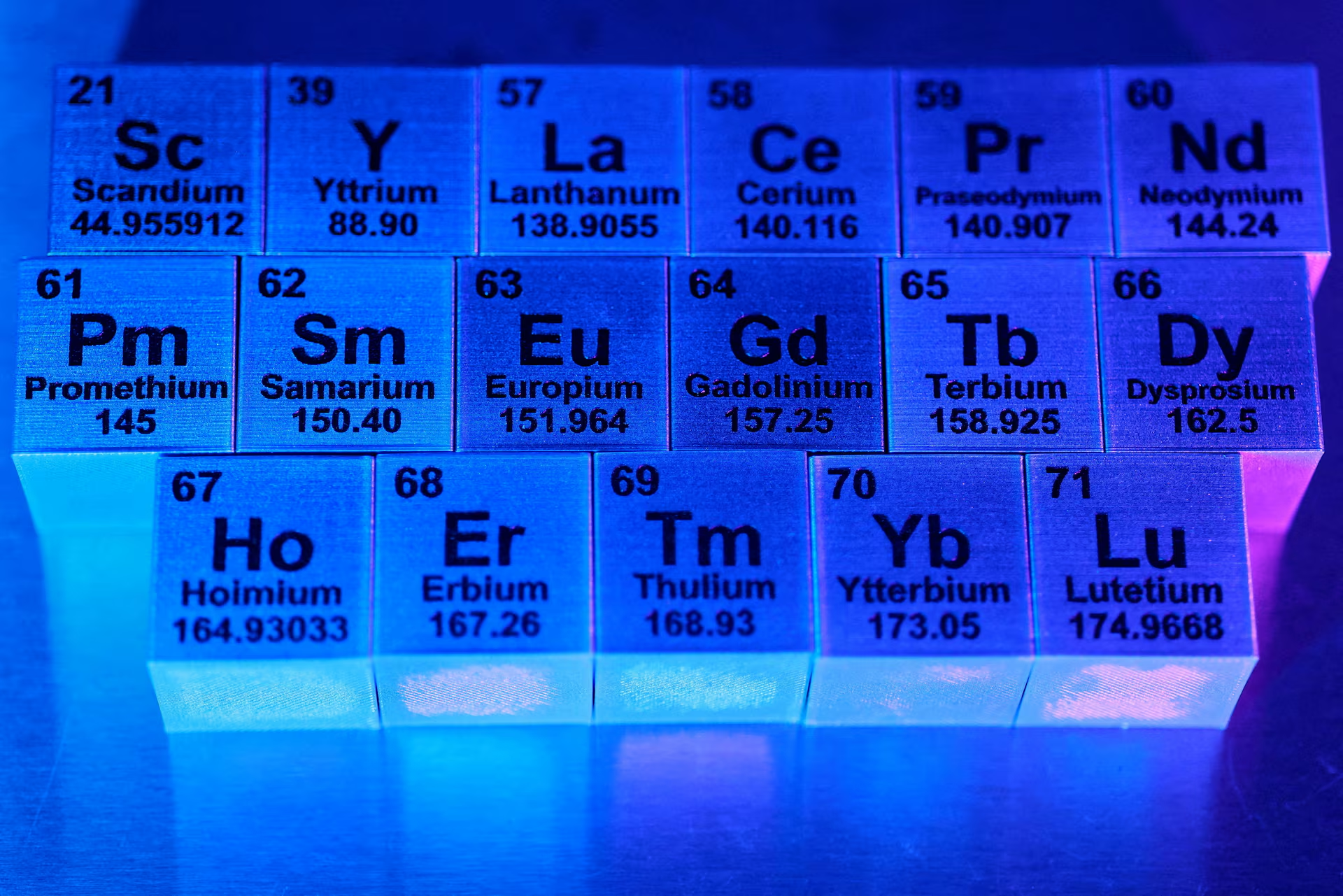
Rare earth processing companies face a complex funding landscape as the U.S. Department of Energy allocated $134 million to two demonstration projects in Louisiana and Oklahoma to extract rare earth elements from waste streams. The commercial impact remains limited: the Louisiana plant expects to produce 150 to 1,000 metric tons annually against global consumption exceeding 200,000 MT. Rare earth elements (REEs) the 17 magnetic and luminescent metals essential for permanent magnets in electric motors, wind turbines, and defense systems currently flow through China dominated supply chains. China operates the majority of the world's processing facilities, with no Western plant achieving commercial processing of heavy rare earths as of early 2026. The demonstration funding prioritizes waste stream recovery: bauxite tailings from alumina refineries and electronic waste conversion.
The numbers expose the scale mismatch between demonstration ambitions and market reality. The Louisiana project will process "red mud" a critical mineral rich bauxite waste product near the Gramercy alumina refinery. Neodymium currently trades at $244.90 per kilogram, up 64% year to date, while dysprosium reached $930.70 per kilogram, surging 105% this year. Consider a mid-sized processor planning capacity around the Louisiana demonstration output: 500 MT annually of mixed rare earth oxides at current pricing would generate $122–465 million in gross revenue before separation, refining, and magnet fabrication costs. China controls roughly 60% of mining and over 90% of processing meaning even successful demonstrations face entrenched competition with established infrastructure and cost advantages.
On the buy side, electric vehicle manufacturers and wind turbine operators need predictable, scaled supplies of separated rare earth metals. Each 3 MW offshore turbine incorporates neodymium praseodymium and dysprosium, with global offshore installations experiencing substantial growth alongside electric vehicle shipment increases. For large automakers or turbine OEMs Ford, General Motors, or Vestas the demonstration outputs represent weeks, not years, of supply security. When China briefly restricted rare earth exports, a Ford plant was forced to shut down almost immediately, and when Trump threatened 100% tariffs, China's response was simple: no more processed rare earths. On the sell side, the demonstration project participants receive significant federal cost-sharing awards require a cost-share of at least 50% by the recipient but must prove commercial economics against subsidized Chinese competitors.
For large integrated operators with derivatives access mining companies like MP Materials or diversified commodity traders the demonstration projects offer offtake optionality but minimal volume impact. The Biden administration provided over $330 million in Department of Defense contracts to MP Materials and Lynas USA for rare earth processing projects, with the Trump administration taking efforts to foster improved domestic production capacity, including MP Materials which is now majority owned by the U.S. government. For smaller regional operators independent magnet manufacturers, specialized alloy producers, electronics component suppliers without Chinese supplier relationships, the demonstrations could provide domestically sourced feedstock at premium pricing. Commercial margins depend on the gap between waste stream processing costs and finished rare earth oxide selling prices, economics that remain unproven at demonstration scale.
Observers should monitor the Colorado School of Mines facility commissioning timeline through late 2026 and track the practical separation efficiency achieved on bauxite waste compared to traditional rare earth ore processing. Chinese export controls remain temporarily suspended until November 2026, creating a window for demonstration projects to prove commercial viability before potential supply restrictions resume. The Pentagon's January 1, 2027 deadline becomes pressing, as Chinese sourced rare earths will be banned from the U.S. defense supply chain starting next year. Watch Colorado School of Mines monthly output reports versus 150 MT minimum targets successful scaling beyond demonstration thresholds would signal genuine alternative supply potential rather than federally subsidized research. The next inflection point: whether private capital follows federal demonstration funding to build commercial scale waste processing capacity independent of Chinese supply chains.





'%3e%3cg id='Final-Copy-2_2_' transform='translate(1275.000000, 200.000000)'%3e%3cpath class='st0' d='M7.4,12.8h6.8l3.1-11.6H7.4C4.2,1.2,1.6,3.8,1.6,7S4.2,12.8,7.4,12.8z'/%3e%3c/g%3e%3c/g%3e%3c/g%3e%3cg id='final---dec.11-2020'%3e%3cg id='_x30_208-our-toggle' transform='translate(-1275.000000, -200.000000)'%3e%3cg id='Final-Copy-2' transform='translate(1275.000000, 200.000000)'%3e%3cpath class='st1' d='M22.6,0H7.4c-3.9,0-7,3.1-7,7s3.1,7,7,7h15.2c3.9,0,7-3.1,7-7S26.4,0,22.6,0z M1.6,7c0-3.2,2.6-5.8,5.8-5.8 h9.9l-3.1,11.6H7.4C4.2,12.8,1.6,10.2,1.6,7z'/%3e%3cpath id='x' class='st2' d='M24.6,4c0.2,0.2,0.2,0.6,0,0.8l0,0L22.5,7l2.2,2.2c0.2,0.2,0.2,0.6,0,0.8c-0.2,0.2-0.6,0.2-0.8,0 l0,0l-2.2-2.2L19.5,10c-0.2,0.2-0.6,0.2-0.8,0c-0.2-0.2-0.2-0.6,0-0.8l0,0L20.8,7l-2.2-2.2c-0.2-0.2-0.2-0.6,0-0.8 c0.2-0.2,0.6-0.2,0.8,0l0,0l2.2,2.2L23.8,4C24,3.8,24.4,3.8,24.6,4z'/%3e%3cpath id='y' class='st3' d='M12.7,4.1c0.2,0.2,0.3,0.6,0.1,0.8l0,0L8.6,9.8C8.5,9.9,8.4,10,8.3,10c-0.2,0.1-0.5,0.1-0.7-0.1l0,0 L5.4,7.7c-0.2-0.2-0.2-0.6,0-0.8c0.2-0.2,0.6-0.2,0.8,0l0,0L8,8.6l3.8-4.5C12,3.9,12.4,3.9,12.7,4.1z'/%3e%3c/g%3e%3c/g%3e%3c/g%3e%3c/g%3e%3c/svg%3e) Privacy Choices
Privacy Choices