.avif)
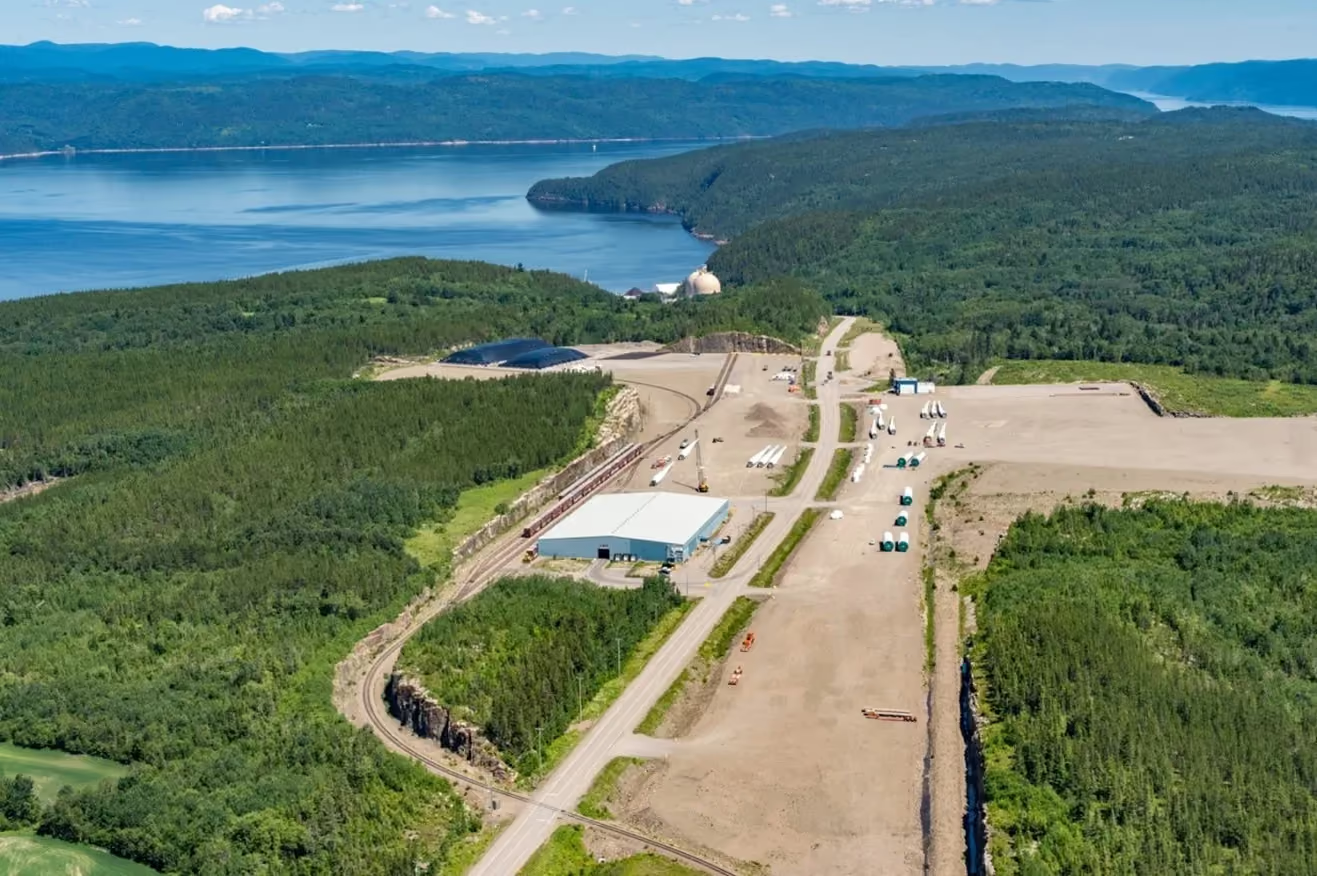
Five governments and institutions across Canada, the European Union, Denmark, Italy, and Belgium have formally aligned behind First Phosphate's Quebec to Saguenay battery materials corridor, with Denmark's Export and Investment Fund (EIFO) signing a letter of interest on 30 March 2026 for a guarantee of up to C$275 million the single largest export credit commitment yet to reach a North American lithium iron phosphate (LFP) supply chain project. LFP batteries the dominant chemistry in electric vehicles and grid storage due to their thermal stability and lower cost versus nickel or cobalt alternatives currently depend almost entirely on Chinese integrated producers for their phosphoric acid feedstock. For export credit agencies (ECAs) evaluating whether this deal represents a bankable milestone or a sophisticated diplomatic announcement, the commercial gap between letters of interest and funded project finance is where the real risk sits.
Export credit agency support works as follows: an ECA a government backed institution that guarantees or co-finances cross border commercial transactions, usually to advance the exporting country's industrial or trade interests issues a guarantee that covers a lender's loss if the borrower defaults. EIFO's C$275 million guarantee would sit between First Phosphate and whatever commercial bank syndicate ultimately funds construction of the Bégin Lamarche phosphate mine in Quebec. A guarantee is not a loan. It does not release cash. It reduces the spread the risk premium lenders charge above a benchmark rate that First Phosphate must pay on its construction debt, potentially by 150–300 basis points (where one basis point equals 0.01% of annual interest cost). On a C$400–500 million construction facility, 200 basis points of savings is approximately C$8–10 million per year in reduced interest cost. That is a meaningful but not transformational benefit it improves project economics at the margin, it does not replace equity or offtake coverage.
The project's publicly cited economic assessment values the Bégin Lamarche mine at an after-tax net present value (NPV the sum of all future cash flows discounted back to today's dollars) of C$1.59 billion, based on annual production of 900,000 tonnes of phosphate concentrate over a 23 year mine life. First Phosphate has confirmed offtake agreements binding long-term purchase contracts for at least 200,000 tonnes per year of concentrate. That is 22% of projected nameplate capacity. Project finance lenders who underwrite construction debt against contracted future revenues, not projected spot prices will require a substantially larger share of output to be under long-term contract before they advance funds. Consider the arithmetic: if lenders require 70% offtake coverage to advance debt, First Phosphate needs contracts for approximately 630,000 tonnes per year. The current gap of roughly 430,000 tonnes per year represents, at indicative phosphate concentrate prices of C$120–150 per tonne, between C$52 million and C$65 million in annual uncontracted revenue. No ECA guarantee bridges that gap. The debt does not close until the offtake does.
The Italian institutional cluster comprising SACE (Italy's export credit insurer), CDP (Cassa Depositi e Prestiti, Italy's state development bank), SIMEST (Italy's export promotion agency), and engineering group MAIRE, deploying Ballestra's proprietary phosphoric acid process technology adds a second project layer at Port Saguenay, where a conversion plant would transform concentrate from Bégin Lamarche into battery grade phosphoric acid at a confirmed rate of at least 60,000 tonnes per year. On the sell side, MAIRE and Ballestra capture technology licensing fees and engineering, procurement, and construction (EPC) margin: a phosphoric acid plant of this scale implies capital expenditure of C$150–300 million, suggesting an EPC fee of C$15–30 million, plus ongoing royalties. On the buy side, North American LFP cathode manufacturers who currently source high-purity phosphoric acid predominantly from Chinese producers such as Hubei Xingfa and Guizhou Chuanheng gain a Western hemisphere alternative, insulating themselves from Chinese export restrictions or elevated freight costs on Asia-to-North America container routes that currently run 18–22 days at $80–120 per tonne for liquid chemical cargoes.
The physical supply chain logic is coherent, even if the timeline is not yet confirmed. Phosphate rock would be mined at Bégin Lamarche in the Saguenay Lac Saint Jean region of Quebec, beneficiated (crushed, separated, and concentrated) on site, and transported approximately 200 kilometres by road or rail to Port Saguenay a deep-water port on the Saguenay Fjord capable of handling bulk and liquid chemical exports. Phosphoric acid produced there would then move to LFP cathode manufacturing plants in North America, displacing a flow that currently originates in Guizhou or Hubei province in China, transits Qinzhou or Shanghai by tank container, crosses the Pacific in 18–22 days, and clears US or Canadian customs. The freight and geopolitical cost embedded in that existing route particularly given US Section 301 tariffs on Chinese chemical imports and the risk of further trade escalation is the structural arbitrage this project is designed to capture. If Chinese export policy tightens, as it did episodically for rare earths and graphite in 2023–2024, spot phosphoric acid premiums in North America would spike, and buyers with long-term Western supply locked in would be insulated entirely.
For a large integrated chemicals trader or ECA with a portfolio of critical minerals transactions EIFO, SACE, or a mandated lead arranger bank such as BNP Paribas or SMBC the practical step is not to increase exposure ahead of offtake coverage improving, but to establish a structured monitoring position: track First Phosphate's quarterly offtake announcements against the 630,000 tonne threshold, and condition any movement from LOI to binding guarantee facility on achieving at least 60% contracted coverage. For a smaller regional operator a North American specialty chemical distributor or a mid-sized LFP cell manufacturer without direct access to ECA backed financing the actionable equivalent is to initiate a non-binding memorandum of understanding (MOU) with First Phosphate now, positioning for a formal offtake negotiation once the project achieves a positive final investment decision (FID). The cost of an MOU is administrative. The cost of being locked out of a Western phosphoric acid supply chain in 2029–2031, if Chinese restrictions materialize, is structural.
The specific signal to watch is not a press release from First Phosphate. It is the EIFO transition from letter of interest to binding guarantee facility, which requires completion of independent technical due diligence, environmental impact assessment approval from Quebec's MELCCFP (Ministère de l'Environnement), and lender syndication a process that typically takes 12–24 months from LOI signature. EIFO's LOI was signed 30 March 2026. If a binding facility is not announced by Q1 2028, the project has encountered material friction in permitting, offtake, or syndication and the C$1.59 billion NPV headline should be discounted accordingly. Monitor EIFO's annual report and project announcements against that window. The gap between a G7 press briefing and a funded construction loan is precisely where ECA backed deals succeed or quietly stall, and Bégin-Lamarche has not yet crossed it.
.jpg)
.jpg)

'%3e%3cg id='Final-Copy-2_2_' transform='translate(1275.000000, 200.000000)'%3e%3cpath class='st0' d='M7.4,12.8h6.8l3.1-11.6H7.4C4.2,1.2,1.6,3.8,1.6,7S4.2,12.8,7.4,12.8z'/%3e%3c/g%3e%3c/g%3e%3c/g%3e%3cg id='final---dec.11-2020'%3e%3cg id='_x30_208-our-toggle' transform='translate(-1275.000000, -200.000000)'%3e%3cg id='Final-Copy-2' transform='translate(1275.000000, 200.000000)'%3e%3cpath class='st1' d='M22.6,0H7.4c-3.9,0-7,3.1-7,7s3.1,7,7,7h15.2c3.9,0,7-3.1,7-7S26.4,0,22.6,0z M1.6,7c0-3.2,2.6-5.8,5.8-5.8 h9.9l-3.1,11.6H7.4C4.2,12.8,1.6,10.2,1.6,7z'/%3e%3cpath id='x' class='st2' d='M24.6,4c0.2,0.2,0.2,0.6,0,0.8l0,0L22.5,7l2.2,2.2c0.2,0.2,0.2,0.6,0,0.8c-0.2,0.2-0.6,0.2-0.8,0 l0,0l-2.2-2.2L19.5,10c-0.2,0.2-0.6,0.2-0.8,0c-0.2-0.2-0.2-0.6,0-0.8l0,0L20.8,7l-2.2-2.2c-0.2-0.2-0.2-0.6,0-0.8 c0.2-0.2,0.6-0.2,0.8,0l0,0l2.2,2.2L23.8,4C24,3.8,24.4,3.8,24.6,4z'/%3e%3cpath id='y' class='st3' d='M12.7,4.1c0.2,0.2,0.3,0.6,0.1,0.8l0,0L8.6,9.8C8.5,9.9,8.4,10,8.3,10c-0.2,0.1-0.5,0.1-0.7-0.1l0,0 L5.4,7.7c-0.2-0.2-0.2-0.6,0-0.8c0.2-0.2,0.6-0.2,0.8,0l0,0L8,8.6l3.8-4.5C12,3.9,12.4,3.9,12.7,4.1z'/%3e%3c/g%3e%3c/g%3e%3c/g%3e%3c/g%3e%3c/svg%3e) Privacy Choices
Privacy Choices