.avif)
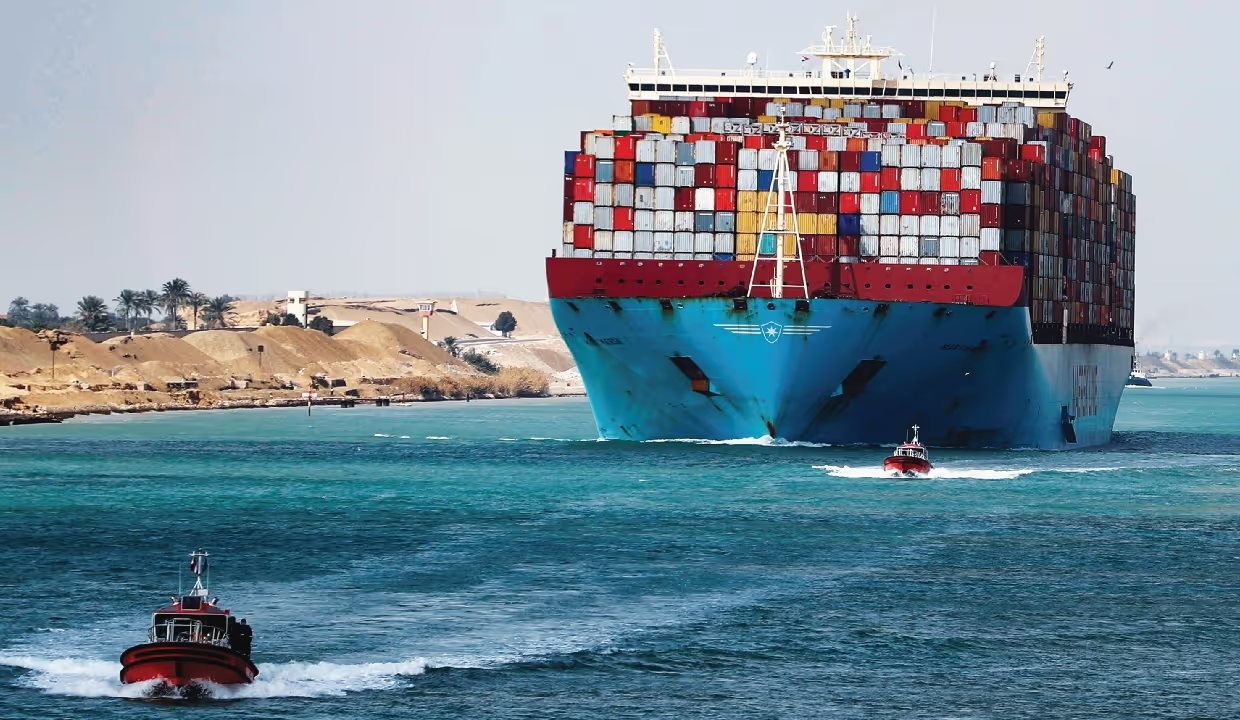
European refiners are paying an additional $800,000 in war risk insurance per crude cargo following Saudi and Kuwaiti cross-border strikes against Iran-backed militias in Iraq. For a typical 80,000 tonne crude shipment worth $60 million, war risk premiums have jumped from $120,000 to $600,000 a cost that cannot be hedged and eliminates the margin on many transactions entirely. These strikes represent the first time Gulf Cooperation Council states have conducted sustained military operations in Iraq since 1991, fundamentally altering the risk calculus for all Persian Gulf supply chains.
According to reports, Saudi fighter jets struck Iranian linked militia targets in Iraq near the kingdom's northern border, while rocket attacks were launched from Kuwaiti territory on militia positions in southern Iraq, killing several fighters and destroying facilities used by Iran backed militia Kataib Hezbollah. The operations targeted infrastructure used to launch drones and missiles against Gulf states' energy facilities. These attacks occurred around the time of the April 7 ceasefire between the US and Iran, indicating that Gulf states are operating independently of broader diplomatic frameworks.
The margin anatomy reveals where procurement costs are concentrating. War risk insurance coverage against hijacking, sabotage, and military action is typically 0.1-0.2% of cargo value. War-risk ship insurance premiums for the strait increased from 0.125% to between 0.2% and 0.4% of the ship insurance value per transit. For very large oil tankers, this is an increase of a quarter of a million dollars. That $250,000 increase per voyage translates directly to the cargo owner not the vessel operator. On a 2 million barrel VLCC cargo worth $140 million at current prices, the insurance cost differential alone is $420,000.
Freight rates are compounding the insurance shock. The benchmark freight rate for Very Large Crude Carriers used to ship 2 million barrels of oil from the Middle East to China hit an all time high of $423,736 per day on Monday, marked an increase of more than 94% from Friday's close. A typical Persian Gulf to Rotterdam voyage takes 25-30 days, meaning freight costs alone have increased by roughly $5.3 million per cargo. Combined with insurance, the additional voyage cost per VLCC is now $5.7 million equivalent to $2.85/barrel before the oil even reaches the refinery gate.
On the buy side: European integrated refiners (Total, Shell, Eni) with derivative access can hedge Brent exposure but cannot hedge war risk premiums or freight rate volatility. A 200,000 barrel per day refinery sourcing 60% of crude from the Persian Gulf faces an additional $620,000 daily in unhedgeable transport costs $226 million annually at current rates. For state refiners without financial market access, this cost increase forces either margin compression or immediate product price increases to consumers.
On the sell side: Saudi Aramco and Kuwait Petroleum Corporation are experiencing the inverse effect. Saudi Arabia informed OPEC that its oil output fell to the lowest level since 1990 due to storage constraints from reduced tanker movements. However, realized oil prices include the war premium Gulf producers receive Dated Brent plus transport cost savings from shorter haul sales to Asian buyers substituting for lost European supply. The net effect depends on volume versus price elasticity, but producers with spare storage capacity benefit from higher realized prices.
For traders and intermediaries: Independent trading houses (Gunvor, Mercuria, regional operators) face asymmetric risk. A standard $10 million credit line supports roughly $200 million in monthly crude throughput. War risk premiums of 0.4% reduce that throughput capacity to $167 million monthly a 16% reduction in commercial velocity. Smaller regional traders without insurance market relationships cannot access alternative coverage, effectively excluding them from Persian Gulf crude arbitrage.
Large integrated players maintain multiple response mechanisms. Saudi Aramco trading arm and Kuwait Petroleum International can bypass insurance markets through self-insurance or government guarantees. Vitol and Trafigura maintain dedicated war risk facilities with Lloyd's syndicates, allowing continued operations at higher cost. Shell and BP's integrated model absorbs transport cost increases across their refinery marketing chain, though this compresses downstream margins rather than eliminating exposure.
For smaller regional operators European heating oil distributors, independent fuel importers, regional cooperatives the mathematics become prohibitive. Consider a mid-sized German fuel distributor importing 30,000 tonnes of diesel monthly from Kuwait. War risk premiums add $120,000 per cargo (0.4% of $30 million cargo value). Annual additional costs of $1.44 million exceed the profit margin on most independent fuel distribution operations, forcing either immediate price increases or supplier diversification to non-Gulf sources.
The physical supply chain is already reorganizing. Pakistan officially requested that Saudi Arabia reroute oil supplies through port of Yanbu on the Red Sea, with Saudi Arabia providing assurances and arranging at least one crude shipment to bypass the closed strait. Saudi authorities also diverted some of their own crude exports via Yanbu. This rerouting adds 8-12 days transit time to Asian destinations and reduces VLCC cargo size by approximately 15% due to Suez Canal depth restrictions costs that compound the insurance and freight impacts.
Historical context reveals the structural shift's magnitude. Major oil supply shortfalls driven by geopolitical events previously occurred following the Yom Kippur War in 1973, the Iranian Revolution in 1979, the outbreak of the Iraq–Iran War in 1980 and the Persian Gulf War in 1990. However, those disruptions involved temporary supply curtailments or infrastructure damage. The current situation involves permanent repricing of operational risk across all Gulf supply chains, regardless of physical damage or production capacity.
Procurement professionals should monitor Brent crude oil futures around $106-108 per barrel and the Brent-Dubai spread currently indicating $12-15/barrel premium for non-Gulf crude. If this spread widens beyond $20/barrel, alternative sourcing becomes economically compelling even with longer transport distances. Watch Lloyd's Joint War Committee area classifications: any expansion beyond current Persian Gulf waters to include Red Sea or Mediterranean routes would trigger industry wide supply chain reconfiguration within 30 days.
'%3e%3cg id='Final-Copy-2_2_' transform='translate(1275.000000, 200.000000)'%3e%3cpath class='st0' d='M7.4,12.8h6.8l3.1-11.6H7.4C4.2,1.2,1.6,3.8,1.6,7S4.2,12.8,7.4,12.8z'/%3e%3c/g%3e%3c/g%3e%3c/g%3e%3cg id='final---dec.11-2020'%3e%3cg id='_x30_208-our-toggle' transform='translate(-1275.000000, -200.000000)'%3e%3cg id='Final-Copy-2' transform='translate(1275.000000, 200.000000)'%3e%3cpath class='st1' d='M22.6,0H7.4c-3.9,0-7,3.1-7,7s3.1,7,7,7h15.2c3.9,0,7-3.1,7-7S26.4,0,22.6,0z M1.6,7c0-3.2,2.6-5.8,5.8-5.8 h9.9l-3.1,11.6H7.4C4.2,12.8,1.6,10.2,1.6,7z'/%3e%3cpath id='x' class='st2' d='M24.6,4c0.2,0.2,0.2,0.6,0,0.8l0,0L22.5,7l2.2,2.2c0.2,0.2,0.2,0.6,0,0.8c-0.2,0.2-0.6,0.2-0.8,0 l0,0l-2.2-2.2L19.5,10c-0.2,0.2-0.6,0.2-0.8,0c-0.2-0.2-0.2-0.6,0-0.8l0,0L20.8,7l-2.2-2.2c-0.2-0.2-0.2-0.6,0-0.8 c0.2-0.2,0.6-0.2,0.8,0l0,0l2.2,2.2L23.8,4C24,3.8,24.4,3.8,24.6,4z'/%3e%3cpath id='y' class='st3' d='M12.7,4.1c0.2,0.2,0.3,0.6,0.1,0.8l0,0L8.6,9.8C8.5,9.9,8.4,10,8.3,10c-0.2,0.1-0.5,0.1-0.7-0.1l0,0 L5.4,7.7c-0.2-0.2-0.2-0.6,0-0.8c0.2-0.2,0.6-0.2,0.8,0l0,0L8,8.6l3.8-4.5C12,3.9,12.4,3.9,12.7,4.1z'/%3e%3c/g%3e%3c/g%3e%3c/g%3e%3c/g%3e%3c/svg%3e) Privacy Choices
Privacy Choices