.avif)

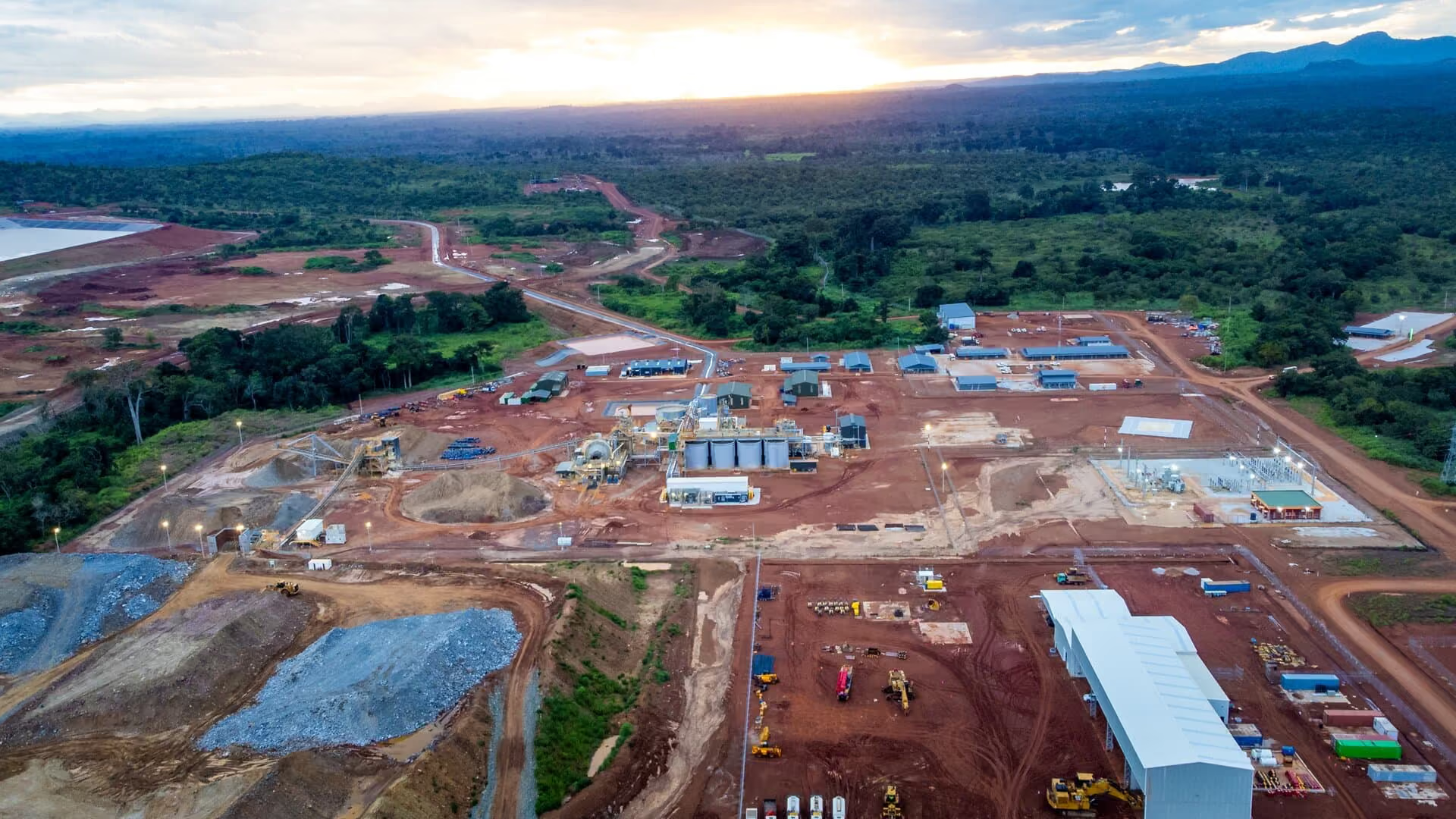
Silver importers faced immediate margin compression on May 16 as India reclassified high-purity silver bars from 'Free' to 'Restricted' import status, forcing more than 90% of silver imports to require government issued licenses. Combined with May 12's duty increase from 6% to 15% plus 3% IGST, the effective cost of importing silver into India jumped dramatically within a single week. Consider a mid-sized Mumbai bullion trader importing 100 tonnes monthly. Before these changes, their landed cost was approximately $77/oz plus 6% duty roughly $82/oz delivered. Now they face 15% duty plus licensing delays. At current silver prices around $77/oz, the additional 9% duty alone adds $7/oz to costs, while licensing uncertainty forces them to maintain 30-60 days additional inventory or risk supply gaps.
The licensing bottleneck operates through India's Directorate General of Foreign Trade (DGFT) the bureaucratic chokepoint that now controls silver flows into the world's largest silver importing market. The restriction targets silver bars under ITC HS Codes 71069221 and 71069229, which previously importers could bring in without special authorization but now need a license, creating bureaucratic gatekeeping on a commodity India imports in massive quantities. Unlike agricultural import licenses with transparent allocation criteria, silver licensing procedures remain undefined. Importers don't know approval timelines, volume caps per operator, or priority criteria. This regulatory opacity creates capture risk where connected operators dominate scarce license allocation while smaller traders face supply disruption.
Silver ETFs exchange-traded funds that hold physical silver to back investor units face immediate supply constraints that could drive fund premiums above underlying metal prices. ETFs can deviate during periods of exceptional demand or supply issues, tending to trade at significant premiums when unable to procure enough physical silver bars at the right price to create fresh units, since current regulations require gold and silver ETFs to acquire equivalent physical metal before issuing new units. Currently it is unclear whether the government will provide licenses for silver imported for investment purposes, and unless there is clarity and supply stabilizes, both physical silver and ETFs will trade at a premium to exchange prices. A silver ETF managing 500 tonnes typically needs 10-20 tonnes monthly for new unit creation. Without reliable import access, funds must either halt new issuance or source domestic silver at premiums.
On the buy side: Large integrated refiners and electronics manufacturers with established import relationships gain relative advantage. Companies like Hindustan Zinc with existing DGFT relationships and compliance infrastructure can navigate licensing more efficiently than smaller operators. Their scale justifies dedicated regulatory teams, while contract manufacturers serving global electronics supply chains maintain access through industrial user categories. For regional jewellery manufacturers, margin compression is immediate. A traditional jeweller in Rajasthan buying 1 tonne quarterly now faces 15% higher input costs without certainty of continued supply. They cannot easily pass through cost increases to price sensitive local customers.
On the sell side: Licensed importers who secure reliable allocation quotas can charge significant premiums for scarce supply. India's government requires licenses for high purity silver imports, tightening supply and fueling domestic premiums over global benchmarks as regulatory uncertainty drives increased silver ETF demand. A large Mumbai based precious metals importer with 200 tonne monthly capacity and strong DGFT relationships could charge 5-10% premiums above international silver prices to domestic buyers desperate for supply. Their margin per tonne jumps from $200-300 to $400-600 purely through regulatory scarcity. Smaller importers without licensing access lose market share entirely, forced to become distributors for larger licensed operators rather than direct importers.
For traders and intermediaries: The policy creates a two-tier market where licensed importers capture regulatory rent while unlicensed operators face margin destruction. Physical silver trading in Mumbai's Zaveri Bazaar India's primary bullion market will see bid ask spreads widen as fewer operators control supply. While there is reasonable inventory of silver bars with bullion traders who will try to manage liquidity from other channels, physical silver and silver ETFs will likely start quoting at higher levels. Arbitrage opportunities emerge between domestic Indian silver prices and international benchmarks, but only licensed importers can capture these spreads.
Freight and logistics implications concentrate around Mumbai and Chennai ports where silver imports clear customs. Shipping companies face irregular cargo flows as importers batch shipments to optimize licensing costs rather than maintaining steady monthly arrivals. A 50,000 tonne annual importer previously receiving 4,000 tonnes monthly now might cluster imports into quarterly 12,000-tonne shipments to minimize licensing applications. This creates freight rate volatility and forces vessel operators to adjust capacity allocation. Storage costs increase as importers maintain larger buffer inventories to manage regulatory uncertainty.
Financing structures shift fundamentally as letters of credit the trade finance instruments that enable silver imports face regulatory risk. Banks issuing LCs for silver imports now must factor licensing approval probability into credit decisions. A $50 million LC for silver imports previously carried commodity price risk and currency exposure. Now it includes regulatory execution risk where license delays could force cargo diversions or contract defaults. Trade financiers will demand higher margins or require pre-approved licenses before LC issuance. Working capital costs for importers increase 200-400 basis points to account for extended approval timelines.
The policy targets specific arbitrage flows, particularly through the India-UAE Comprehensive Economic Partnership Agreement (CEPA) corridor. The India-UAE free trade agreement created a pricing gap that traders were exploiting, with importers bringing silver through the UAE corridor at preferential rates, effectively undercutting the standard duty structure, and by restricting imports and hiking tariffs simultaneously, Delhi is closing that loophole. UAE-based precious metals trading firms lose their India arbitrage advantage as regulatory complexity negates their duty benefits. This redirects silver trade flows through traditional channels controlled by established Indian importers rather than new UAE-India trade routes.
Market structure implications extend beyond immediate supply disruption. With about 80% of its silver demand met through imports, India's dependence on foreign supplies makes it vulnerable to fluctuations in both currency value and geopolitical stability. The licensing system creates permanent market concentration where 10-15 large operators could control 70-80% of import capacity versus previously fragmented competition among hundreds of smaller importers. This oligopoly structure enables price coordination and reduces competitive pressure on import margins. Silver prices in India could permanently trade 3-5% above international benchmarks even after initial supply adjustments.
For observers tracking this story's evolution: Monitor Mumbai silver spot prices versus international benchmarks weekly. Premium expansion above 2-3% indicates supply constraints are binding. Silver rose to 76.75 USD/t.oz on May 18, 2026, providing a baseline for premium calculations. Watch DGFT announcements for licensing criteria and allocation volumes within 30 days silence suggests regulatory capture risk is materializing. Track silver ETF premiums to NAV through exchanges; sustained premiums above 1% confirm physical supply shortages are affecting investment products. The June MCX silver futures curve will show whether markets expect temporary disruption or permanent structural premiums.



.avif)
'%3e%3cg id='Final-Copy-2_2_' transform='translate(1275.000000, 200.000000)'%3e%3cpath class='st0' d='M7.4,12.8h6.8l3.1-11.6H7.4C4.2,1.2,1.6,3.8,1.6,7S4.2,12.8,7.4,12.8z'/%3e%3c/g%3e%3c/g%3e%3c/g%3e%3cg id='final---dec.11-2020'%3e%3cg id='_x30_208-our-toggle' transform='translate(-1275.000000, -200.000000)'%3e%3cg id='Final-Copy-2' transform='translate(1275.000000, 200.000000)'%3e%3cpath class='st1' d='M22.6,0H7.4c-3.9,0-7,3.1-7,7s3.1,7,7,7h15.2c3.9,0,7-3.1,7-7S26.4,0,22.6,0z M1.6,7c0-3.2,2.6-5.8,5.8-5.8 h9.9l-3.1,11.6H7.4C4.2,12.8,1.6,10.2,1.6,7z'/%3e%3cpath id='x' class='st2' d='M24.6,4c0.2,0.2,0.2,0.6,0,0.8l0,0L22.5,7l2.2,2.2c0.2,0.2,0.2,0.6,0,0.8c-0.2,0.2-0.6,0.2-0.8,0 l0,0l-2.2-2.2L19.5,10c-0.2,0.2-0.6,0.2-0.8,0c-0.2-0.2-0.2-0.6,0-0.8l0,0L20.8,7l-2.2-2.2c-0.2-0.2-0.2-0.6,0-0.8 c0.2-0.2,0.6-0.2,0.8,0l0,0l2.2,2.2L23.8,4C24,3.8,24.4,3.8,24.6,4z'/%3e%3cpath id='y' class='st3' d='M12.7,4.1c0.2,0.2,0.3,0.6,0.1,0.8l0,0L8.6,9.8C8.5,9.9,8.4,10,8.3,10c-0.2,0.1-0.5,0.1-0.7-0.1l0,0 L5.4,7.7c-0.2-0.2-0.2-0.6,0-0.8c0.2-0.2,0.6-0.2,0.8,0l0,0L8,8.6l3.8-4.5C12,3.9,12.4,3.9,12.7,4.1z'/%3e%3c/g%3e%3c/g%3e%3c/g%3e%3c/g%3e%3c/svg%3e) Privacy Choices
Privacy Choices