.avif)

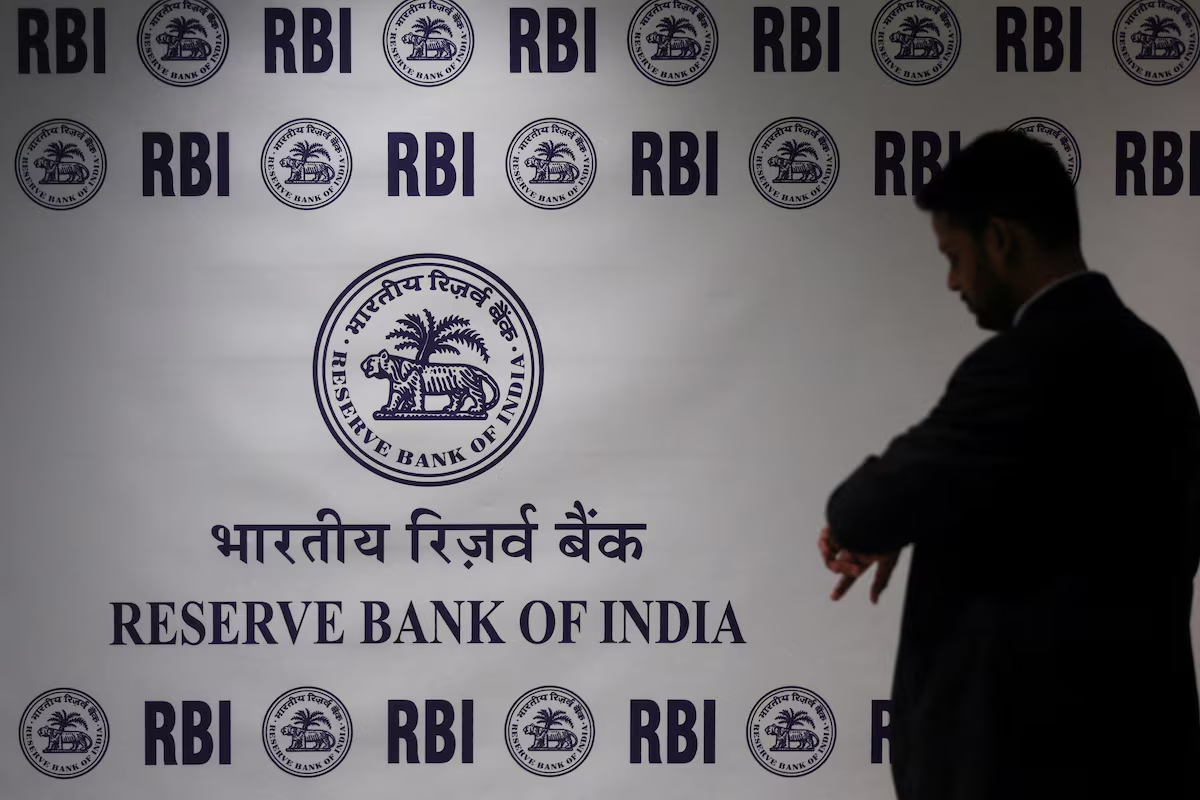
Silver importers into India face immediate execution disruption as the import of silver bars is now "restricted" rather than "free," meaning only shipments licensed by India's Directorate General of Foreign Trade can be brought into the country. The restriction applies to high-purity 99.9% silver bars, semi-manufactured silver, unwrought silver, and silver powder, covering categories that accounted for over 90% of India's total silver imports in the prior fiscal year. Silver rose to 76.75 USD/t.oz on May 18, 2026, up 1.33% from the previous day, but the permit requirement creates execution uncertainty that pricing cannot resolve.
A permit system a government approval mechanism requiring importers to seek prior authorization before customs clearance fundamentally alters the operational framework for silver trade into India. India is the world's largest consumer of silver. Silver is widely used in jewellery, coins, bars and industrial sectors such as solar power and electronics, making the restriction significant across multiple demand categories. The government notification provides no timeline for permit processing, no criteria for approval, and no grandfathering provisions for existing contracts. Importers with silver already purchased or in transit face potential customs delays with undefined resolution mechanisms.
Consider a mid-sized Mumbai silver importer with a standard 100-tonne monthly requirement for jewelry manufacturing. Before May 16, this importer operated under free import status customs clearance required standard documentation but no prior government approval. The 100 tonne monthly flow at current silver prices represents approximately $7.6 million in monthly imports. On May 13, India raised import tariffs on gold and silver to 15% from 6%. The latest restrictions come as India is trying to narrow its trade deficit and ease the pressure on the country's foreign exchange reserve. The permit requirement adds operational uncertainty that cannot be hedged through financial instruments.
On the buy side, Indian jewelry manufacturers, electronics companies, and solar panel fabricators face supply chain disruption if permit processing creates delays beyond existing inventory buffers. Large integrated manufacturers with 60-90 day inventory buffers can absorb short-term permit delays. Smaller workshops operating on 15-30 day inventory cycles face immediate pressure if permits require weeks rather than days for approval. Industrial users particularly electronics fabricators with just-in-time supply requirements have no inventory buffer for permit-related delays.
On the sell side, international silver suppliers face contract execution risk for shipments to Indian buyers. Letters of credit bank guarantees that payment will be made once shipping documents are presented may not cover permit-related delays that prevent customs clearance. Suppliers with silver already shipped to Indian ports face potential demurrage charges fees for delayed cargo handling if permits delay customs release. The practical effect: more than 90% of silver imports now require a government-issued license. This concentration of approval authority creates systemic bottleneck risk.
For large integrated trading houses (Trafigura, MMTC, State Trading Corporation), the permit system creates margin concentration opportunities through restricted access. These operators typically maintain government relationships, regulatory expertise, and compliance infrastructure that smaller importers lack. Their permit approval capability becomes a competitive advantage worth 2-5% premium over spot silver prices for domestic Indian delivery. The permit requirement effectively creates a two-tier market permit-holders versus non-permit holders.
For smaller regional operators independent jewelry manufacturers, regional distributors, specialized industrial users the permit system adds 3-7% cost burden through compliance infrastructure, legal fees, and delay risk. These operators lack dedicated regulatory teams and must outsource permit applications to specialized consultants or law firms. The additional cost structure cannot be passed through immediately in competitive markets, compressing margins until domestic silver prices adjust upward to reflect the new operational reality.
The physical supply chain impacts extend beyond immediate permit delays. With about 80% of its silver demand met through imports, the country's dependence on foreign supplies makes it vulnerable to fluctuations in both currency value and geopolitical stability. Silver shipments typically transit through Mumbai, Chennai, and Kolkata ports before reaching inland distribution centers. Permit delays at customs create port congestion, vessel scheduling disruptions, and warehouse capacity constraints that amplify beyond individual shipment delays. The broader India-UAE free trade agreement which had created preferential routing for some silver imports becomes operationally irrelevant if permit approvals become the constraining factor regardless of tariff treatment.
For observers, the specific signal to monitor is permit processing timeframes through the Directorate General of Foreign Trade (DGFT) portal. If permit approvals consistently require more than 10-15 business days, domestic Indian silver premiums will expand beyond the current 1-2% over London spot prices. Watch LBMA-Mumbai silver price spreads weekly through June 2026 persistent premiums above 3% indicate permit system bottlenecks are restricting physical supply effectively. Any DGFT announcement of permit approval criteria or processing timelines will signal whether the restriction operates as controlled throttling or administrative barrier.



.avif)
'%3e%3cg id='Final-Copy-2_2_' transform='translate(1275.000000, 200.000000)'%3e%3cpath class='st0' d='M7.4,12.8h6.8l3.1-11.6H7.4C4.2,1.2,1.6,3.8,1.6,7S4.2,12.8,7.4,12.8z'/%3e%3c/g%3e%3c/g%3e%3c/g%3e%3cg id='final---dec.11-2020'%3e%3cg id='_x30_208-our-toggle' transform='translate(-1275.000000, -200.000000)'%3e%3cg id='Final-Copy-2' transform='translate(1275.000000, 200.000000)'%3e%3cpath class='st1' d='M22.6,0H7.4c-3.9,0-7,3.1-7,7s3.1,7,7,7h15.2c3.9,0,7-3.1,7-7S26.4,0,22.6,0z M1.6,7c0-3.2,2.6-5.8,5.8-5.8 h9.9l-3.1,11.6H7.4C4.2,12.8,1.6,10.2,1.6,7z'/%3e%3cpath id='x' class='st2' d='M24.6,4c0.2,0.2,0.2,0.6,0,0.8l0,0L22.5,7l2.2,2.2c0.2,0.2,0.2,0.6,0,0.8c-0.2,0.2-0.6,0.2-0.8,0 l0,0l-2.2-2.2L19.5,10c-0.2,0.2-0.6,0.2-0.8,0c-0.2-0.2-0.2-0.6,0-0.8l0,0L20.8,7l-2.2-2.2c-0.2-0.2-0.2-0.6,0-0.8 c0.2-0.2,0.6-0.2,0.8,0l0,0l2.2,2.2L23.8,4C24,3.8,24.4,3.8,24.6,4z'/%3e%3cpath id='y' class='st3' d='M12.7,4.1c0.2,0.2,0.3,0.6,0.1,0.8l0,0L8.6,9.8C8.5,9.9,8.4,10,8.3,10c-0.2,0.1-0.5,0.1-0.7-0.1l0,0 L5.4,7.7c-0.2-0.2-0.2-0.6,0-0.8c0.2-0.2,0.6-0.2,0.8,0l0,0L8,8.6l3.8-4.5C12,3.9,12.4,3.9,12.7,4.1z'/%3e%3c/g%3e%3c/g%3e%3c/g%3e%3c/g%3e%3c/svg%3e) Privacy Choices
Privacy Choices